MSDE and AIB report early gains under Blueprint for Maryland’s Future, urge continued funding and flexibility
May 01, 2026 | Ways and Means Committee, HOUSE OF REPRESENTATIVES, Committees, Legislative, Maryland
This article was created by AI summarizing key points discussed. AI makes mistakes, so for full details and context, please refer to the video of the full meeting. Please report any errors so we can fix them. Report an error »
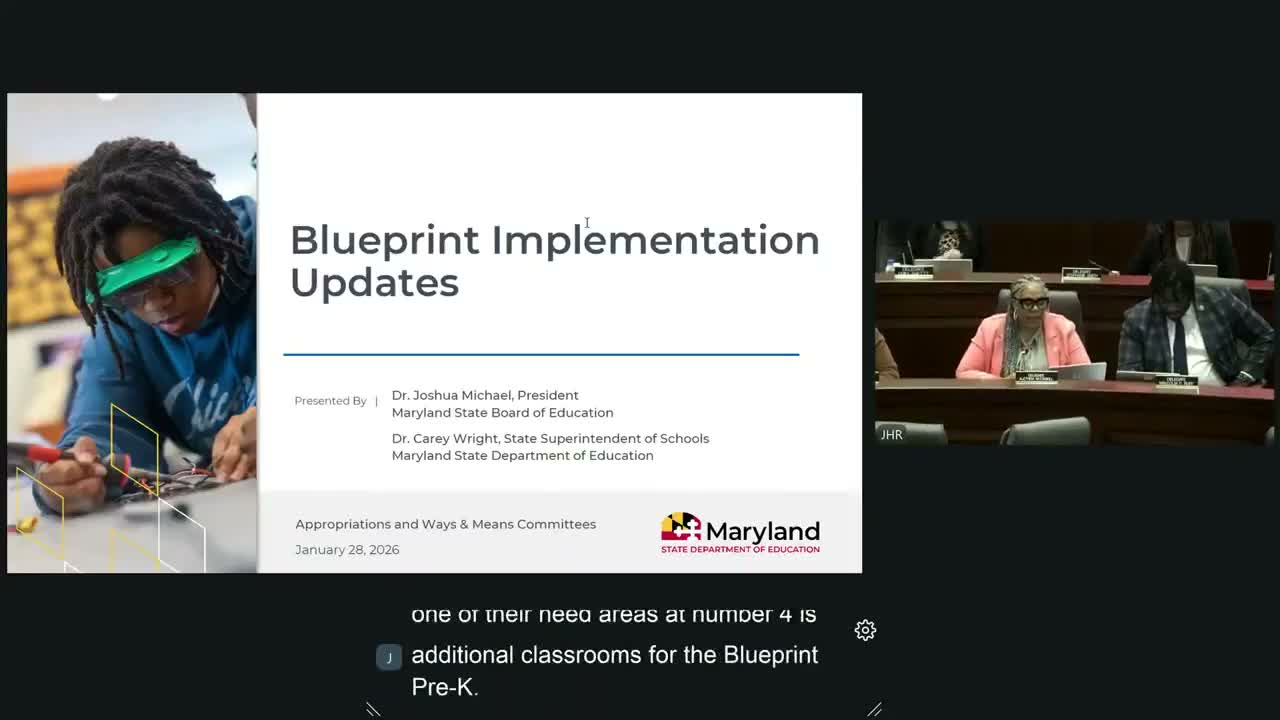
State education leaders told a joint briefing of the Ways and Means and Appropriations committees that early measures of the Blueprint for Maryland’s Future show promising gains but that implementation will require ongoing funding, local collaboration and policy adjustments.
Dr. Michael, speaking for the State Board and the Maryland State Department of Education, said recent assessment results show progress: “English language arts increased from 45.3 percent in 2023 to 50.8 percent in 2025,” and “in mathematics, proficiency increased from 21 percent to 26.5 percent.” He attributed those gains to a statewide focus on instructional core, better materials and stronger teaching.
Superintendent Dr. Wright described how MSDE has aligned a new Maryland Momentum strategic plan to the Blueprint’s five pillars and highlighted programmatic investments including expanded full-day pre-K, a $194,400,000 Grow Your Own educators grant, and widespread piloting of teacher coaching. “This year the State Board adopted a new college and career ready standard,” Wright told lawmakers, noting the department is also making “minor amendments” to the state accountability statute to implement task-force recommendations.
Ike Leggett, chair of the Accountability and Implementation Board, said AIB is overseeing implementation and has commissioned an independent evaluation by NORC. “NORC is in the field now,” Leggett said; he said draft findings will begin in early fall with a final evaluation to AIB in December and recommendations to the governor and legislature in January.
Lawmakers pressed officials on several implementation questions, including the causes of Maryland’s earlier NAEP declines. MSDE officials pointed to a removal of an inflationary factor in the prior Thornton Commission funding structure, changes in assessments and curriculum, and leadership turnover in the 2010s as contributors to the earlier dip and said current stability has helped reverse that trend.
Committee members also raised capacity issues for pre-K expansion and asked how the state will address classroom shortages. AIB and MSDE officials said many new full-day pre-K seats are being provided through private providers and local partners; they also referenced an interagency estimate that fully implementing pre-K could require 200–500 additional classrooms at roughly $1,000,000 each, and urged collaboration across public and private providers to meet demand.
On finance, MSDE’s chief financial officer, Donna Gunning, told the panel the governor’s allowance includes a request to true up national board certification payments and that the department requested a deficiency to cover outstanding “maintenance of certification” payments.
Officials cautioned that inputs (such as increased national board-certified teachers and expanded pre-K seats) are building blocks but that the full impact on student outcomes will become clearer after the independent evaluation and continued implementation. Leggett emphasized the need to avoid reversing course: “We have gone 26 miles or more, but we’ve never gotten across,” he said, urging lawmakers not to “turn around and swim back.”
The committee asked for follow-up materials and deeper data on several topics, including breakdowns of private-provider pre-K seats, the NORC evaluation timeline and metrics, and further fiscal detail on the coaching programs and accountability changes. The briefing closed with a commitment to continue regular collaboration among MSDE, AIB and local education agencies.
The committees received the presentations and indicated they will use the upcoming evaluation and requested data to inform budget and statutory decisions next session.
Dr. Michael, speaking for the State Board and the Maryland State Department of Education, said recent assessment results show progress: “English language arts increased from 45.3 percent in 2023 to 50.8 percent in 2025,” and “in mathematics, proficiency increased from 21 percent to 26.5 percent.” He attributed those gains to a statewide focus on instructional core, better materials and stronger teaching.
Superintendent Dr. Wright described how MSDE has aligned a new Maryland Momentum strategic plan to the Blueprint’s five pillars and highlighted programmatic investments including expanded full-day pre-K, a $194,400,000 Grow Your Own educators grant, and widespread piloting of teacher coaching. “This year the State Board adopted a new college and career ready standard,” Wright told lawmakers, noting the department is also making “minor amendments” to the state accountability statute to implement task-force recommendations.
Ike Leggett, chair of the Accountability and Implementation Board, said AIB is overseeing implementation and has commissioned an independent evaluation by NORC. “NORC is in the field now,” Leggett said; he said draft findings will begin in early fall with a final evaluation to AIB in December and recommendations to the governor and legislature in January.
Lawmakers pressed officials on several implementation questions, including the causes of Maryland’s earlier NAEP declines. MSDE officials pointed to a removal of an inflationary factor in the prior Thornton Commission funding structure, changes in assessments and curriculum, and leadership turnover in the 2010s as contributors to the earlier dip and said current stability has helped reverse that trend.
Committee members also raised capacity issues for pre-K expansion and asked how the state will address classroom shortages. AIB and MSDE officials said many new full-day pre-K seats are being provided through private providers and local partners; they also referenced an interagency estimate that fully implementing pre-K could require 200–500 additional classrooms at roughly $1,000,000 each, and urged collaboration across public and private providers to meet demand.
On finance, MSDE’s chief financial officer, Donna Gunning, told the panel the governor’s allowance includes a request to true up national board certification payments and that the department requested a deficiency to cover outstanding “maintenance of certification” payments.
Officials cautioned that inputs (such as increased national board-certified teachers and expanded pre-K seats) are building blocks but that the full impact on student outcomes will become clearer after the independent evaluation and continued implementation. Leggett emphasized the need to avoid reversing course: “We have gone 26 miles or more, but we’ve never gotten across,” he said, urging lawmakers not to “turn around and swim back.”
The committee asked for follow-up materials and deeper data on several topics, including breakdowns of private-provider pre-K seats, the NORC evaluation timeline and metrics, and further fiscal detail on the coaching programs and accountability changes. The briefing closed with a commitment to continue regular collaboration among MSDE, AIB and local education agencies.
The committees received the presentations and indicated they will use the upcoming evaluation and requested data to inform budget and statutory decisions next session.
View the Full Meeting & All Its Details
This article offers just a summary. Unlock complete video, transcripts, and insights as a Founder Member.
✓
Watch full, unedited meeting videos
✓
Search every word spoken in unlimited transcripts
✓
AI summaries & real-time alerts (all government levels)
✓
Permanent access to expanding government content
30-day money-back guarantee
