Lawmakers press MSDE on pre-K classroom shortfalls and role of private providers
May 01, 2026 | Ways and Means Committee, HOUSE OF REPRESENTATIVES, Committees, Legislative, Maryland
This article was created by AI summarizing key points discussed. AI makes mistakes, so for full details and context, please refer to the video of the full meeting. Please report any errors so we can fix them. Report an error »
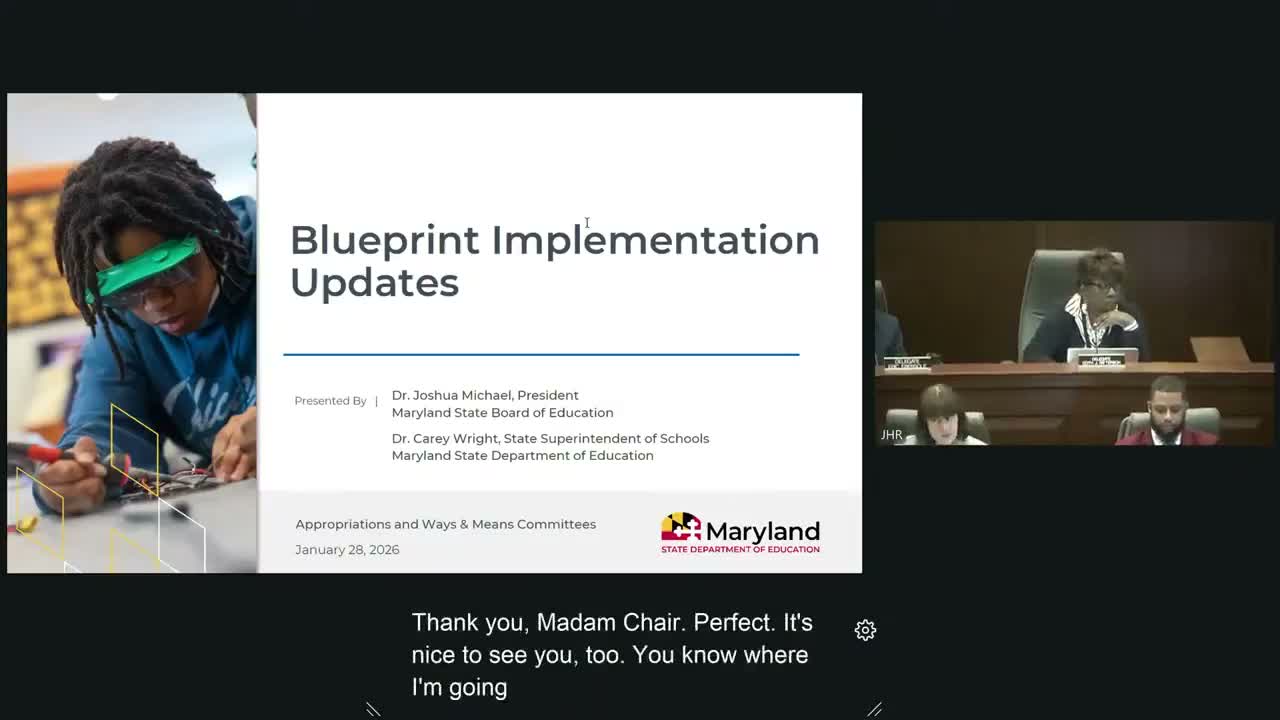
Lawmakers at a joint Ways and Means and Appropriations briefing pressed state education officials on how the Blueprint for Maryland’s Future will meet demand for full-day pre-K seats, particularly given limits on public construction capacity.
Delegates pointed to an interagency commission estimate — relayed during the briefing — that full implementation could require 200 to 500 additional classrooms at about $1,000,000 apiece, and asked whether the state can realistically build that capacity. A committee member said the figure raised concerns about land, cost and timeline.
MSDE and AIB witnesses said the state is pursuing a mixed-delivery strategy that relies heavily on local partnerships and private providers. "Nearly 50 percent of new full-day seats are in private settings," one panelist noted, and AIB said local philanthropic investments have helped expand private pre-K participation in some counties.
Officials framed the classroom need as a multi-part challenge: capital capacity (classrooms), operating funding and provider participation. They said MSDE’s early-childhood assistant superintendent will lead cross-sector planning and that the department is prepared to share county-level breakdowns of private-provider seats and family child‑care participation when requested by the committee.
Lawmakers asked for more granular data: how many private family child‑care providers are delivering Blueprint seats, the county-level distribution of seats, and a clearer estimate of capital needs and potential funding options. The committee asked AIB and MSDE to provide county one-pagers and dashboards showing where new seats have been created and what gaps remain.
The briefing did not produce a specific funding plan for pre-K capital; lawmakers said they will use the NORC evaluation and the requested county breakdowns to weigh capital and operating options in forthcoming budget deliberations.
Delegates pointed to an interagency commission estimate — relayed during the briefing — that full implementation could require 200 to 500 additional classrooms at about $1,000,000 apiece, and asked whether the state can realistically build that capacity. A committee member said the figure raised concerns about land, cost and timeline.
MSDE and AIB witnesses said the state is pursuing a mixed-delivery strategy that relies heavily on local partnerships and private providers. "Nearly 50 percent of new full-day seats are in private settings," one panelist noted, and AIB said local philanthropic investments have helped expand private pre-K participation in some counties.
Officials framed the classroom need as a multi-part challenge: capital capacity (classrooms), operating funding and provider participation. They said MSDE’s early-childhood assistant superintendent will lead cross-sector planning and that the department is prepared to share county-level breakdowns of private-provider seats and family child‑care participation when requested by the committee.
Lawmakers asked for more granular data: how many private family child‑care providers are delivering Blueprint seats, the county-level distribution of seats, and a clearer estimate of capital needs and potential funding options. The committee asked AIB and MSDE to provide county one-pagers and dashboards showing where new seats have been created and what gaps remain.
The briefing did not produce a specific funding plan for pre-K capital; lawmakers said they will use the NORC evaluation and the requested county breakdowns to weigh capital and operating options in forthcoming budget deliberations.
View the Full Meeting & All Its Details
This article offers just a summary. Unlock complete video, transcripts, and insights as a Founder Member.
✓
Watch full, unedited meeting videos
✓
Search every word spoken in unlimited transcripts
✓
AI summaries & real-time alerts (all government levels)
✓
Permanent access to expanding government content
30-day money-back guarantee
