Buncombe County planning group adopts two-year criminal-justice strategic plan
May 01, 2026 | Buncombe County, North Carolina
This article was created by AI summarizing key points discussed. AI makes mistakes, so for full details and context, please refer to the video of the full meeting. Please report any errors so we can fix them. Report an error »
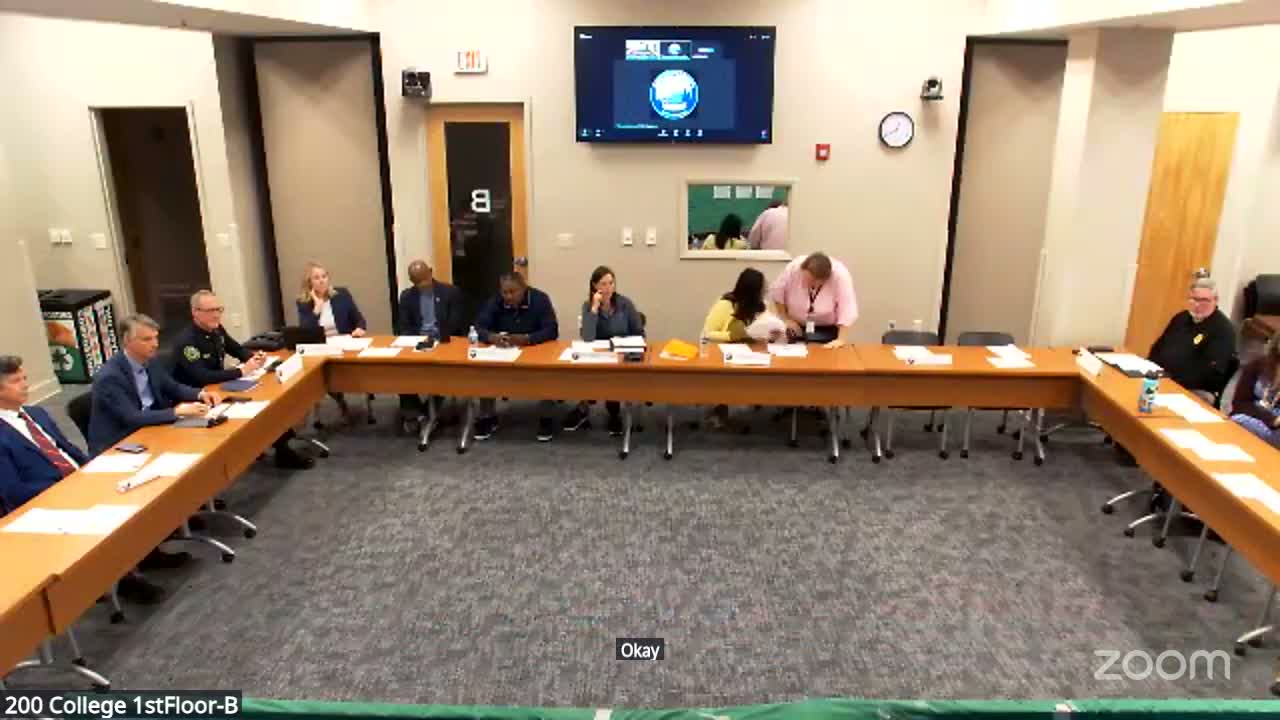
A Buncombe County criminal-justice planning group on an unspecified date voted to adopt a two-year strategic plan that sets priorities across behavioral health, alternative response coordination, court case-processing guidance, domestic-violence and sexual-assault protocols, law-enforcement diversion options and juvenile-detention review.
Lee Creighton, a county staff member who said he had been working with the group on the plan, told members the document is organized by high-level focus areas with assigned work groups, a member chair and a staff lead for each area. "We're talking about a 2 year strategic plan," Creighton said, describing the structure that pairs goals with measurable outcomes.
The plan’s behavioral-health priorities include identifying barriers and recommending ways to expand law-enforcement utilization of behavioral-health urgent care and reviewing inpatient-bed utilization by facility with the goal of addressing access barriers. Members agreed to keep the scope broad — reviewing all community inpatient beds while working toward the ability to disaggregate data about people who are justice-involved if agencies can share that information.
On alternative responses, the group broadened an originally "co-responder"-specific goal to encompass a wider set of nonpolice or co-response programs countywide, with the stated objective of strengthening cross-agency collaboration and recommending data-driven ways to scale and coordinate those programs. The measure under discussion focused on the number of agencies participating in coordinated, compliant data sharing for alternative responses.
Court-related work will emphasize producing guidelines and recommendations rather than binding mandates, members said, and participants pushed for clarity about what county staff may request from the Office of the Administrative Courts and other partners. Members also flagged limitations on available court data and the legal constraints that restrict what the clerk's office can share in detail.
Domestic-violence and sexual-assault work was split into three goals: (1) improving protocols for connecting survivors to services, with a pragmatic recommendation to track the number of protocols developed or formalized as an initial, measurable output; (2) exploring and developing protocols for connecting offenders to interventions, while noting gaps in local availability for certain offender-treatment services; and (3) expanding monitoring to include related harms such as child maltreatment, human trafficking, stalking and elder abuse so partners can review year-over-year trends.
The group also agreed to explore Law Enforcement Assisted Diversion (LEAD) and other diversion alternatives, with possible measures including the number of agencies participating in diversion discussions and the number of alternatives identified for implementation. Members recommended the work group keep the scope open to pre-arrest and post-arrest diversion options.
On juvenile justice, the plan calls for reviewing juvenile-detention data and recommending strategies to reduce length of stay; members noted that recent state changes and cases tried as adults complicate length-of-stay metrics and may require coordination with the Juvenile Crime Prevention Council and the courts.
Near the end of the meeting a member moved to adopt the strategic plan. The motion was seconded and approved by voice vote after the chair called for "all those in favor" and members responded "Aye." The transcript does not include a roll-call tally.
A public commenter, Alani Brin, described repeated personal experiences of assault and cited failures in the family-court process — including an unsigned protective order and a dismissed case — that left her without enforceable protection. "How are we measuring success if survivors are technically connected to services, but those services fail in practice?" Brin asked. Staff acknowledged her testimony and offered to distribute copies of her written materials to members.
Next steps recorded during the session include standing up or designating work groups (behavioral health, domestic-violence response, law enforcement/diversion, juvenile justice and community engagement), identifying chairs and staff leads for several groups, and follow-up meetings to refine measures and data-sharing agreements. Several members emphasized that many plan items are recommendations for independent agencies rather than binding requirements.
The committee recorded the adoption motion and voice approval and noted the plan would proceed with the agreed measures and further work-group development.
Lee Creighton, a county staff member who said he had been working with the group on the plan, told members the document is organized by high-level focus areas with assigned work groups, a member chair and a staff lead for each area. "We're talking about a 2 year strategic plan," Creighton said, describing the structure that pairs goals with measurable outcomes.
The plan’s behavioral-health priorities include identifying barriers and recommending ways to expand law-enforcement utilization of behavioral-health urgent care and reviewing inpatient-bed utilization by facility with the goal of addressing access barriers. Members agreed to keep the scope broad — reviewing all community inpatient beds while working toward the ability to disaggregate data about people who are justice-involved if agencies can share that information.
On alternative responses, the group broadened an originally "co-responder"-specific goal to encompass a wider set of nonpolice or co-response programs countywide, with the stated objective of strengthening cross-agency collaboration and recommending data-driven ways to scale and coordinate those programs. The measure under discussion focused on the number of agencies participating in coordinated, compliant data sharing for alternative responses.
Court-related work will emphasize producing guidelines and recommendations rather than binding mandates, members said, and participants pushed for clarity about what county staff may request from the Office of the Administrative Courts and other partners. Members also flagged limitations on available court data and the legal constraints that restrict what the clerk's office can share in detail.
Domestic-violence and sexual-assault work was split into three goals: (1) improving protocols for connecting survivors to services, with a pragmatic recommendation to track the number of protocols developed or formalized as an initial, measurable output; (2) exploring and developing protocols for connecting offenders to interventions, while noting gaps in local availability for certain offender-treatment services; and (3) expanding monitoring to include related harms such as child maltreatment, human trafficking, stalking and elder abuse so partners can review year-over-year trends.
The group also agreed to explore Law Enforcement Assisted Diversion (LEAD) and other diversion alternatives, with possible measures including the number of agencies participating in diversion discussions and the number of alternatives identified for implementation. Members recommended the work group keep the scope open to pre-arrest and post-arrest diversion options.
On juvenile justice, the plan calls for reviewing juvenile-detention data and recommending strategies to reduce length of stay; members noted that recent state changes and cases tried as adults complicate length-of-stay metrics and may require coordination with the Juvenile Crime Prevention Council and the courts.
Near the end of the meeting a member moved to adopt the strategic plan. The motion was seconded and approved by voice vote after the chair called for "all those in favor" and members responded "Aye." The transcript does not include a roll-call tally.
A public commenter, Alani Brin, described repeated personal experiences of assault and cited failures in the family-court process — including an unsigned protective order and a dismissed case — that left her without enforceable protection. "How are we measuring success if survivors are technically connected to services, but those services fail in practice?" Brin asked. Staff acknowledged her testimony and offered to distribute copies of her written materials to members.
Next steps recorded during the session include standing up or designating work groups (behavioral health, domestic-violence response, law enforcement/diversion, juvenile justice and community engagement), identifying chairs and staff leads for several groups, and follow-up meetings to refine measures and data-sharing agreements. Several members emphasized that many plan items are recommendations for independent agencies rather than binding requirements.
The committee recorded the adoption motion and voice approval and noted the plan would proceed with the agreed measures and further work-group development.
View the Full Meeting & All Its Details
This article offers just a summary. Unlock complete video, transcripts, and insights as a Founder Member.
✓
Watch full, unedited meeting videos
✓
Search every word spoken in unlimited transcripts
✓
AI summaries & real-time alerts (all government levels)
✓
Permanent access to expanding government content
30-day money-back guarantee
