Superintendent pitches “Top 5 in 5” goals, sets literacy, math and graduation targets for Seattle schools
April 30, 2026 | Seattle School District No. 1, School Districts, Washington
This article was created by AI summarizing key points discussed. AI makes mistakes, so for full details and context, please refer to the video of the full meeting. Please report any errors so we can fix them. Report an error »
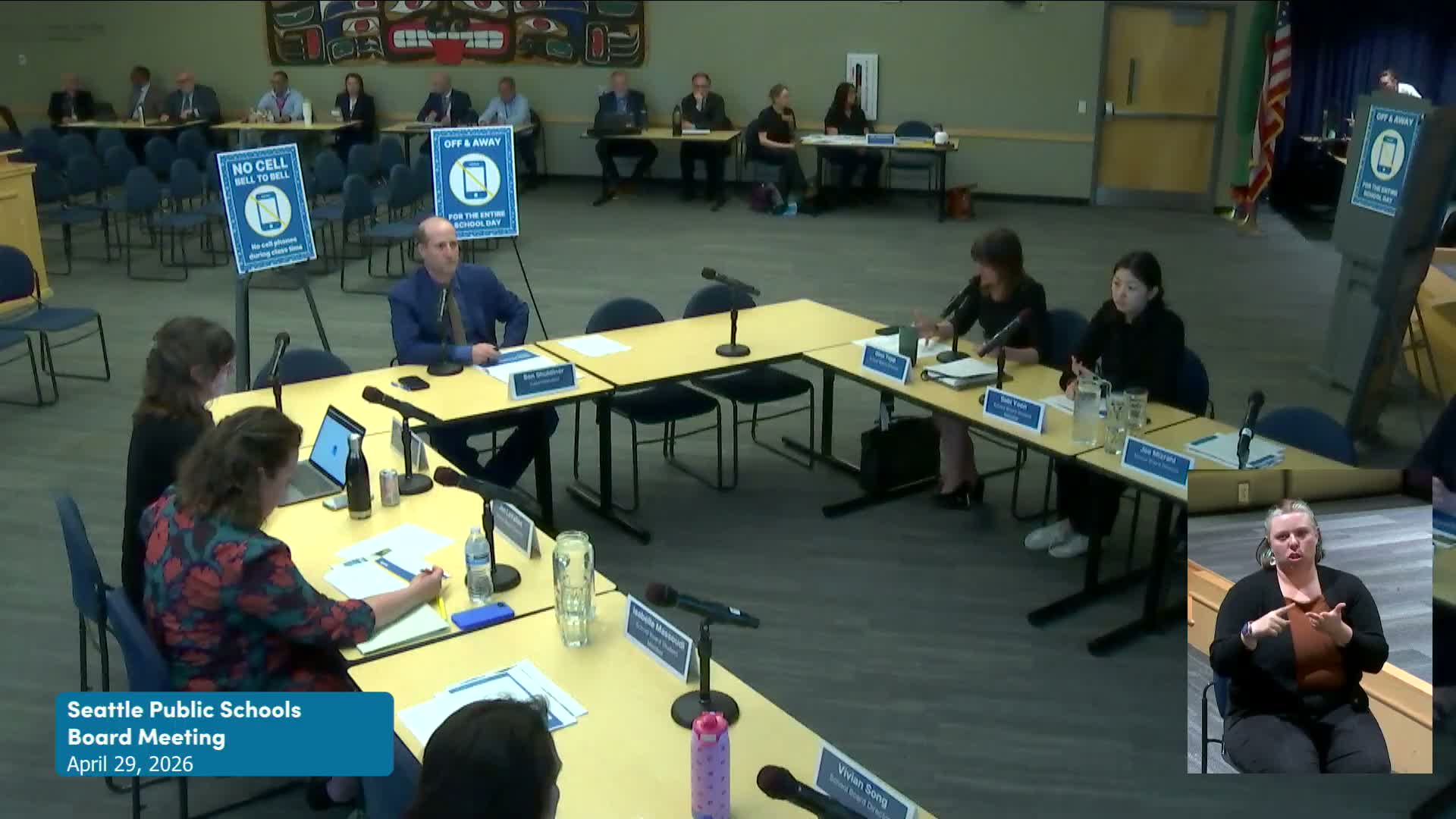
Superintendent Scholdner told the board at a special work session that he wants Seattle Public Schools to be “the best urban public school district in America” and proposed a measurable ‘‘Top 5 in 5’’ framework to aim for the top five performers among the 50 largest districts that administer the state SBA tests.
Scholdner proposed concrete academic benchmarks. For third‑grade ELA he said the district baseline is 62.6% and the top‑5 benchmark is roughly 67.2%; his recommended target was 67.5% to allow a small buffer. On math he presented two options: retain a sixth‑grade metric (current proficiency about 56.8%) or adopt an eighth‑grade target (current proficiency about 50.3), noting that using eighth grade would set a harder but potentially more meaningful standard for middle‑school growth. For graduation he said Seattle’s current rate is 86.1% versus a top‑five Washington benchmark of about 94.2%, and proposed a complementary “graduation plus” metric (college‑ or career‑readiness) with an internal target of 75% (current 59.5%).
The superintendent also outlined organizational goals and financial targets: an enrollment goal rising from roughly 48,957 (October count) to 52,500 in five years and an aim to turn an estimated fund‑balance projection of -$72,000,000 by fiscal 2031 into a positive $100,000,000 fund balance by that same year if changes are made.
Board members sought detail on how progress would be tracked and presented. Vice President Briggs and Director LaValle pushed for clear interim measures and a reliable reporting cadence; Scholdner proposed periodic reporting (roughly three times a year or quarterly for select metrics) and a dashboard tied to curriculum adoption and implementation fidelity. Director Mizrahi and others asked how goals would be reflected in the superintendent evaluation; Scholdner said the targets would align with evaluation criteria and that interim ‘checkpoints’ could be added.
On equity, Scholdner emphasized disaggregation of results by student groups and acknowledged serious gaps: he said low‑income students’ third‑grade ELA proficiency is about 34% versus a top‑five target near 49.7%, and highlighted particularly low rates among some racial groups. He noted pockets of strength — for example, students with IEPs and some multilingual learners were at or near top‑five levels in specific measures — and said those patterns will inform targeted strategies.
The board did not vote on the framework during the session. President Gina Topp said the goal is to bring goals and guardrails forward for introduction in May with a vote in June, to align adoption ahead of the coming school year.
What’s next: the board requested more detail on interim measures, funding implications and the superintendent evaluation crosswalk; the superintendent said staff will return with supporting materials, data breakdowns and a recommended reporting schedule.
Scholdner proposed concrete academic benchmarks. For third‑grade ELA he said the district baseline is 62.6% and the top‑5 benchmark is roughly 67.2%; his recommended target was 67.5% to allow a small buffer. On math he presented two options: retain a sixth‑grade metric (current proficiency about 56.8%) or adopt an eighth‑grade target (current proficiency about 50.3), noting that using eighth grade would set a harder but potentially more meaningful standard for middle‑school growth. For graduation he said Seattle’s current rate is 86.1% versus a top‑five Washington benchmark of about 94.2%, and proposed a complementary “graduation plus” metric (college‑ or career‑readiness) with an internal target of 75% (current 59.5%).
The superintendent also outlined organizational goals and financial targets: an enrollment goal rising from roughly 48,957 (October count) to 52,500 in five years and an aim to turn an estimated fund‑balance projection of -$72,000,000 by fiscal 2031 into a positive $100,000,000 fund balance by that same year if changes are made.
Board members sought detail on how progress would be tracked and presented. Vice President Briggs and Director LaValle pushed for clear interim measures and a reliable reporting cadence; Scholdner proposed periodic reporting (roughly three times a year or quarterly for select metrics) and a dashboard tied to curriculum adoption and implementation fidelity. Director Mizrahi and others asked how goals would be reflected in the superintendent evaluation; Scholdner said the targets would align with evaluation criteria and that interim ‘checkpoints’ could be added.
On equity, Scholdner emphasized disaggregation of results by student groups and acknowledged serious gaps: he said low‑income students’ third‑grade ELA proficiency is about 34% versus a top‑five target near 49.7%, and highlighted particularly low rates among some racial groups. He noted pockets of strength — for example, students with IEPs and some multilingual learners were at or near top‑five levels in specific measures — and said those patterns will inform targeted strategies.
The board did not vote on the framework during the session. President Gina Topp said the goal is to bring goals and guardrails forward for introduction in May with a vote in June, to align adoption ahead of the coming school year.
What’s next: the board requested more detail on interim measures, funding implications and the superintendent evaluation crosswalk; the superintendent said staff will return with supporting materials, data breakdowns and a recommended reporting schedule.
View the Full Meeting & All Its Details
This article offers just a summary. Unlock complete video, transcripts, and insights as a Founder Member.
✓
Watch full, unedited meeting videos
✓
Search every word spoken in unlimited transcripts
✓
AI summaries & real-time alerts (all government levels)
✓
Permanent access to expanding government content
30-day money-back guarantee
