Alachua County and Children’s Trust back community‑led violence interventions, direct staff to craft plan and CTAC to fund start‑up
May 06, 2024 | Alachua County, Florida
This article was created by AI summarizing key points discussed. AI makes mistakes, so for full details and context, please refer to the video of the full meeting. Please report any errors so we can fix them. Report an error »
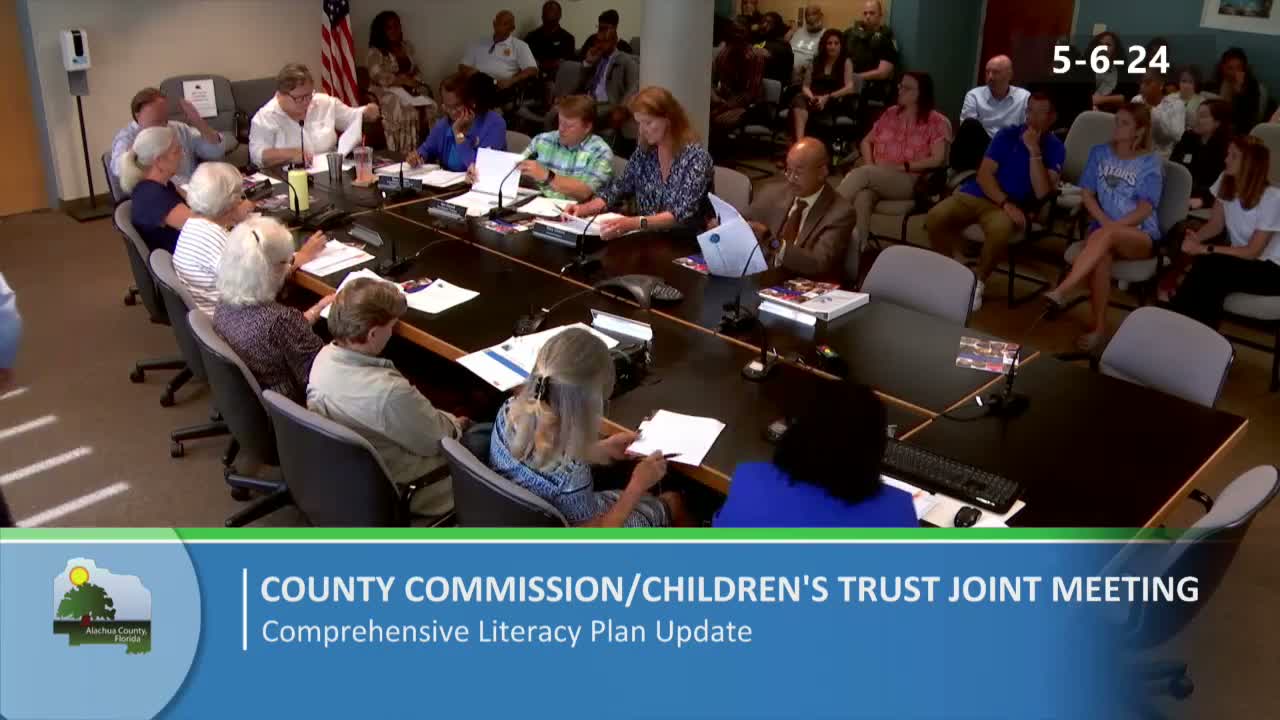
Alachua County commissioners and the Children’s Trust moved Tuesday to translate recent city and nonprofit presentations on violence prevention into an immediate local package of support, voting unanimously to ask staff to assemble a coordinated implementation and funding plan and to authorize CTAC staff to return with recommendations to direct up to $250,000 in one‑time funds to community‑based interruption programs.
The action followed a multi‑part presentation that included Britney Coleman, the City of Gainesville’s gun violence intervention program manager, who laid out the city’s “Impact GMV” framework — a public‑health approach that emphasizes trauma‑informed outreach, youth engagement and partnerships with existing neighborhood organizations. Coleman said the city and county each allocated $150,000 initially and are working on a joint alliance and budget to scale programs and sustain staffing.
Speakers from Cure Violence Global, the national organization that pioneered the interruption model, described how the approach pairs outreach workers who have community credibility with referrals to services and data‑driven tracking. “It’s about stopping violence today while building local systems to sustain prevention,” said Dr. Vonique Williams, chief executive of Cure Violence Global, explaining that the organization typically provides technical assistance and training while a local agency serves as the sustainable ‘home’ for operations.
Local, grassroots proposals also featured prominently. Jarrell Whitehead of Strong Minded Mentoring and Pastor Gerard Duncan presented “Seize Violence in the Hood,” a community‑led plan that would deploy people with lived experience to build relationships in high‑risk neighborhoods, connect residents to services and identify individuals at immediate risk of violence. Whitehead and other local speakers urged that funding and capacity be directed to neighborhood‑based groups and credible messengers already working in affected areas.
Commissioners said they wanted both a short‑term infusion of resources and a transparent governance structure for longer‑term work. Commissioner Prizzi moved that staff work with CTAC and other partners to gather budget estimates for adopting an evidence‑based intervention model locally; the board then directed CTAC staff to collaborate with county and city managers to identify up to $250,000 in one‑time CTAC funding to enhance community‑based gun‑violence efforts and return proposals within 30–60 days. The CTAC motion passed by voice vote and was recorded as unanimous.
Supporters emphasized the need for local ownership and sustainability. Dr. Williams and members of Cure Violence Global said they typically act as trainers and technical assistants; local governments, health departments or coalitions often serve as the implementation backbone. Panelists recommended creating an alliance with clear feedback loops and community representation so resident‑led groups have roles in planning and oversight.
Board members pressed for specifics on where the implementation office would sit, how partner roles would be coordinated and how the new funding would be bridged into the next county budget cycle. Commissioner Cornell outlined a proposal to use CTAC’s current year funding as seed money while county managers explore bridge financing and budget adjustments for 2024–25.
Next steps: staff will work with city and county offices, CTAC and community partners to specify budget needs, governance, and program administration and return recommendations within the requested timeframe. The motions do not appropriate final ongoing dollars; they direct staff to prepare proposals and identify short‑term one‑time funding options.
The action followed a multi‑part presentation that included Britney Coleman, the City of Gainesville’s gun violence intervention program manager, who laid out the city’s “Impact GMV” framework — a public‑health approach that emphasizes trauma‑informed outreach, youth engagement and partnerships with existing neighborhood organizations. Coleman said the city and county each allocated $150,000 initially and are working on a joint alliance and budget to scale programs and sustain staffing.
Speakers from Cure Violence Global, the national organization that pioneered the interruption model, described how the approach pairs outreach workers who have community credibility with referrals to services and data‑driven tracking. “It’s about stopping violence today while building local systems to sustain prevention,” said Dr. Vonique Williams, chief executive of Cure Violence Global, explaining that the organization typically provides technical assistance and training while a local agency serves as the sustainable ‘home’ for operations.
Local, grassroots proposals also featured prominently. Jarrell Whitehead of Strong Minded Mentoring and Pastor Gerard Duncan presented “Seize Violence in the Hood,” a community‑led plan that would deploy people with lived experience to build relationships in high‑risk neighborhoods, connect residents to services and identify individuals at immediate risk of violence. Whitehead and other local speakers urged that funding and capacity be directed to neighborhood‑based groups and credible messengers already working in affected areas.
Commissioners said they wanted both a short‑term infusion of resources and a transparent governance structure for longer‑term work. Commissioner Prizzi moved that staff work with CTAC and other partners to gather budget estimates for adopting an evidence‑based intervention model locally; the board then directed CTAC staff to collaborate with county and city managers to identify up to $250,000 in one‑time CTAC funding to enhance community‑based gun‑violence efforts and return proposals within 30–60 days. The CTAC motion passed by voice vote and was recorded as unanimous.
Supporters emphasized the need for local ownership and sustainability. Dr. Williams and members of Cure Violence Global said they typically act as trainers and technical assistants; local governments, health departments or coalitions often serve as the implementation backbone. Panelists recommended creating an alliance with clear feedback loops and community representation so resident‑led groups have roles in planning and oversight.
Board members pressed for specifics on where the implementation office would sit, how partner roles would be coordinated and how the new funding would be bridged into the next county budget cycle. Commissioner Cornell outlined a proposal to use CTAC’s current year funding as seed money while county managers explore bridge financing and budget adjustments for 2024–25.
Next steps: staff will work with city and county offices, CTAC and community partners to specify budget needs, governance, and program administration and return recommendations within the requested timeframe. The motions do not appropriate final ongoing dollars; they direct staff to prepare proposals and identify short‑term one‑time funding options.
Don't Miss a Word: See the Full Meeting!
Go beyond summaries. Unlock every video, transcript, and key insight with a Founder Membership.
✓
Get instant access to full meeting videos
✓
Search and clip any phrase from complete transcripts
✓
Receive AI-powered summaries & custom alerts
✓
Enjoy lifetime, unrestricted access to government data
30-day money-back guarantee
