San Diego approves 10‑year EV charging concession, creates EV Charging Program Fund
May 13, 2024 | San Diego City, San Diego County, California
This article was created by AI summarizing key points discussed. AI makes mistakes, so for full details and context, please refer to the video of the full meeting. Please report any errors so we can fix them. Report an error »
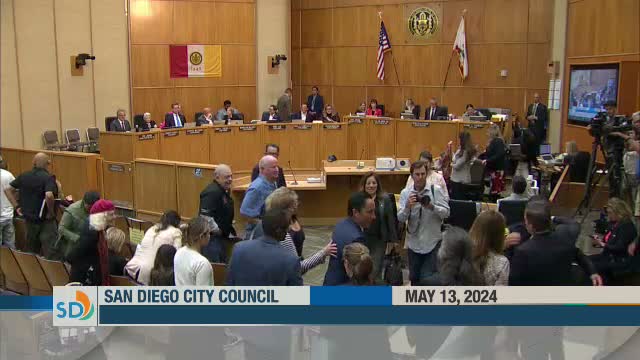
The San Diego City Council on May 13 approved a 10‑year exclusive concession agreement with True Upside Consulting (TUC) to finance, install, operate and maintain public electric‑vehicle charging stations on city parking lots, and established an EV Charging Program Fund to collect revenue and reserve funds for an end‑of‑term buyout. The ordinance passed unanimously, 9–0.
Heather Werner, interim director of the city27s Sustainability and Mobility Department (SUMO), told the council the portfolio approach addresses equity and technical consistency across roughly 400 city parking lots and prioritizes installations at libraries, recreation centers and beaches in the first two years. "We are uniquely positioned to offer a portfolio of potential charging locations to help meet climate action plan goals and address community needs," Werner said during the presentation.
SUMO explained the contract structure shifts capital financing and early market risk to the contractor; the city would acquire the installed electrical infrastructure at the end of the term for a not‑to‑exceed buyout (contract cap $60,000,000). The Independent Budget Analyst (IBA) noted staff27s estimate of an end‑of‑term buyout near $30,000,000 and staff27s projected 10‑year revenue of roughly $23,000,000, leaving a potential $7,000,000 shortfall that could require financing or appropriation if grants and utilization projections fall short. "Under‑utilization of the system could result in a dramatic decline in the revenue generated from this contract," IBA Jordan Moore told the council.
Community stakeholders offered both support and cautions during public comment. Labor and union groups urged approval and noted local job and apprenticeship opportunities; the Chicano Park Museum requested an explicit exclusion so its tenant‑led Via Verde micro‑transit and charging project could proceed. Randy Wild, senior policy advisor in the mayor27s office, and a TUC representative both said the contract would not preclude existing tenant projects. "We do not see this contract as at all precluding their ability to move forward with their plan," Wild said; TUC added it would "absolutely not interfere" with projects already in process.
The contract calls for monthly reporting on utilization, downtime and revenue, with performance targets and financial damages for missed service levels. Councilmembers asked staff to provide more frequent updates; SUMO agreed to deliver program reports at least twice a year and to coordinate with council districts on planned installations. Staff also said grant funding (state and federal) could materially reduce the city27s end‑of‑term liability.
The ordinance awards the contract to True Upside Consulting and establishes the EV Charging Program Fund; implementation now turns to site surveys, community engagement and coordination with utility providers and city departments to begin installations.
Heather Werner, interim director of the city27s Sustainability and Mobility Department (SUMO), told the council the portfolio approach addresses equity and technical consistency across roughly 400 city parking lots and prioritizes installations at libraries, recreation centers and beaches in the first two years. "We are uniquely positioned to offer a portfolio of potential charging locations to help meet climate action plan goals and address community needs," Werner said during the presentation.
SUMO explained the contract structure shifts capital financing and early market risk to the contractor; the city would acquire the installed electrical infrastructure at the end of the term for a not‑to‑exceed buyout (contract cap $60,000,000). The Independent Budget Analyst (IBA) noted staff27s estimate of an end‑of‑term buyout near $30,000,000 and staff27s projected 10‑year revenue of roughly $23,000,000, leaving a potential $7,000,000 shortfall that could require financing or appropriation if grants and utilization projections fall short. "Under‑utilization of the system could result in a dramatic decline in the revenue generated from this contract," IBA Jordan Moore told the council.
Community stakeholders offered both support and cautions during public comment. Labor and union groups urged approval and noted local job and apprenticeship opportunities; the Chicano Park Museum requested an explicit exclusion so its tenant‑led Via Verde micro‑transit and charging project could proceed. Randy Wild, senior policy advisor in the mayor27s office, and a TUC representative both said the contract would not preclude existing tenant projects. "We do not see this contract as at all precluding their ability to move forward with their plan," Wild said; TUC added it would "absolutely not interfere" with projects already in process.
The contract calls for monthly reporting on utilization, downtime and revenue, with performance targets and financial damages for missed service levels. Councilmembers asked staff to provide more frequent updates; SUMO agreed to deliver program reports at least twice a year and to coordinate with council districts on planned installations. Staff also said grant funding (state and federal) could materially reduce the city27s end‑of‑term liability.
The ordinance awards the contract to True Upside Consulting and establishes the EV Charging Program Fund; implementation now turns to site surveys, community engagement and coordination with utility providers and city departments to begin installations.
View the Full Meeting & All Its Details
This article offers just a summary. Unlock complete video, transcripts, and insights as a Founder Member.
✓
Watch full, unedited meeting videos
✓
Search every word spoken in unlimited transcripts
✓
AI summaries & real-time alerts (all government levels)
✓
Permanent access to expanding government content
30-day money-back guarantee
