Utility board OKs $100,000 mapping contract to comply with EPA lead‑and‑copper rule revisions
May 30, 2024 | Weatherford, Parker County, Texas
This article was created by AI summarizing key points discussed. AI makes mistakes, so for full details and context, please refer to the video of the full meeting. Please report any errors so we can fix them. Report an error »
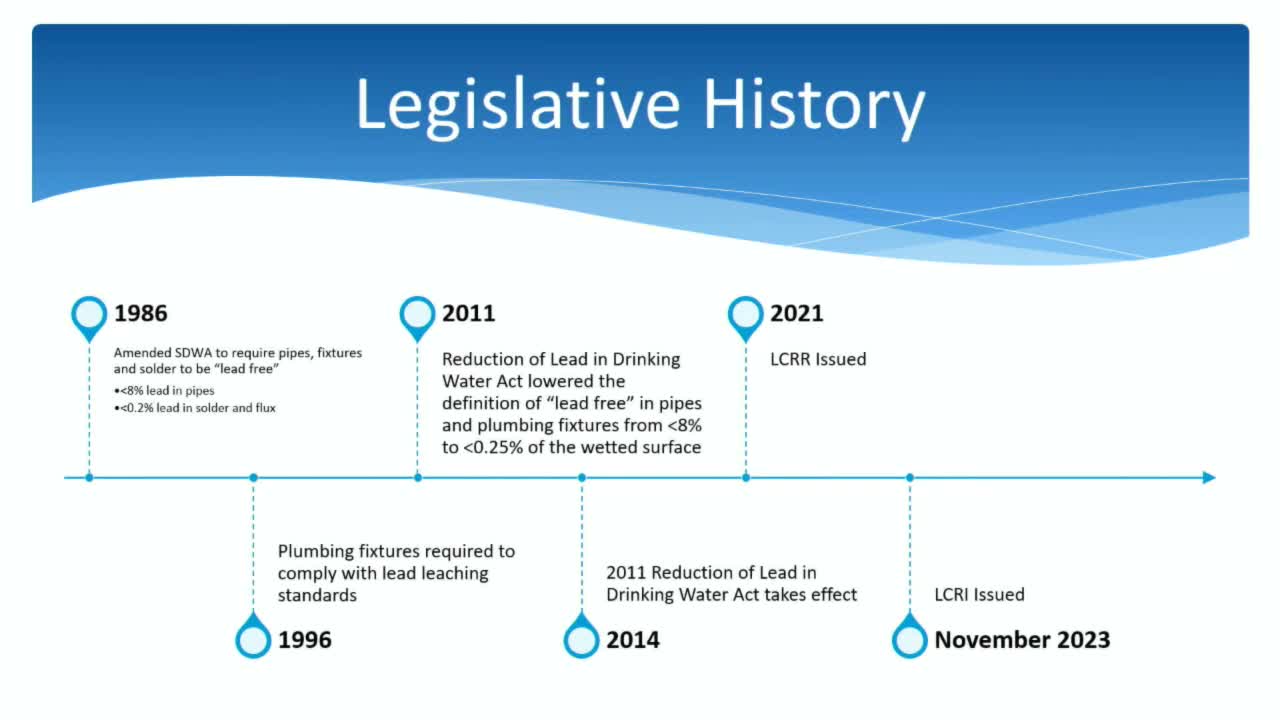
Rick Schaffer, the city's Water Utilities presenter, told the Municipal Utility Board that the U.S. Environmental Protection Agency's updated Lead and Copper Rule revisions (LCRR/LCRI) require utilities to inventory and, over time, replace all lead and galvanized service lines and to expand sampling and communications efforts.
"The initial compliance date is October of this year," Schaffer said, describing new requirements that include a lead service line inventory (LSLI), a communications plan, increased sampling frequency until lines are removed, and testing of elementary schools and child‑care facilities within five years. He said the city currently has no known customer‑side lead service lines on record but has identified 4 galvanized lines on the city side of the meter and roughly 500 unknowns on the city side and about 5,000 unknowns on the customer side.
Schaffer said the $100,000 contract with Yellow Rose Mapping LLC would fund consultant work to help identify service line materials and accelerate completion of the LSLI, supplementing staff efforts already underway. He also said the city has applied for state grant funding and passed an initial selection phase that will allow a full application for funds that could cover customer‑side replacement costs.
Council questions focused on what "customer side" means and whether testing alone can indicate material; Schaffer clarified that identification requires exposing the pipe at the meter and that the customer side refers to the piping from the meter to the house, excluding plumbing inside the building. He also told the board the city's previous sampling results do not exceed the current or new lower lead action levels but that the replacement requirement is independent of sampling results.
The motion to authorize the city manager to execute a professional services contract with Yellow Rose Mapping LLC for up to $100,000 was made by Ken Davis and seconded by Heidi Wilder; the board approved the item.
Why it matters: The LCRR expands legal duties and timelines for water systems and requires new customer notifications and testing that involve multiple city departments. The consultant work and potential grant funds will affect whether customers bear replacement costs for private service lines.
"The initial compliance date is October of this year," Schaffer said, describing new requirements that include a lead service line inventory (LSLI), a communications plan, increased sampling frequency until lines are removed, and testing of elementary schools and child‑care facilities within five years. He said the city currently has no known customer‑side lead service lines on record but has identified 4 galvanized lines on the city side of the meter and roughly 500 unknowns on the city side and about 5,000 unknowns on the customer side.
Schaffer said the $100,000 contract with Yellow Rose Mapping LLC would fund consultant work to help identify service line materials and accelerate completion of the LSLI, supplementing staff efforts already underway. He also said the city has applied for state grant funding and passed an initial selection phase that will allow a full application for funds that could cover customer‑side replacement costs.
Council questions focused on what "customer side" means and whether testing alone can indicate material; Schaffer clarified that identification requires exposing the pipe at the meter and that the customer side refers to the piping from the meter to the house, excluding plumbing inside the building. He also told the board the city's previous sampling results do not exceed the current or new lower lead action levels but that the replacement requirement is independent of sampling results.
The motion to authorize the city manager to execute a professional services contract with Yellow Rose Mapping LLC for up to $100,000 was made by Ken Davis and seconded by Heidi Wilder; the board approved the item.
Why it matters: The LCRR expands legal duties and timelines for water systems and requires new customer notifications and testing that involve multiple city departments. The consultant work and potential grant funds will affect whether customers bear replacement costs for private service lines.
Don't Miss a Word: See the Full Meeting!
Go beyond summaries. Unlock every video, transcript, and key insight with a Founder Membership.
✓
Get instant access to full meeting videos
✓
Search and clip any phrase from complete transcripts
✓
Receive AI-powered summaries & custom alerts
✓
Enjoy lifetime, unrestricted access to government data
30-day money-back guarantee
