Finance Committee advances PUC reauthorization amid debate over appeals, securitization and third‑party program rules
April 30, 2026 | 2026 Legislature CO, Colorado
This article was created by AI summarizing key points discussed. AI makes mistakes, so for full details and context, please refer to the video of the full meeting. Please report any errors so we can fix them. Report an error »
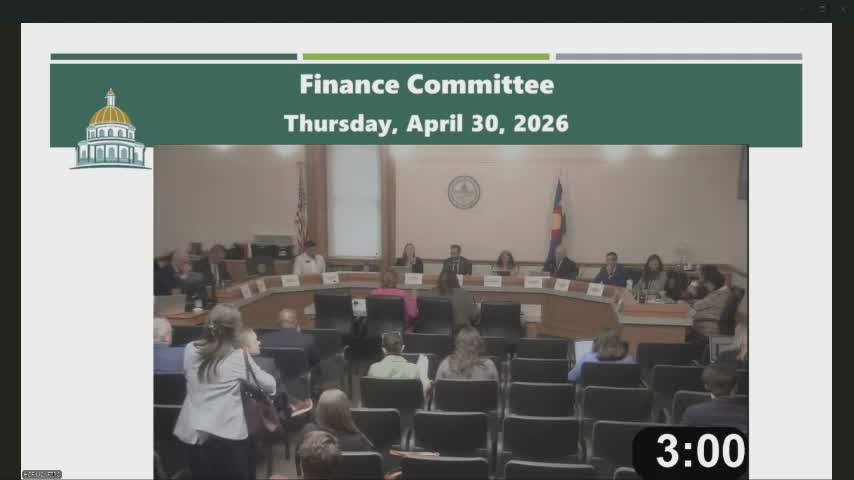
House Bill 13‑26, a seven‑year reauthorization and set of updates to the Public Utilities Commission (PUC), cleared the House Finance Committee on a 6‑3 voice/roll call after sponsors offered several amendments to address stakeholder concerns.
The bill’s sponsors told the committee the measure largely implements recommendations from a 2025 sunset review by the Colorado Office of Policy Research and Regulatory Reform (COPRR) and aims to modernize the PUC’s authority across energy, telecommunications, water and pipeline safety. “House Bill 13‑26 is a vital measure that continues the Public Utilities Commission for another seven years,” the majority sponsor said, urging members to advance the bill as amended.
Why it matters: The PUC regulates utilities that affect every household and business in Colorado. The bill includes changes sponsors say are necessary to implement modern grid planning, program delivery and telecom oversight; opponents said several provisions risk shifting costs to ratepayers, expanding state power over local land‑use decisions and unsettling labor markets.
Key details and debate
- Section 13 (appeals of local land‑use denials): Representative Gonzales and multiple municipal and county representatives pressed sponsors and PUC staff on who proposed the language and whether it expanded appeal rights. Sponsors said COPRR drafted the original recommendation and that the section updates an opaque, two‑decade‑old statute. Director Rebecca White of the PUC told the committee the PUC had seen “only one instance in 20 years” of a land‑use appeal prior to very recent cases and that clarifying the statute modernizes how the law applies. Municipal associations and the Colorado Municipal League opposed the provision as amended, arguing it creates a new pathway for independent power producers and transmission developers to appeal local denials and imposes unbudgeted legal costs on local governments. The sponsors offered amendment L014 to narrow and clarify siting appeals; the committee adopted L014 without objection.
- Section 12 (third‑party administration of customer programs): Representative Rosanna Camacho and several labor witnesses questioned whether allowing the PUC to direct utilities to use third‑party administrators would displace union jobs or reduce oversight. Sponsors said the provision is a tool of last resort for programs that underperform and that they are negotiating language to protect existing collective‑bargaining arrangements. Energy outreach and nonprofit witnesses warned against noncompetitive selections and urged safeguards for community‑based programs.
- Securitization and finance authority: Sponsors and some witnesses described securitization as an occasional, powerful financing tool — for example, to spread wildfire mitigation costs — that can lower immediate customer bills in specific circumstances. Xcel Energy and other industry witnesses warned that broad, commission‑level securitization authority could make utilities less creditworthy, raise long‑term costs, and tie up future policy choices. Sponsors said the bill does not make securitization mandatory in all cases but would allow the commission to use the tool when financial modeling demonstrates clear customer benefit.
- Commission bench, staffing and fees: Stakeholders were divided on proposals to expand the PUC from three to five commissioners and on where to fund any growth. Some labor and regional groups supported expansion to add capacity and expertise; environmental groups and others worried that expanding the bench increases costs and delays. The committee adopted technical amendments affecting TNC permit fees (L021) and removed duplicative TNC penalty language (L019).
Amendments and outcome
The committee adopted a package of sponsor and member amendments addressing municipal concerns, duplicative provisions and administrative procedure. Notable actions included:
- L014 (clarify electric siting appeal authority) — adopted
- L019 (remove duplicative TNC provisions) — adopted
- L021 (raise cap on TNC permit fee) — adopted
- L020 (clarify exhaustion of administrative remedies for certain civil suits) — adopted
After amendments, the committee voted to send HB 13‑26 as amended to the Committee on Appropriations; the clerk recorded the motion as passing with a 6‑3 vote and two members excused.
Who spoke (selection)
- Rebecca White, Director, Public Utilities Commission: testified for the PUC and answered committee questions about appeals, staffing and securitization protocols. She said the COPRR sunset review produced the recommendations in the bill and called the changes “modernizing” clarifications.
- Representative Wilford (co‑prime sponsor): explained bill intent and defended amendments as part of ongoing negotiations.
- Robert Kenny, President, Xcel Energy Colorado: warned that giving the commission broad, discretionary securitization authority could harm utility creditworthiness and raise long‑term costs.
- Andrew Bennett, vice president of advocacy, Energy Outreach Colorado: testified in opposition, raising concerns about cost pressures on low‑income households and nonprofit program continuity.
What’s next
The committee referred HB 13‑26, as amended, to the Committee on Appropriations for further fiscal review and consideration. Sponsors and stakeholders indicated additional negotiations will continue as the bill proceeds.
Ending note
Committee members repeatedly asked for clearer, consolidated fiscal modeling of how the bill’s multiple provisions will affect ratepayers and local governments; several witnesses and members urged more time to reconcile workforce and municipal concerns during later stages of the process.
The bill’s sponsors told the committee the measure largely implements recommendations from a 2025 sunset review by the Colorado Office of Policy Research and Regulatory Reform (COPRR) and aims to modernize the PUC’s authority across energy, telecommunications, water and pipeline safety. “House Bill 13‑26 is a vital measure that continues the Public Utilities Commission for another seven years,” the majority sponsor said, urging members to advance the bill as amended.
Why it matters: The PUC regulates utilities that affect every household and business in Colorado. The bill includes changes sponsors say are necessary to implement modern grid planning, program delivery and telecom oversight; opponents said several provisions risk shifting costs to ratepayers, expanding state power over local land‑use decisions and unsettling labor markets.
Key details and debate
- Section 13 (appeals of local land‑use denials): Representative Gonzales and multiple municipal and county representatives pressed sponsors and PUC staff on who proposed the language and whether it expanded appeal rights. Sponsors said COPRR drafted the original recommendation and that the section updates an opaque, two‑decade‑old statute. Director Rebecca White of the PUC told the committee the PUC had seen “only one instance in 20 years” of a land‑use appeal prior to very recent cases and that clarifying the statute modernizes how the law applies. Municipal associations and the Colorado Municipal League opposed the provision as amended, arguing it creates a new pathway for independent power producers and transmission developers to appeal local denials and imposes unbudgeted legal costs on local governments. The sponsors offered amendment L014 to narrow and clarify siting appeals; the committee adopted L014 without objection.
- Section 12 (third‑party administration of customer programs): Representative Rosanna Camacho and several labor witnesses questioned whether allowing the PUC to direct utilities to use third‑party administrators would displace union jobs or reduce oversight. Sponsors said the provision is a tool of last resort for programs that underperform and that they are negotiating language to protect existing collective‑bargaining arrangements. Energy outreach and nonprofit witnesses warned against noncompetitive selections and urged safeguards for community‑based programs.
- Securitization and finance authority: Sponsors and some witnesses described securitization as an occasional, powerful financing tool — for example, to spread wildfire mitigation costs — that can lower immediate customer bills in specific circumstances. Xcel Energy and other industry witnesses warned that broad, commission‑level securitization authority could make utilities less creditworthy, raise long‑term costs, and tie up future policy choices. Sponsors said the bill does not make securitization mandatory in all cases but would allow the commission to use the tool when financial modeling demonstrates clear customer benefit.
- Commission bench, staffing and fees: Stakeholders were divided on proposals to expand the PUC from three to five commissioners and on where to fund any growth. Some labor and regional groups supported expansion to add capacity and expertise; environmental groups and others worried that expanding the bench increases costs and delays. The committee adopted technical amendments affecting TNC permit fees (L021) and removed duplicative TNC penalty language (L019).
Amendments and outcome
The committee adopted a package of sponsor and member amendments addressing municipal concerns, duplicative provisions and administrative procedure. Notable actions included:
- L014 (clarify electric siting appeal authority) — adopted
- L019 (remove duplicative TNC provisions) — adopted
- L021 (raise cap on TNC permit fee) — adopted
- L020 (clarify exhaustion of administrative remedies for certain civil suits) — adopted
After amendments, the committee voted to send HB 13‑26 as amended to the Committee on Appropriations; the clerk recorded the motion as passing with a 6‑3 vote and two members excused.
Who spoke (selection)
- Rebecca White, Director, Public Utilities Commission: testified for the PUC and answered committee questions about appeals, staffing and securitization protocols. She said the COPRR sunset review produced the recommendations in the bill and called the changes “modernizing” clarifications.
- Representative Wilford (co‑prime sponsor): explained bill intent and defended amendments as part of ongoing negotiations.
- Robert Kenny, President, Xcel Energy Colorado: warned that giving the commission broad, discretionary securitization authority could harm utility creditworthiness and raise long‑term costs.
- Andrew Bennett, vice president of advocacy, Energy Outreach Colorado: testified in opposition, raising concerns about cost pressures on low‑income households and nonprofit program continuity.
What’s next
The committee referred HB 13‑26, as amended, to the Committee on Appropriations for further fiscal review and consideration. Sponsors and stakeholders indicated additional negotiations will continue as the bill proceeds.
Ending note
Committee members repeatedly asked for clearer, consolidated fiscal modeling of how the bill’s multiple provisions will affect ratepayers and local governments; several witnesses and members urged more time to reconcile workforce and municipal concerns during later stages of the process.
View the Full Meeting & All Its Details
This article offers just a summary. Unlock complete video, transcripts, and insights as a Founder Member.
✓
Watch full, unedited meeting videos
✓
Search every word spoken in unlimited transcripts
✓
AI summaries & real-time alerts (all government levels)
✓
Permanent access to expanding government content
30-day money-back guarantee
