Committee approves bill banning PPE paycheck deductions and requiring restroom access at large meatpacking plants
April 30, 2026 | 2026 Legislature CO, Colorado
This article was created by AI summarizing key points discussed. AI makes mistakes, so for full details and context, please refer to the video of the full meeting. Please report any errors so we can fix them. Report an error »
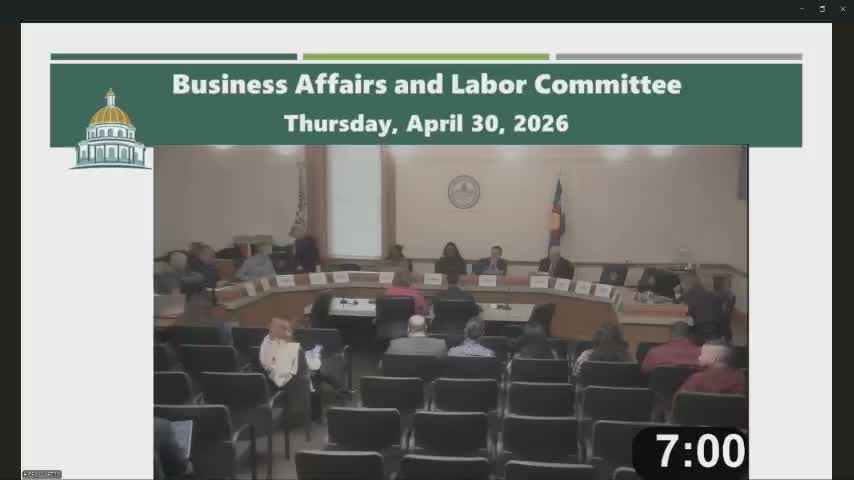
Senate Bill 160, advanced by the Colorado House Business, Labor & Employment Committee on an 8–5 vote, would prohibit employers from deducting the cost of employer‑required personal protective equipment (PPE) from worker pay and require large meatpacking employers (500 or more employees) to provide reasonable access to restrooms during shifts.
The bill’s sponsors framed the measure as codifying established workplace norms. Majority Leader Duran told the committee the bill “codifies basic workplace safety norms” and provides certainty for workers “regardless of enforcement or any changes at the federal level.” Co‑sponsor Representative Matt Martinez cited documented complaints at the JBS Greeley facility and said the measure is tailored to large operations where incidents have been most prevalent.
Supporters—primarily union representatives and current employees at JBS—testified with first‑hand accounts that formed the emotional core of the hearing. Ticelli Moyes, a union representative for UFCW Local 7, said members repeatedly reported supervisors denying restroom breaks and described a pattern of PPE being charged to workers. On the floor of the committee, Deborah Rodarte described a coworker who urinated on himself after waiting 20 minutes for a relief worker and who was later disciplined; Frank Gutierrez, a trainer, and Bernice Garcia, a trim lifter, gave similar first‑hand accounts. Matt Schechter, general counsel for UFCW Local 7, said the bill builds on existing OSHA rules and would give the Department of Labor (CDLE) permissive fine authority to encourage compliance.
Committee members raised multiple technical and policy concerns. Some asked why the bill is limited to meatpacking rather than all industries where PPE and restroom access are relevant; sponsors said the bill targets documented, egregious incidents at large facilities and is designed to avoid burdens on small “mom‑and‑pop” employers. Other members warned about federal preemption, noting that OSHA already requires employers to provide PPE and reasonable bathroom access; sponsors said amendment L001 (adopted in committee) clarifies language to align the bill with current state regulations and mitigate preemption risk.
The bill’s enforcement was described as intentionally modest: the sponsors explained a fine scheme of $100 per violation, capped at $200 per employee per week, with CDLE authority to waive penalties to encourage compliance. Sponsors emphasized the bill is not creating a new regulatory system but providing a clear state standard and a modest incentive structure for enforcement.
After extensive testimony and amendments, the committee adopted amendment L001 and moved SB 160 as amended to the Committee of the Whole. The roll call recorded eight votes in favor and five opposed.
The bill’s sponsors framed the measure as codifying established workplace norms. Majority Leader Duran told the committee the bill “codifies basic workplace safety norms” and provides certainty for workers “regardless of enforcement or any changes at the federal level.” Co‑sponsor Representative Matt Martinez cited documented complaints at the JBS Greeley facility and said the measure is tailored to large operations where incidents have been most prevalent.
Supporters—primarily union representatives and current employees at JBS—testified with first‑hand accounts that formed the emotional core of the hearing. Ticelli Moyes, a union representative for UFCW Local 7, said members repeatedly reported supervisors denying restroom breaks and described a pattern of PPE being charged to workers. On the floor of the committee, Deborah Rodarte described a coworker who urinated on himself after waiting 20 minutes for a relief worker and who was later disciplined; Frank Gutierrez, a trainer, and Bernice Garcia, a trim lifter, gave similar first‑hand accounts. Matt Schechter, general counsel for UFCW Local 7, said the bill builds on existing OSHA rules and would give the Department of Labor (CDLE) permissive fine authority to encourage compliance.
Committee members raised multiple technical and policy concerns. Some asked why the bill is limited to meatpacking rather than all industries where PPE and restroom access are relevant; sponsors said the bill targets documented, egregious incidents at large facilities and is designed to avoid burdens on small “mom‑and‑pop” employers. Other members warned about federal preemption, noting that OSHA already requires employers to provide PPE and reasonable bathroom access; sponsors said amendment L001 (adopted in committee) clarifies language to align the bill with current state regulations and mitigate preemption risk.
The bill’s enforcement was described as intentionally modest: the sponsors explained a fine scheme of $100 per violation, capped at $200 per employee per week, with CDLE authority to waive penalties to encourage compliance. Sponsors emphasized the bill is not creating a new regulatory system but providing a clear state standard and a modest incentive structure for enforcement.
After extensive testimony and amendments, the committee adopted amendment L001 and moved SB 160 as amended to the Committee of the Whole. The roll call recorded eight votes in favor and five opposed.
View the Full Meeting & All Its Details
This article offers just a summary. Unlock complete video, transcripts, and insights as a Founder Member.
✓
Watch full, unedited meeting videos
✓
Search every word spoken in unlimited transcripts
✓
AI summaries & real-time alerts (all government levels)
✓
Permanent access to expanding government content
30-day money-back guarantee
