Committee advances rideshare safety bill after months of negotiation; audio/video opt‑in, more frequent checks and PUC rulemaking adopted
April 30, 2026 | 2026 Legislature CO, Colorado
This article was created by AI summarizing key points discussed. AI makes mistakes, so for full details and context, please refer to the video of the full meeting. Please report any errors so we can fix them. Report an error »
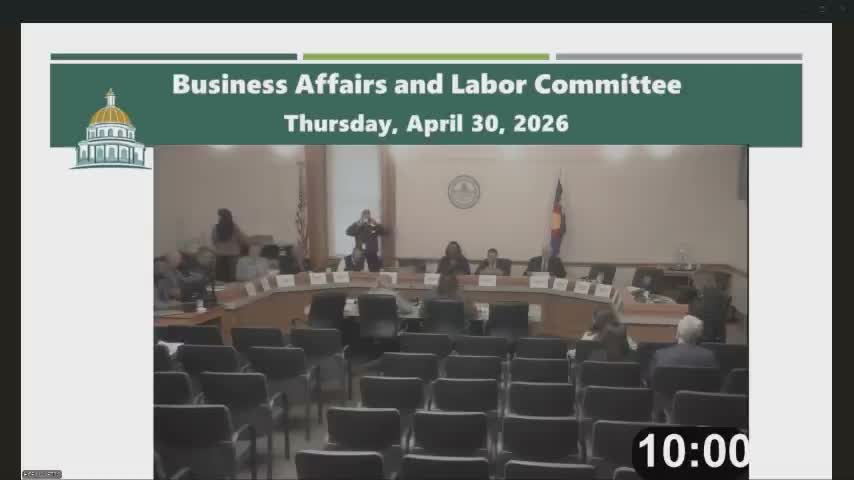
House Bill 1424, a broad set of measures aimed at improving passenger and driver safety on transportation network company (TNC) platforms, cleared the Business, Labor & Employment Committee on an 8–5 vote after an intensive hearing and multiple negotiated amendments.
Sponsors framed HB 1424 as a public‑safety bill grounded in survivor testimony and criminal cases. Greg Wilford, a sponsor who opened the hearing with a personal account, described patterns in national reporting on assaults connected to platform rides and urged mandatory reporting and better deactivation processes for dangerous drivers. Denver District Attorney John Walsh and Deputy DA Holly Snead recounted prosecution of a serial offender who used rideshare impersonation to victimize multiple women and told the committee rapid access to platform records and quicker deactivation could prevent repeat offenses.
The bill’s core components—many of which were narrowed from an earlier, vetoed version—include: more frequent criminal history screening (every six months, with continuous monitoring systems discussed as supplementary), clearer rules and penalties around imposter accounts, an opt‑in audio and video recording option for riders and drivers (with cannot increase fare for opting in), and requirements for TNCs to adopt policies addressing account sharing and account renting. Sponsors said rideshare items tied to Public Utilities Commission rulemaking (PUC) will be subject to an extended rulemaking window; the PUC has until 06/01/2028 to complete rules, while non‑PUC provisions would take effect on 01/01/2027.
Industry witnesses (including Uber) said they support many safety goals and had agreed to some changes—Uber told the committee it will increase background checks in Colorado to twice a year and already operates continuous monitoring systems—but asked for refinement on operational feasibility for audio/video workflows, data retention and privacy protections, and on how cross‑platform deactivation and data sharing will work in practice. Driver organizations and smaller operators (including a Drivers Co‑op) urged carveouts or a different threshold for “large operator” status (the bill defines a large operator as 1,500 or more drivers) and warned that duplicate background checks and opt‑in recording integration could create insurance and cost burdens for small local startups.
Sponsors offered and the committee adopted several technical amendments (L2, L3, L4, L5, L6, L8) to address driver‑co‑op, union and industry concerns: removing a 72‑hour self‑notification requirement for driver convictions, clarifying what shared driver information a PUC‑managed cross‑platform database must include (both punitive and exonerative data), adding plausibility language to deletion of unfair ratings, narrowing crash reporting timing, forbidding fare increases tied to opting into recording, and directing the PUC to adopt driver/rider training standards. During the hearing, the Denver DA’s office requested quicker law‑enforcement access to records and better cooperation on subpoenas and search warrants; sponsors said the bill tightens those timelines and the PUC rulemaking will consider practical implementation timelines.
Representative Froelich, co‑sponsor, said the bill balances safety with technical feasibility and emphasized the removal of a private right of action and tightening disqualifying offenses to felony‑level crimes compared with last year’s draft. The committee adopted the package of amendments and moved the bill forward by an 8–5 vote.
Next steps: HB 1424 goes to the Committee of the Whole; sponsors and stakeholders signaled ongoing work to finalize operational language for identity verification, automated deactivation safeguards, and accommodations for local co‑ops and startups.
Sponsors framed HB 1424 as a public‑safety bill grounded in survivor testimony and criminal cases. Greg Wilford, a sponsor who opened the hearing with a personal account, described patterns in national reporting on assaults connected to platform rides and urged mandatory reporting and better deactivation processes for dangerous drivers. Denver District Attorney John Walsh and Deputy DA Holly Snead recounted prosecution of a serial offender who used rideshare impersonation to victimize multiple women and told the committee rapid access to platform records and quicker deactivation could prevent repeat offenses.
The bill’s core components—many of which were narrowed from an earlier, vetoed version—include: more frequent criminal history screening (every six months, with continuous monitoring systems discussed as supplementary), clearer rules and penalties around imposter accounts, an opt‑in audio and video recording option for riders and drivers (with cannot increase fare for opting in), and requirements for TNCs to adopt policies addressing account sharing and account renting. Sponsors said rideshare items tied to Public Utilities Commission rulemaking (PUC) will be subject to an extended rulemaking window; the PUC has until 06/01/2028 to complete rules, while non‑PUC provisions would take effect on 01/01/2027.
Industry witnesses (including Uber) said they support many safety goals and had agreed to some changes—Uber told the committee it will increase background checks in Colorado to twice a year and already operates continuous monitoring systems—but asked for refinement on operational feasibility for audio/video workflows, data retention and privacy protections, and on how cross‑platform deactivation and data sharing will work in practice. Driver organizations and smaller operators (including a Drivers Co‑op) urged carveouts or a different threshold for “large operator” status (the bill defines a large operator as 1,500 or more drivers) and warned that duplicate background checks and opt‑in recording integration could create insurance and cost burdens for small local startups.
Sponsors offered and the committee adopted several technical amendments (L2, L3, L4, L5, L6, L8) to address driver‑co‑op, union and industry concerns: removing a 72‑hour self‑notification requirement for driver convictions, clarifying what shared driver information a PUC‑managed cross‑platform database must include (both punitive and exonerative data), adding plausibility language to deletion of unfair ratings, narrowing crash reporting timing, forbidding fare increases tied to opting into recording, and directing the PUC to adopt driver/rider training standards. During the hearing, the Denver DA’s office requested quicker law‑enforcement access to records and better cooperation on subpoenas and search warrants; sponsors said the bill tightens those timelines and the PUC rulemaking will consider practical implementation timelines.
Representative Froelich, co‑sponsor, said the bill balances safety with technical feasibility and emphasized the removal of a private right of action and tightening disqualifying offenses to felony‑level crimes compared with last year’s draft. The committee adopted the package of amendments and moved the bill forward by an 8–5 vote.
Next steps: HB 1424 goes to the Committee of the Whole; sponsors and stakeholders signaled ongoing work to finalize operational language for identity verification, automated deactivation safeguards, and accommodations for local co‑ops and startups.
Don't Miss a Word: See the Full Meeting!
Go beyond summaries. Unlock every video, transcript, and key insight with a Founder Membership.
✓
Get instant access to full meeting videos
✓
Search and clip any phrase from complete transcripts
✓
Receive AI-powered summaries & custom alerts
✓
Enjoy lifetime, unrestricted access to government data
30-day money-back guarantee
