Senate committee advances bill to broaden enforcement on human-bear attractants
April 30, 2026 | 2026 Legislature CO, Colorado
This article was created by AI summarizing key points discussed. AI makes mistakes, so for full details and context, please refer to the video of the full meeting. Please report any errors so we can fix them. Report an error »
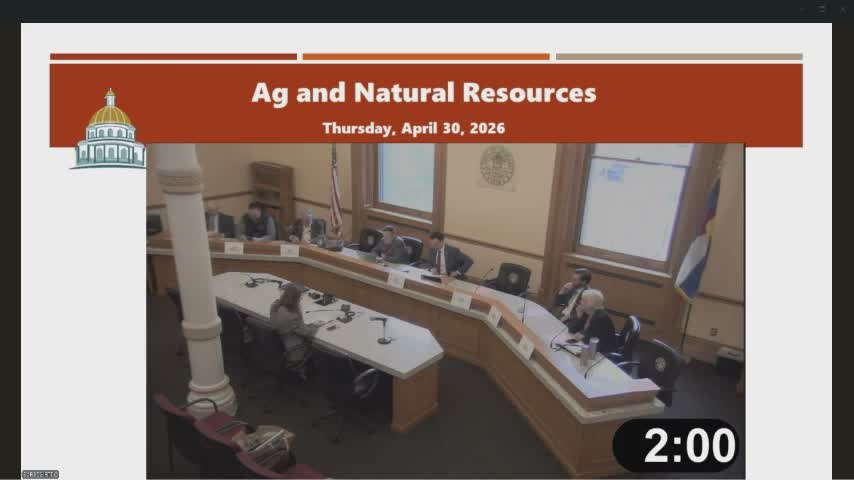
Senator Marchman introduced House Bill 13-42, saying Colorado recorded more than 5,000 human-bear conflict reports in 2024 and that over half were linked to trash. The bill would let Colorado Parks and Wildlife (CPW) issue penalties to people who "knowingly place food or edible waste in the open in circumstances where there's a reasonable probability of luring a wild bear," and would raise the maximum fine for third and subsequent offenses from $2,000 to $5,000.
Supporters, including CPW Southeast Region Manager Frank McGee and Brenda Lee of the Colorado Bear Coalition, said the existing "intent" standard is nearly impossible to prove and has left officers without prosecutable tools. "The current intent standard is a significant barrier to our effectiveness," McGee said, urging the committee to approve the change so officers can intervene earlier and prevent bears from becoming habituated to humans.
Several witnesses described the human cost to wildlife. Melinda Marquis recounted the story of a bear called "Tripod," which CPW euthanized after the animal repeatedly accessed human food: "Tripod and her cub would not have lived in the neighborhood if people had not provided them with food," Marquis said. Animal-welfare and bear-safety advocates argued the bill would reduce lethal outcomes by reducing attractants.
Opponents and concerned witnesses warned the wording could be read too broadly. Dean Seifert, representing the collective owners of Wild Birds Unlimited stores, urged an explicit exemption for bird feeders, saying the proposed language could "technically" criminalize residents who hang hummingbird feeders in neighborhoods where bears are "reasonably probable." Bill Bryant, a Golden resident, urged adding explicit exceptions for bird feeders, grilling and otherwise secured trash to reduce neighbor-on-neighbor enforcement or unintended prosecutions.
During Q&A, committee members pressed CPW on investigative standards and the removal of a mandatory first-offense warning. McGee said officers still generally plan to issue warnings but removing the mandatory-warning requirement preserves officer discretion in egregious cases and that many routes exist to show a person acted "knowingly" (for example, documented prior warnings or admissions). He emphasized that the $5,000 amount is a statutory maximum and that "a judge would be the one who ultimately determined what would be an appropriate fine."
The committee approved a motion to send HB 13-42 to the Committee of the Whole on a recorded vote, 4 to 2. The vote advances the bill; further amendment and debate are possible when it reaches the next committee.
The sponsor said the bill includes an agricultural exemption already in statute and reiterated that ordinary activities done responsibly—such as maintaining bird feeders or grilling—would not be the bill's intended targets. The committee passed the bill forward; the bill's authors and stakeholders will continue discussions about specific exemptions and implementation.
Supporters, including CPW Southeast Region Manager Frank McGee and Brenda Lee of the Colorado Bear Coalition, said the existing "intent" standard is nearly impossible to prove and has left officers without prosecutable tools. "The current intent standard is a significant barrier to our effectiveness," McGee said, urging the committee to approve the change so officers can intervene earlier and prevent bears from becoming habituated to humans.
Several witnesses described the human cost to wildlife. Melinda Marquis recounted the story of a bear called "Tripod," which CPW euthanized after the animal repeatedly accessed human food: "Tripod and her cub would not have lived in the neighborhood if people had not provided them with food," Marquis said. Animal-welfare and bear-safety advocates argued the bill would reduce lethal outcomes by reducing attractants.
Opponents and concerned witnesses warned the wording could be read too broadly. Dean Seifert, representing the collective owners of Wild Birds Unlimited stores, urged an explicit exemption for bird feeders, saying the proposed language could "technically" criminalize residents who hang hummingbird feeders in neighborhoods where bears are "reasonably probable." Bill Bryant, a Golden resident, urged adding explicit exceptions for bird feeders, grilling and otherwise secured trash to reduce neighbor-on-neighbor enforcement or unintended prosecutions.
During Q&A, committee members pressed CPW on investigative standards and the removal of a mandatory first-offense warning. McGee said officers still generally plan to issue warnings but removing the mandatory-warning requirement preserves officer discretion in egregious cases and that many routes exist to show a person acted "knowingly" (for example, documented prior warnings or admissions). He emphasized that the $5,000 amount is a statutory maximum and that "a judge would be the one who ultimately determined what would be an appropriate fine."
The committee approved a motion to send HB 13-42 to the Committee of the Whole on a recorded vote, 4 to 2. The vote advances the bill; further amendment and debate are possible when it reaches the next committee.
The sponsor said the bill includes an agricultural exemption already in statute and reiterated that ordinary activities done responsibly—such as maintaining bird feeders or grilling—would not be the bill's intended targets. The committee passed the bill forward; the bill's authors and stakeholders will continue discussions about specific exemptions and implementation.
View the Full Meeting & All Its Details
This article offers just a summary. Unlock complete video, transcripts, and insights as a Founder Member.
✓
Watch full, unedited meeting videos
✓
Search every word spoken in unlimited transcripts
✓
AI summaries & real-time alerts (all government levels)
✓
Permanent access to expanding government content
30-day money-back guarantee
