Lisle CUSD 202 board reviews 27 policies; asks administration for clarifications on resident agenda items, parent notice and hiring language
April 28, 2026 | Lisle CUSD 202, School Boards, Illinois
This article was created by AI summarizing key points discussed. AI makes mistakes, so for full details and context, please refer to the video of the full meeting. Please report any errors so we can fix them. Report an error »
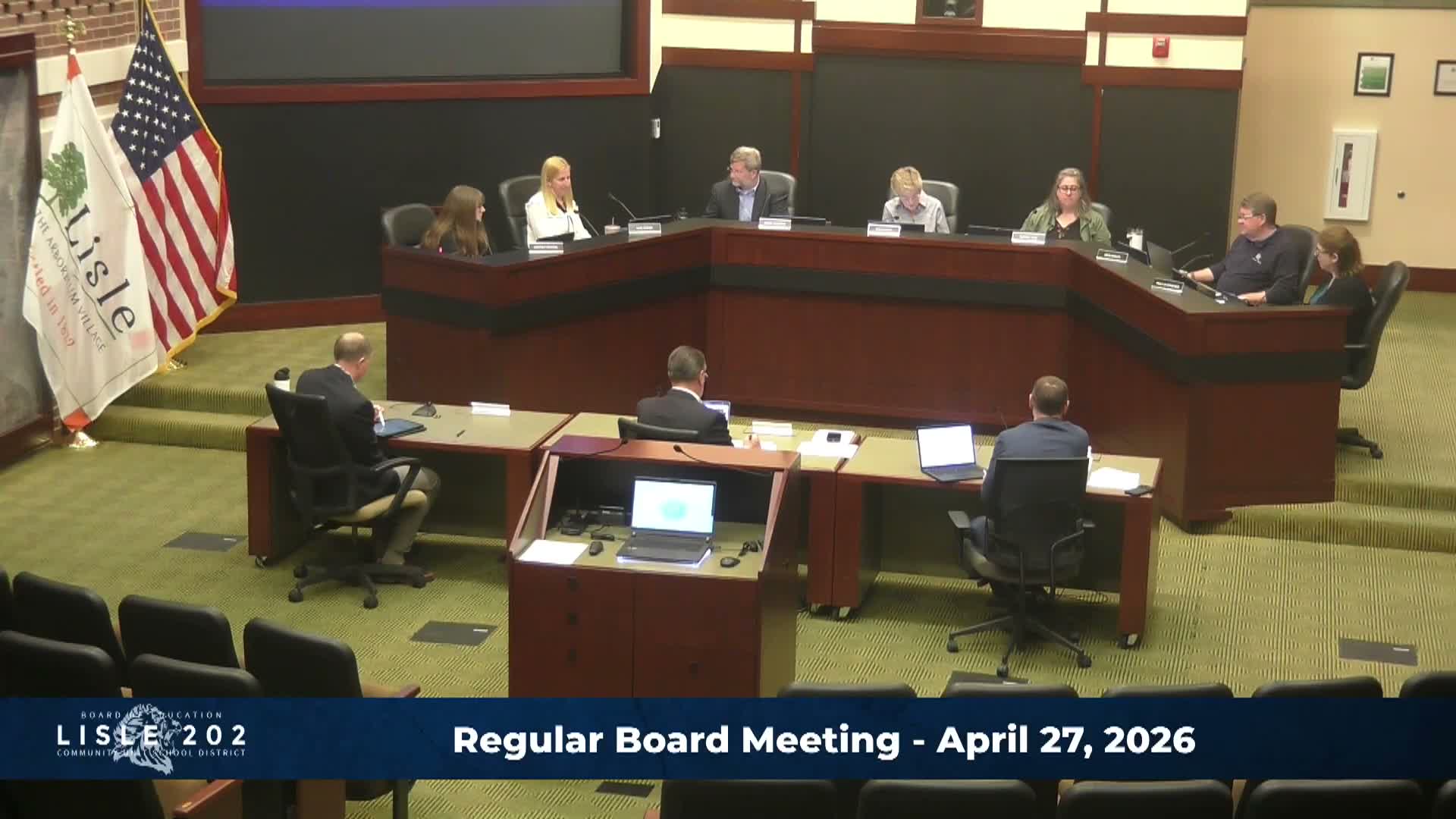
The Lisle Community Unit School District 202 Board of Education completed a single-night review of 27 policies on April 27, approving most suggested edits but sending several topics back for follow-up and a second reading.
Key issues and follow-ups included debate over policy 2.2 (Board of Education meeting procedure), where one board member questioned language that appears to require a unanimous vote to place a resident-suggested agenda item on a future meeting. That member asked whether a majority vote could suffice; administration agreed to research whether the wording reflects a legal requirement and report back for the board’s second reading. "I just I feel like so many other things we have, we do by majority vote," a board member said while asking the administration to check the legal basis.
On policy 2:250 (access to district public records), board members discussed whether to retain the term "voluminous" or use "high volume" in FOIA-related language; administration and board legal counsel noted "voluminous" is a commonly used technical term in FOIA responses.
For the uniform grievance procedure (policy 2:260) the board noted the nondiscrimination coordinator’s title will change on July 1 when a new hire starts; the policy text will be updated accordingly.
Board members pressed administration about whether the district should continue to provide advance notice to parents when certain child-safety or sensitive lessons will occur, after state law changes removed some prior mandates. Several members urged a communication practice even if the requirement was repealed: "If a parent really didn't want their children in this, that option's gone," a board member said; administrators responded that curriculum objection processes still exist and that the district can develop a notification practice. Administration said it will draft suggested language for the next reading.
Other targeted edits to be returned for clarity included a sentence in policy 5:30 (hiring process and criteria) about who notifies applicants when fingerprint-based criminal-history checks identify records; the board directed administration to reword the provision into two sentences to eliminate confusion.
On workplace impairment and testing (policy 5:50), the board asked how the district would handle an employee who appeared impaired. Administration said testing would not be random, that responses would be handled case by case, likely with legal consultation, and that the district has worked with its school-resource officer in past incidents to assess acute situations.
Why it matters: Policy language determines how the district responds to FOIA requests, grievances, hiring background checks, curriculum objections, and employee-safety incidents. The board’s requests for legal review and clearer communications are intended to reduce ambiguity before final adoption.
What’s next: Administration will research the unanimous-vs-majority question for resident-suggested agenda items, draft parent-notification language for sensitive instruction, and provide rewritten hiring-policy language; those items will appear at second reading in a future meeting.
Key issues and follow-ups included debate over policy 2.2 (Board of Education meeting procedure), where one board member questioned language that appears to require a unanimous vote to place a resident-suggested agenda item on a future meeting. That member asked whether a majority vote could suffice; administration agreed to research whether the wording reflects a legal requirement and report back for the board’s second reading. "I just I feel like so many other things we have, we do by majority vote," a board member said while asking the administration to check the legal basis.
On policy 2:250 (access to district public records), board members discussed whether to retain the term "voluminous" or use "high volume" in FOIA-related language; administration and board legal counsel noted "voluminous" is a commonly used technical term in FOIA responses.
For the uniform grievance procedure (policy 2:260) the board noted the nondiscrimination coordinator’s title will change on July 1 when a new hire starts; the policy text will be updated accordingly.
Board members pressed administration about whether the district should continue to provide advance notice to parents when certain child-safety or sensitive lessons will occur, after state law changes removed some prior mandates. Several members urged a communication practice even if the requirement was repealed: "If a parent really didn't want their children in this, that option's gone," a board member said; administrators responded that curriculum objection processes still exist and that the district can develop a notification practice. Administration said it will draft suggested language for the next reading.
Other targeted edits to be returned for clarity included a sentence in policy 5:30 (hiring process and criteria) about who notifies applicants when fingerprint-based criminal-history checks identify records; the board directed administration to reword the provision into two sentences to eliminate confusion.
On workplace impairment and testing (policy 5:50), the board asked how the district would handle an employee who appeared impaired. Administration said testing would not be random, that responses would be handled case by case, likely with legal consultation, and that the district has worked with its school-resource officer in past incidents to assess acute situations.
Why it matters: Policy language determines how the district responds to FOIA requests, grievances, hiring background checks, curriculum objections, and employee-safety incidents. The board’s requests for legal review and clearer communications are intended to reduce ambiguity before final adoption.
What’s next: Administration will research the unanimous-vs-majority question for resident-suggested agenda items, draft parent-notification language for sensitive instruction, and provide rewritten hiring-policy language; those items will appear at second reading in a future meeting.
View the Full Meeting & All Its Details
This article offers just a summary. Unlock complete video, transcripts, and insights as a Founder Member.
✓
Watch full, unedited meeting videos
✓
Search every word spoken in unlimited transcripts
✓
AI summaries & real-time alerts (all government levels)
✓
Permanent access to expanding government content
30-day money-back guarantee
