Student services director details special-education counts, IEP alignment and upcoming DESE review
April 30, 2026 | Westborough Public Schools, School Boards, Massachusetts
This article was created by AI summarizing key points discussed. AI makes mistakes, so for full details and context, please refer to the video of the full meeting. Please report any errors so we can fix them. Report an error »
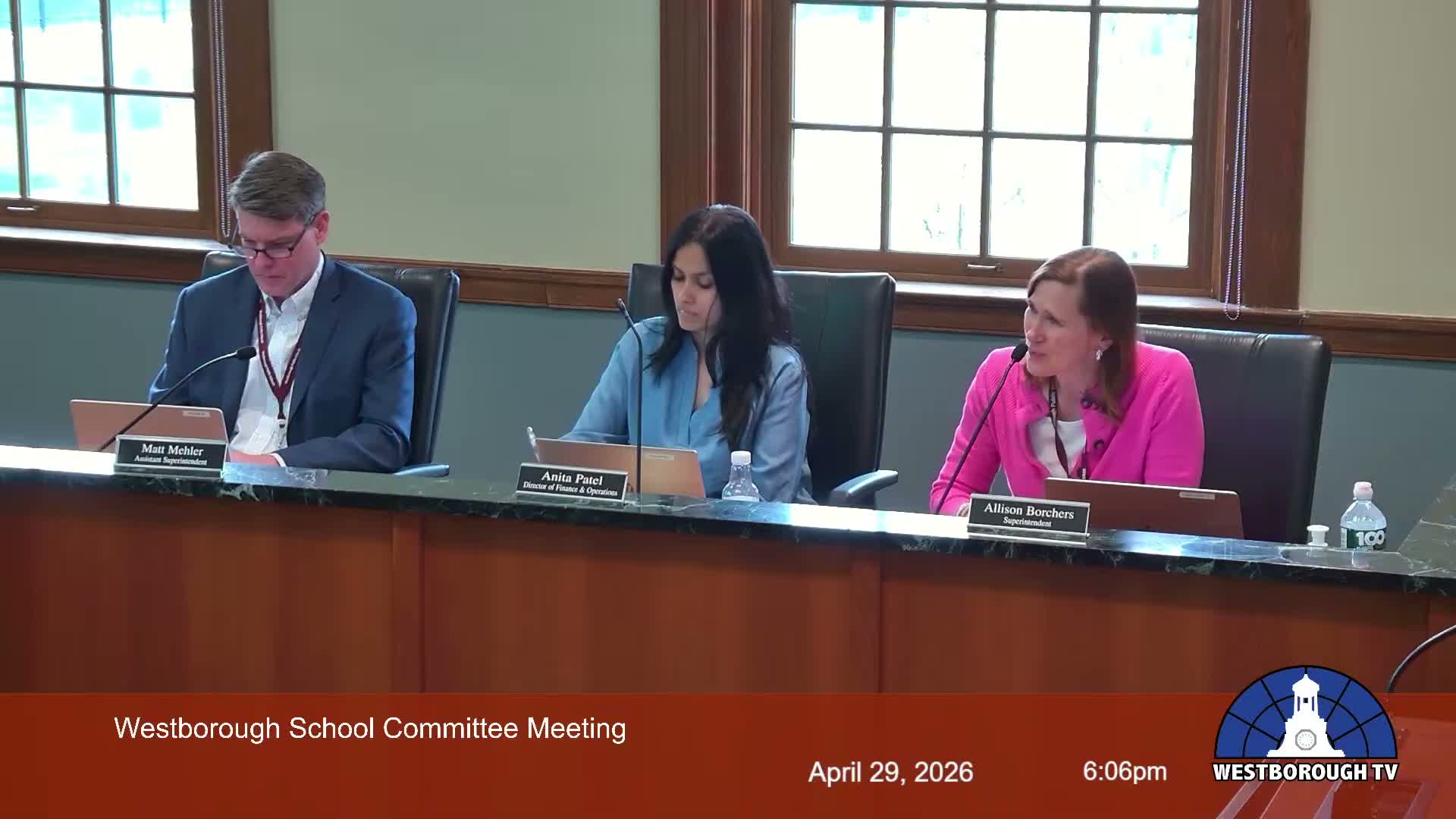
Meg Garvey, Westborough’s director of student services, gave the committee a detailed update on special-education programming, staffing and compliance work, citing both recent numbers and near-term reviews.
Garvey told the committee that special-education enrollment was 626 last year and 619 on the district’s March report. "Due to the drop in enrollment in Westborough public schools, that just increased our percentage slightly to 16, 0.9 as a as a, as a percentage of special education students," she said, noting that the district’s percentage remains below the state average cited in her presentation. She said autism is the largest category of need and that the district is seeing increased needs among younger students.
On placements and costs, Garvey said Westborough had 34 out-of-district placements this year and anticipates 27 next year, but cautioned those figures can change based on student needs and moves. She told the committee rising out-of-district tuition and transportation are significant budget drivers.
Garvey outlined several initiatives to address consistency and quality: the department partnered with DESE-approved trainer Alan Bloom to produce a Westborough-specific IEP-writing guide and is providing professional development across buildings. The district also added five temporary paraprofessionals this year; those positions are being budgeted as permanent for next year.
The presentation described a new tiered job-description system for paraprofessionals—rebranded as educational support professionals (ESPs) beginning in September—designed to align training and compensation to distinct responsibilities. Garvey explained the tiers range from general-assistance roles to Tier 3 positions that require specialized training (safety-care, restraint training and other supports) for students with the highest needs.
Garvey also previewed the Department of Elementary and Secondary Education (DESE) Integrated Monitoring Review (IMR) the district will undergo: district staff are uploading data this spring on indicators such as child find, early childhood transition and secondary transition; DESE will follow with a document upload and an on-site visit in May and then issue a report noting strengths and recommendations. "While no one likes to be under the microscope, I think this always is a good opportunity for us to see where we have places to grow," she said.
Committee members asked about IMR timing and potential ramifications; Garvey and the superintendent said findings typically arrive shortly after the on-site visit and that oversight levels depend on review results. The superintendent and Garvey also discussed broader state-level advocacy on tuition and reimbursement that could affect districts' ability to afford out-of-district placements.
Garvey told the committee that special-education enrollment was 626 last year and 619 on the district’s March report. "Due to the drop in enrollment in Westborough public schools, that just increased our percentage slightly to 16, 0.9 as a as a, as a percentage of special education students," she said, noting that the district’s percentage remains below the state average cited in her presentation. She said autism is the largest category of need and that the district is seeing increased needs among younger students.
On placements and costs, Garvey said Westborough had 34 out-of-district placements this year and anticipates 27 next year, but cautioned those figures can change based on student needs and moves. She told the committee rising out-of-district tuition and transportation are significant budget drivers.
Garvey outlined several initiatives to address consistency and quality: the department partnered with DESE-approved trainer Alan Bloom to produce a Westborough-specific IEP-writing guide and is providing professional development across buildings. The district also added five temporary paraprofessionals this year; those positions are being budgeted as permanent for next year.
The presentation described a new tiered job-description system for paraprofessionals—rebranded as educational support professionals (ESPs) beginning in September—designed to align training and compensation to distinct responsibilities. Garvey explained the tiers range from general-assistance roles to Tier 3 positions that require specialized training (safety-care, restraint training and other supports) for students with the highest needs.
Garvey also previewed the Department of Elementary and Secondary Education (DESE) Integrated Monitoring Review (IMR) the district will undergo: district staff are uploading data this spring on indicators such as child find, early childhood transition and secondary transition; DESE will follow with a document upload and an on-site visit in May and then issue a report noting strengths and recommendations. "While no one likes to be under the microscope, I think this always is a good opportunity for us to see where we have places to grow," she said.
Committee members asked about IMR timing and potential ramifications; Garvey and the superintendent said findings typically arrive shortly after the on-site visit and that oversight levels depend on review results. The superintendent and Garvey also discussed broader state-level advocacy on tuition and reimbursement that could affect districts' ability to afford out-of-district placements.
View the Full Meeting & All Its Details
This article offers just a summary. Unlock complete video, transcripts, and insights as a Founder Member.
✓
Watch full, unedited meeting videos
✓
Search every word spoken in unlimited transcripts
✓
AI summaries & real-time alerts (all government levels)
✓
Permanent access to expanding government content
30-day money-back guarantee
