Retail consultants outline plan to recruit national and regional retailers to Richland
April 28, 2026 | Richland , Benton County, Washington
This article was created by AI summarizing key points discussed. AI makes mistakes, so for full details and context, please refer to the video of the full meeting. Please report any errors so we can fix them. Report an error »
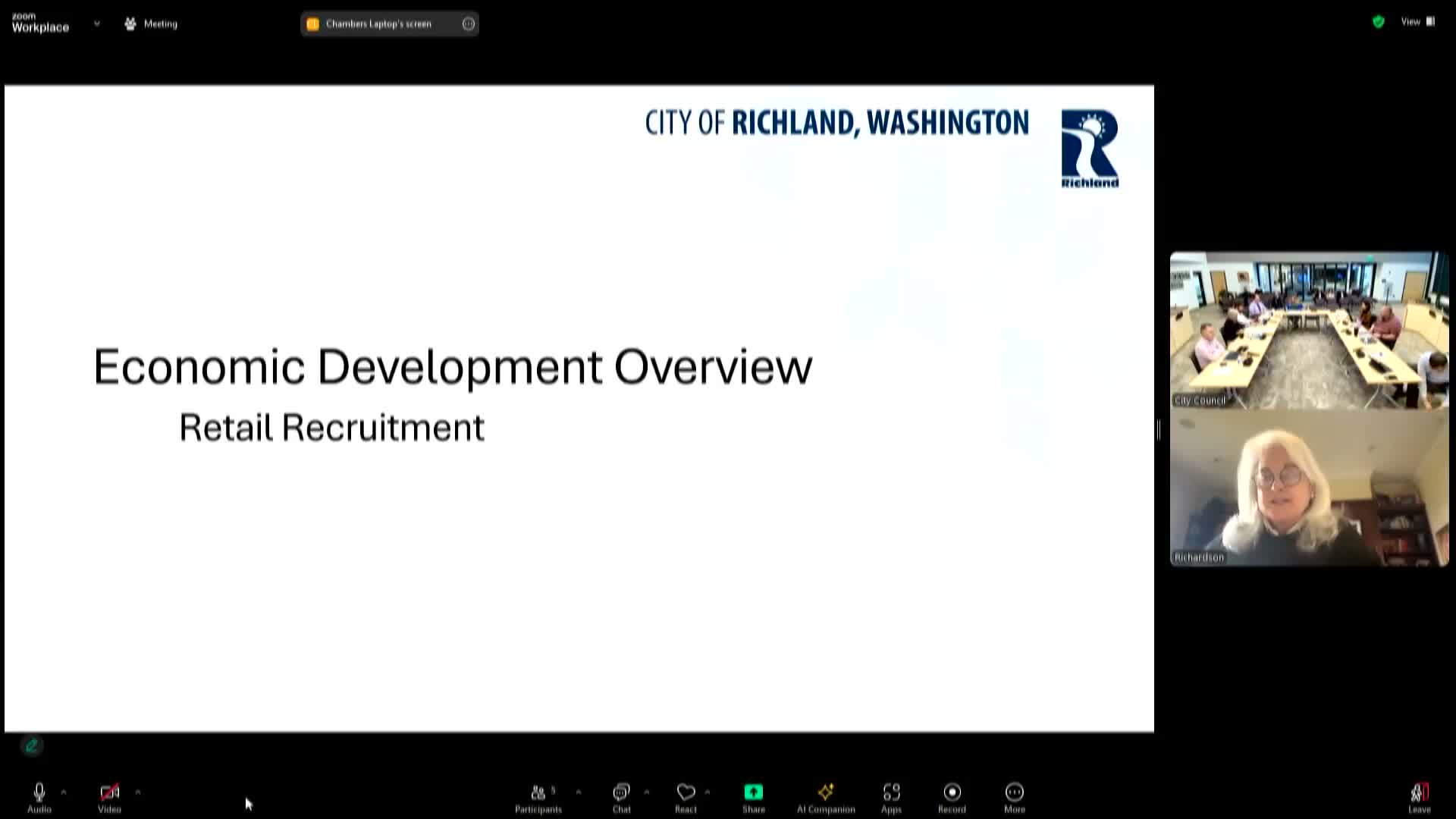
Richland’s economic development staff and a contracted retail‑recruitment firm presented a strategy to attract national and regional retailers to the city at an Oct. 28 workshop.
Amanda Wilmer, who led the city’s economic development overview, said the program focuses on ‘‘the creation of jobs and, of course, the expansion of our tax base,’’ and described a mix of business‑retention work, industrial recruitment and a targeted retail program that uses grants and a commercial‑façade fund to support storefront improvements.
Brooke Hill of Veil Strategies, the city’s retail consultant, described the firm’s approach: demographic and drive‑time analyses using the same site‑selection software retailers use, mobile‑tracking data to draw custom trade areas, a boots‑on‑the‑ground property catalog, and direct outreach to tenant representatives and retail real‑estate directors. ‘‘We come, we’re driving the market. We meet with Mandy and her team as the local experts,’’ Hill said.
John Mark Boozer, the firm’s market lead, walked council through a typical retail timeline: from initial market identification and tenant‑representative engagement through letters of intent, pro formas and eventual lease or purchase. Boozer called the slide a ‘‘retail 101’’ roadmap and said deals can close in ‘‘6 months’’ or take ‘‘6 years’’ depending on site readiness and tenant requirements.
Hill and Boozer said Veil Strategies has contacted more than 100 prospects since the partnership began in 2023 and currently tracks 14 retailers with varying levels of interest. The roster, shown in general categories for the public meeting, included seven food‑and‑beverage prospects (full‑service to QSR), two general‑merchandise concepts, experiential retailers, a specialty grocer and a health/fitness brand. In a public example they cited 5 Below as an opportunistic retailer that filled second‑generation space after Party City closed in the region.
Wilmer told the council she maintains a wish list of preferred concepts—specialty downtown grocers, a pharmacy and some higher‑end auto dealerships—and urged council members and residents to submit leads. When asked whether CityView or Tracks D and E would see commercial construction first, Wilmer said, ‘‘I think you'll see CityView first mostly because it's a greenfield site and it's ready for development.’’
Council members asked how the city ensures the consultant‑gathered data remains public. Hill said Veil Strategies ‘‘see[s] ourselves as your data concierge’’ and confirmed the city retains the data collected under the contract.
Councilors also pressed the consultants on how e‑commerce and omnichannel retailing affect recruitment. Boozer and Hill said many retailers still value a physical presence for services and omnichannel operations — smaller showrooms, distribution‑adjacent footprints, or reduced build‑outs — and that these changing formats are integrated into their site‑selection work.
Wilmer and consultants tied retail recruitment to other city priorities: leveraging the Northwest Advanced Clean Energy Park to attract supply‑chain manufacturers, coordinating with Washington State University to develop workforce pipelines, and using lodging‑tax and façade grants to support local business growth.
The council did not take formal action at the workshop. Staff said they will continue outreach, update the city’s property catalog and bring future recruitment milestones back to the council for review.
Amanda Wilmer, who led the city’s economic development overview, said the program focuses on ‘‘the creation of jobs and, of course, the expansion of our tax base,’’ and described a mix of business‑retention work, industrial recruitment and a targeted retail program that uses grants and a commercial‑façade fund to support storefront improvements.
Brooke Hill of Veil Strategies, the city’s retail consultant, described the firm’s approach: demographic and drive‑time analyses using the same site‑selection software retailers use, mobile‑tracking data to draw custom trade areas, a boots‑on‑the‑ground property catalog, and direct outreach to tenant representatives and retail real‑estate directors. ‘‘We come, we’re driving the market. We meet with Mandy and her team as the local experts,’’ Hill said.
John Mark Boozer, the firm’s market lead, walked council through a typical retail timeline: from initial market identification and tenant‑representative engagement through letters of intent, pro formas and eventual lease or purchase. Boozer called the slide a ‘‘retail 101’’ roadmap and said deals can close in ‘‘6 months’’ or take ‘‘6 years’’ depending on site readiness and tenant requirements.
Hill and Boozer said Veil Strategies has contacted more than 100 prospects since the partnership began in 2023 and currently tracks 14 retailers with varying levels of interest. The roster, shown in general categories for the public meeting, included seven food‑and‑beverage prospects (full‑service to QSR), two general‑merchandise concepts, experiential retailers, a specialty grocer and a health/fitness brand. In a public example they cited 5 Below as an opportunistic retailer that filled second‑generation space after Party City closed in the region.
Wilmer told the council she maintains a wish list of preferred concepts—specialty downtown grocers, a pharmacy and some higher‑end auto dealerships—and urged council members and residents to submit leads. When asked whether CityView or Tracks D and E would see commercial construction first, Wilmer said, ‘‘I think you'll see CityView first mostly because it's a greenfield site and it's ready for development.’’
Council members asked how the city ensures the consultant‑gathered data remains public. Hill said Veil Strategies ‘‘see[s] ourselves as your data concierge’’ and confirmed the city retains the data collected under the contract.
Councilors also pressed the consultants on how e‑commerce and omnichannel retailing affect recruitment. Boozer and Hill said many retailers still value a physical presence for services and omnichannel operations — smaller showrooms, distribution‑adjacent footprints, or reduced build‑outs — and that these changing formats are integrated into their site‑selection work.
Wilmer and consultants tied retail recruitment to other city priorities: leveraging the Northwest Advanced Clean Energy Park to attract supply‑chain manufacturers, coordinating with Washington State University to develop workforce pipelines, and using lodging‑tax and façade grants to support local business growth.
The council did not take formal action at the workshop. Staff said they will continue outreach, update the city’s property catalog and bring future recruitment milestones back to the council for review.
View the Full Meeting & All Its Details
This article offers just a summary. Unlock complete video, transcripts, and insights as a Founder Member.
✓
Watch full, unedited meeting videos
✓
Search every word spoken in unlimited transcripts
✓
AI summaries & real-time alerts (all government levels)
✓
Permanent access to expanding government content
30-day money-back guarantee
