Alaska restarts DGGS geothermal program, presses for modern data and federal partnerships
April 28, 2026 | 2026 Legislature Alaska, Alaska
This article was created by AI summarizing key points discussed. AI makes mistakes, so for full details and context, please refer to the video of the full meeting. Please report any errors so we can fix them. Report an error »
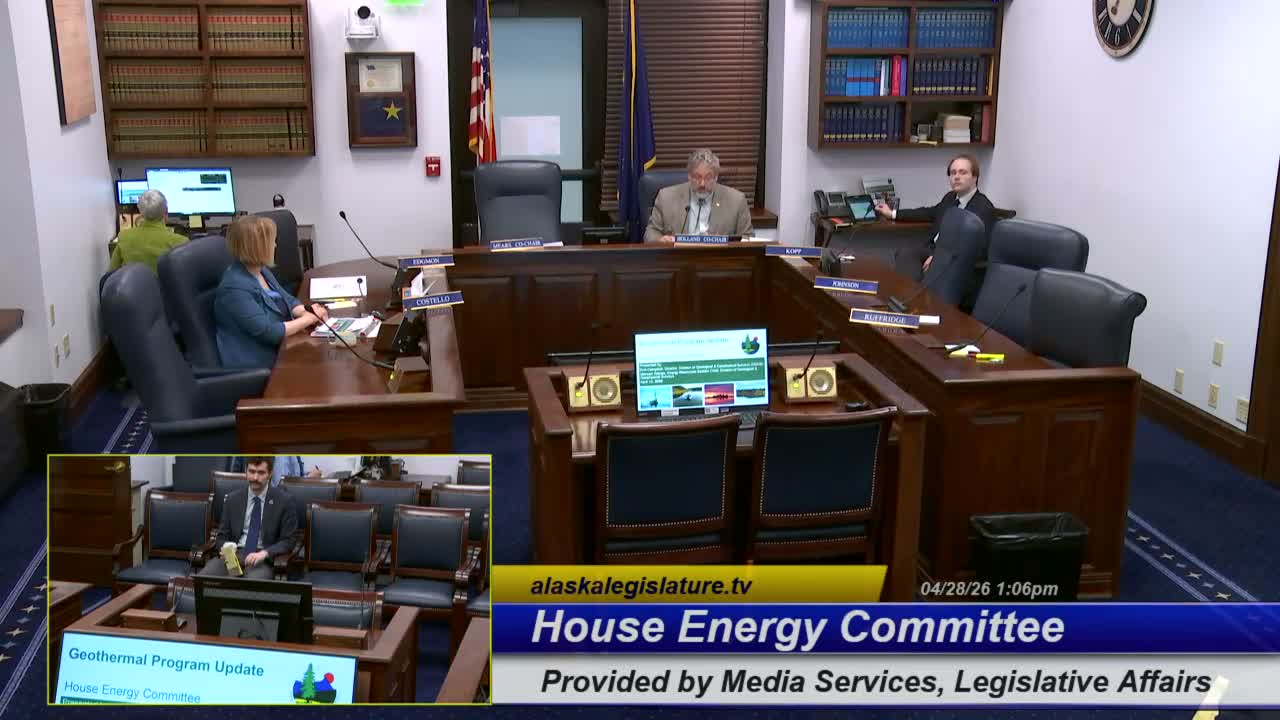
The Alaska House Energy Committee heard an update April 28 from Dr. Erin Campbell, chief geologist and director of the Division of Geological and Geophysical Surveys, on the state’s newly restarted geothermal program and the data-driven strategy intended to attract private and federal investment.
Campbell said the program was reauthorized for fiscal years 2025–2027 at $1,000,000 per year and staffed to include a program manager hired in March 2025. "We are not approaching this as an academic question or a research problem, but working for the best return on investment for state dollars and to have a tangible effect on providing energy to Alaska's residents," Campbell said.
The nut of the DGGS approach is modern, publicly accessible baseline data. Marwan Mortis, energy resources section chief at DGGS, described a public geothermal database and web app that combines DGGS field data with Alaska Energy Authority infrastructure layers so users can screen prospects by both resource strength and connectivity to transmission or communities. "The platform allows users — whether a community, a developer, or an agency — to quickly screen locations around Alaska and identify areas with potential," Mortis said.
Why it matters: Alaska has varied geothermal opportunities — from high-temperature volcanic targets such as Augustine and Makushin to lower-temperature sites such as Pilgrim and Chena that already support direct-use applications. DGGS told lawmakers that decades-old, sparse subsurface data are the main barrier to development; the program’s immediate goal is to reduce exploration risk by collecting airborne electromagnetic and magnetic surveys, magnetotelluric data, hyperspectral airborne surveys, and targeted field geology.
Officials emphasized that the program is designed to leverage federal funding. Campbell said DGGS has two competitive proposals selected for Department of Energy Regional Partnerships for Geothermal Data funding and that successful federal awards could yield about a 4-to-1 return on each state dollar. DGGS staff and lawmakers also discussed cooperation with national laboratories, the U.S. Geological Survey and university partners (UAF and UAA) to target priority regions and deploy modern geophysical tools.
Committee members questioned how the database handles land status and transmission access; Mortis confirmed a land-status layer is included or planned and noted that protected federal lands (national parks, wildlife refuges) will rule out development in many high-temperature locales. Lawmakers pressed DGGS on how to ensure Alaskan firms and researchers benefit from the activity; DGGS said publicly available data, university collaboration and local recruiting are intended to reduce barriers for Alaska-based startups.
DGGS also announced outreach work: it formed an Alaska Regional Interest Group (about 65 members) to coordinate industry and stakeholder engagement and plans to host an international geothermal meeting in Anchorage next May to raise awareness and attract partners.
What’s next: DGGS said it is continuing recruitments for two open positions and will prioritize a handful of high-value regions (including Augustine and Spur) for more detailed investigation. The committee asked DGGS to return with details on prioritization and how the program will connect data production to Alaska-based economic opportunities.
No formal votes occurred on April 28; the presentation ended with committee members encouraging continued coordination among DGGS, DNR leasing authorities, universities and federal partners.
Campbell said the program was reauthorized for fiscal years 2025–2027 at $1,000,000 per year and staffed to include a program manager hired in March 2025. "We are not approaching this as an academic question or a research problem, but working for the best return on investment for state dollars and to have a tangible effect on providing energy to Alaska's residents," Campbell said.
The nut of the DGGS approach is modern, publicly accessible baseline data. Marwan Mortis, energy resources section chief at DGGS, described a public geothermal database and web app that combines DGGS field data with Alaska Energy Authority infrastructure layers so users can screen prospects by both resource strength and connectivity to transmission or communities. "The platform allows users — whether a community, a developer, or an agency — to quickly screen locations around Alaska and identify areas with potential," Mortis said.
Why it matters: Alaska has varied geothermal opportunities — from high-temperature volcanic targets such as Augustine and Makushin to lower-temperature sites such as Pilgrim and Chena that already support direct-use applications. DGGS told lawmakers that decades-old, sparse subsurface data are the main barrier to development; the program’s immediate goal is to reduce exploration risk by collecting airborne electromagnetic and magnetic surveys, magnetotelluric data, hyperspectral airborne surveys, and targeted field geology.
Officials emphasized that the program is designed to leverage federal funding. Campbell said DGGS has two competitive proposals selected for Department of Energy Regional Partnerships for Geothermal Data funding and that successful federal awards could yield about a 4-to-1 return on each state dollar. DGGS staff and lawmakers also discussed cooperation with national laboratories, the U.S. Geological Survey and university partners (UAF and UAA) to target priority regions and deploy modern geophysical tools.
Committee members questioned how the database handles land status and transmission access; Mortis confirmed a land-status layer is included or planned and noted that protected federal lands (national parks, wildlife refuges) will rule out development in many high-temperature locales. Lawmakers pressed DGGS on how to ensure Alaskan firms and researchers benefit from the activity; DGGS said publicly available data, university collaboration and local recruiting are intended to reduce barriers for Alaska-based startups.
DGGS also announced outreach work: it formed an Alaska Regional Interest Group (about 65 members) to coordinate industry and stakeholder engagement and plans to host an international geothermal meeting in Anchorage next May to raise awareness and attract partners.
What’s next: DGGS said it is continuing recruitments for two open positions and will prioritize a handful of high-value regions (including Augustine and Spur) for more detailed investigation. The committee asked DGGS to return with details on prioritization and how the program will connect data production to Alaska-based economic opportunities.
No formal votes occurred on April 28; the presentation ended with committee members encouraging continued coordination among DGGS, DNR leasing authorities, universities and federal partners.
View the Full Meeting & All Its Details
This article offers just a summary. Unlock complete video, transcripts, and insights as a Founder Member.
✓
Watch full, unedited meeting videos
✓
Search every word spoken in unlimited transcripts
✓
AI summaries & real-time alerts (all government levels)
✓
Permanent access to expanding government content
30-day money-back guarantee
