Experts tell Alaska committee geological hydrogen could be 'transformational'; lawmakers urged to plan licensing and pilot work
April 28, 2026 | 2026 Legislature Alaska, Alaska
This article was created by AI summarizing key points discussed. AI makes mistakes, so for full details and context, please refer to the video of the full meeting. Please report any errors so we can fix them. Report an error »
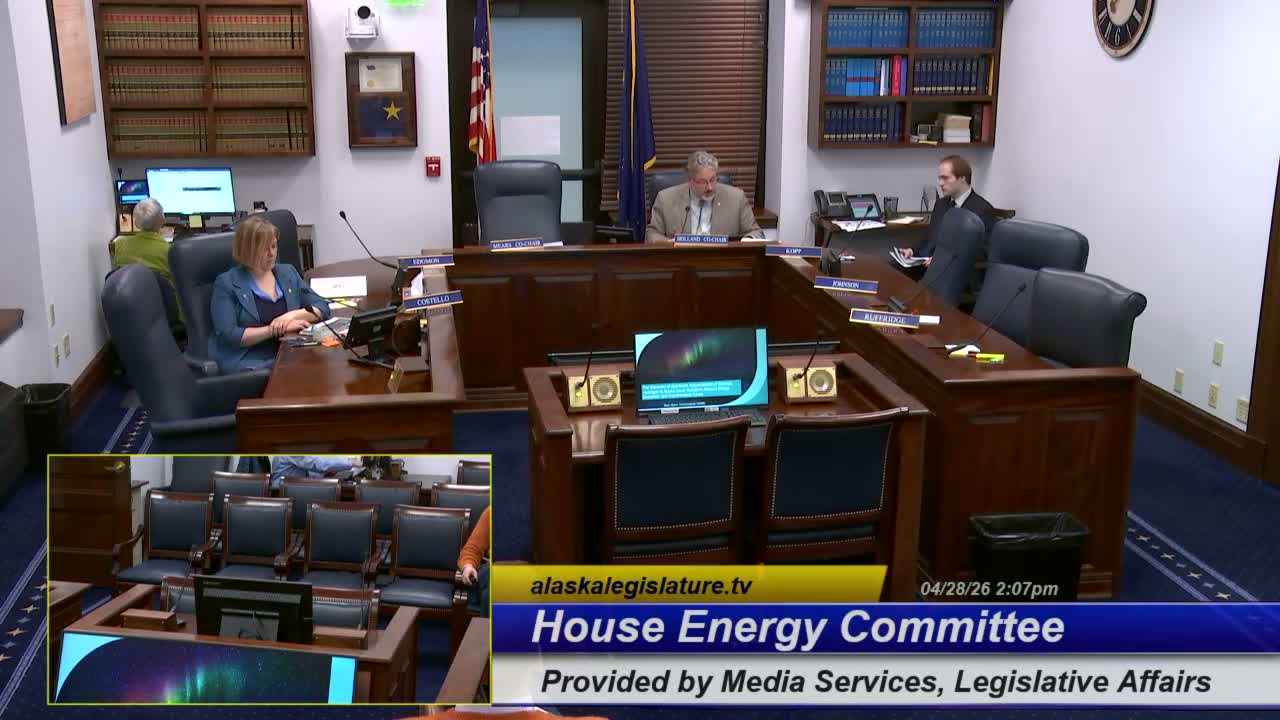
Dr. Mark Myers, a member of the U.S. Arctic Research Commission and former Alaska Department of Natural Resources commissioner, told the House Energy Committee on April 28 that geological hydrogen — naturally occurring hydrogen gas trapped underground — is an emerging global resource that could be "transformational for Alaska's energy future" if economic accumulations are confirmed.
Myers summarized three natural generation mechanisms (serpentinization of iron-rich igneous rocks, radiolysis in radioactive granites, and stimulated production by injection and fracturing) and cited recent global drilling activity. He told the committee the U.S. Geological Survey and other national labs are now mapping hydrogen potential and that a USGS assessment of Alaska is expected to be released following peer review.
Economic promise and practical constraints: Myers said DOE and other analyses estimate geologic hydrogen production could be far cheaper than electrolytic hydrogen, citing an illustrative DOE mean estimate near $0.60 per kilogram and noting some estimates place production below $1 per kilogram. He emphasized uncertainty: public well flow-test data are sparse and many private-sector tests are not yet released.
Myers also described practical transport and storage issues: hydrogen can be blended with natural gas only to limited percentages (about 20%) because high hydrogen content can embrittle pipeline steel; alternatives include conversion to ammonia or other carrier forms and underground storage in suitable reservoirs. "There are a lot of ways to ship and store it... converting to ammonia is one option," he said.
Policy and next steps recommended: Myers urged the legislature and state agencies to begin preparatory work now — to fund a few technical positions in DGGS and related agencies, to task DNR with evaluating licensing and royalty options, and to support UAF and national-lab partnerships for integrated pilot projects. He suggested the state consider a coordinator (possibly in the governor's office) or a small legislative-supported office to link multiple resource and data programs and pursue AI-driven data integration.
Why it matters: If Alaska's geology preserves economic hydrogen accumulations, the resource could supply local industrial needs (mines, bases, villages), feed fertilizer production or transport fuels, and become an export commodity. Myers and the committee agreed that unlocking that potential will require pilot drilling, economic feasibility studies, clear environmental standards, and a licensing framework.
No binding action was taken; the committee requested further coordination and follow-up on university proposals and federal mapping efforts.
Myers summarized three natural generation mechanisms (serpentinization of iron-rich igneous rocks, radiolysis in radioactive granites, and stimulated production by injection and fracturing) and cited recent global drilling activity. He told the committee the U.S. Geological Survey and other national labs are now mapping hydrogen potential and that a USGS assessment of Alaska is expected to be released following peer review.
Economic promise and practical constraints: Myers said DOE and other analyses estimate geologic hydrogen production could be far cheaper than electrolytic hydrogen, citing an illustrative DOE mean estimate near $0.60 per kilogram and noting some estimates place production below $1 per kilogram. He emphasized uncertainty: public well flow-test data are sparse and many private-sector tests are not yet released.
Myers also described practical transport and storage issues: hydrogen can be blended with natural gas only to limited percentages (about 20%) because high hydrogen content can embrittle pipeline steel; alternatives include conversion to ammonia or other carrier forms and underground storage in suitable reservoirs. "There are a lot of ways to ship and store it... converting to ammonia is one option," he said.
Policy and next steps recommended: Myers urged the legislature and state agencies to begin preparatory work now — to fund a few technical positions in DGGS and related agencies, to task DNR with evaluating licensing and royalty options, and to support UAF and national-lab partnerships for integrated pilot projects. He suggested the state consider a coordinator (possibly in the governor's office) or a small legislative-supported office to link multiple resource and data programs and pursue AI-driven data integration.
Why it matters: If Alaska's geology preserves economic hydrogen accumulations, the resource could supply local industrial needs (mines, bases, villages), feed fertilizer production or transport fuels, and become an export commodity. Myers and the committee agreed that unlocking that potential will require pilot drilling, economic feasibility studies, clear environmental standards, and a licensing framework.
No binding action was taken; the committee requested further coordination and follow-up on university proposals and federal mapping efforts.
View the Full Meeting & All Its Details
This article offers just a summary. Unlock complete video, transcripts, and insights as a Founder Member.
✓
Watch full, unedited meeting videos
✓
Search every word spoken in unlimited transcripts
✓
AI summaries & real-time alerts (all government levels)
✓
Permanent access to expanding government content
30-day money-back guarantee
