Presenter outlines state tools to curb hospital and drug price growth
April 27, 2026 | 2026 Legislature Alaska, Alaska
This article was created by AI summarizing key points discussed. AI makes mistakes, so for full details and context, please refer to the video of the full meeting. Please report any errors so we can fix them. Report an error »
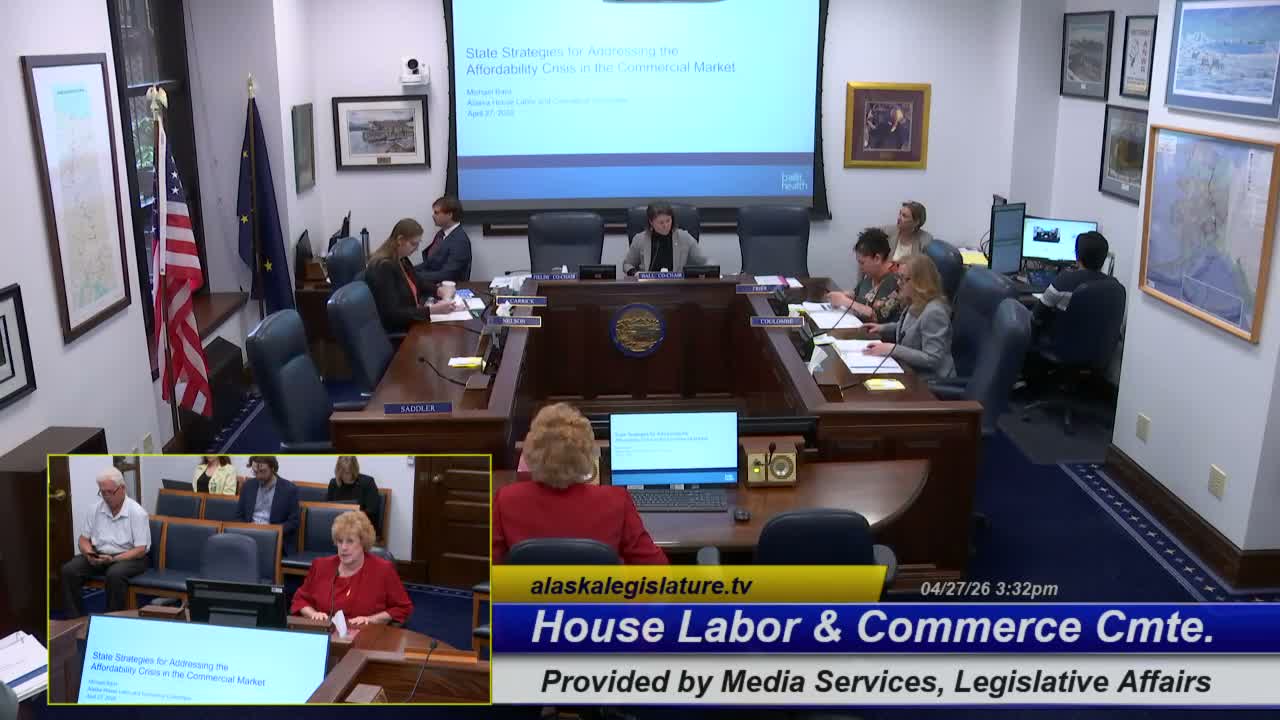
Michael Ballet, presenting remotely as a consultant from Ballet Health, told the House Labor and Commerce Committee on April 27 that hospital and pharmacy spending are the dominant drivers of commercial health‑insurance cost growth and reviewed a range of state strategies to address them.
Ballet said national surveys show many people skip care or prescriptions because of cost and that about 4 in 10 adults report medical debt. He told the committee Alaska is among the states with the highest premiums and noted that roughly half of commercial spending goes to hospitals — a share that rises if physician practices owned by hospitals are counted.
“Hospital and pharmacy spending are the twin drivers of spending growth,” Ballet said, summarizing cross‑state experience. He described three implementation paths for price limits: use state purchasing power (for public plans), insurance‑department rules for fully insured plans, or direct provider price regulation. He cited Indiana and New Mexico as recent examples and noted Oregon’s 2019 public‑plan cap (200% of Medicare, 185% out‑of‑network) has been associated—per a 2024 evaluation—with reduced spending and no evidence hospitals left public‑plan networks.
Ballet also reviewed price‑growth caps (limits on how rapidly prices may rise, often tied to CPI), site‑neutral payment policies and bans on facility fees when hospitals acquire outpatient practices. He said Rhode Island’s longstanding price‑growth limit (CPI + 1%) was linked to average annual savings and a decline in hospital prices in the state versus neighboring Massachusetts.
Committee members asked about potential unintended consequences, including whether caps could push providers out of network or shift costs to other payers. Ballet cautioned that many of the policies are new and outcomes can vary by scope and design; some legal challenges have arisen (he noted Colorado has defended pharmacy price limits in court so far).
Cochair Fields raised concerns about private‑nonprofit systems’ profitability in Alaska, citing data that Providence’s Alaska operations had higher margins than in other regions; Ballet said vertical integration and private‑equity ownership can complicate oversight and hide profit taking.
Ballet concluded by pointing committee members to resources (state hubs, Peterson‑Milbank, Yale’s affordability lab) and offered follow‑up. Cochair Hall said the presentation gives the committee material to explore further during the interim.
The presentation was informational; the committee did not take formal action on pricing policy during the hearing.
Ballet said national surveys show many people skip care or prescriptions because of cost and that about 4 in 10 adults report medical debt. He told the committee Alaska is among the states with the highest premiums and noted that roughly half of commercial spending goes to hospitals — a share that rises if physician practices owned by hospitals are counted.
“Hospital and pharmacy spending are the twin drivers of spending growth,” Ballet said, summarizing cross‑state experience. He described three implementation paths for price limits: use state purchasing power (for public plans), insurance‑department rules for fully insured plans, or direct provider price regulation. He cited Indiana and New Mexico as recent examples and noted Oregon’s 2019 public‑plan cap (200% of Medicare, 185% out‑of‑network) has been associated—per a 2024 evaluation—with reduced spending and no evidence hospitals left public‑plan networks.
Ballet also reviewed price‑growth caps (limits on how rapidly prices may rise, often tied to CPI), site‑neutral payment policies and bans on facility fees when hospitals acquire outpatient practices. He said Rhode Island’s longstanding price‑growth limit (CPI + 1%) was linked to average annual savings and a decline in hospital prices in the state versus neighboring Massachusetts.
Committee members asked about potential unintended consequences, including whether caps could push providers out of network or shift costs to other payers. Ballet cautioned that many of the policies are new and outcomes can vary by scope and design; some legal challenges have arisen (he noted Colorado has defended pharmacy price limits in court so far).
Cochair Fields raised concerns about private‑nonprofit systems’ profitability in Alaska, citing data that Providence’s Alaska operations had higher margins than in other regions; Ballet said vertical integration and private‑equity ownership can complicate oversight and hide profit taking.
Ballet concluded by pointing committee members to resources (state hubs, Peterson‑Milbank, Yale’s affordability lab) and offered follow‑up. Cochair Hall said the presentation gives the committee material to explore further during the interim.
The presentation was informational; the committee did not take formal action on pricing policy during the hearing.
Don't Miss a Word: See the Full Meeting!
Go beyond summaries. Unlock every video, transcript, and key insight with a Founder Membership.
✓
Get instant access to full meeting videos
✓
Search and clip any phrase from complete transcripts
✓
Receive AI-powered summaries & custom alerts
✓
Enjoy lifetime, unrestricted access to government data
30-day money-back guarantee
