Senate committee advances optional caps on assessment growth, drawing mixed testimony
April 27, 2026 | 2026 Legislature Alaska, Alaska
This article was created by AI summarizing key points discussed. AI makes mistakes, so for full details and context, please refer to the video of the full meeting. Please report any errors so we can fix them. Report an error »
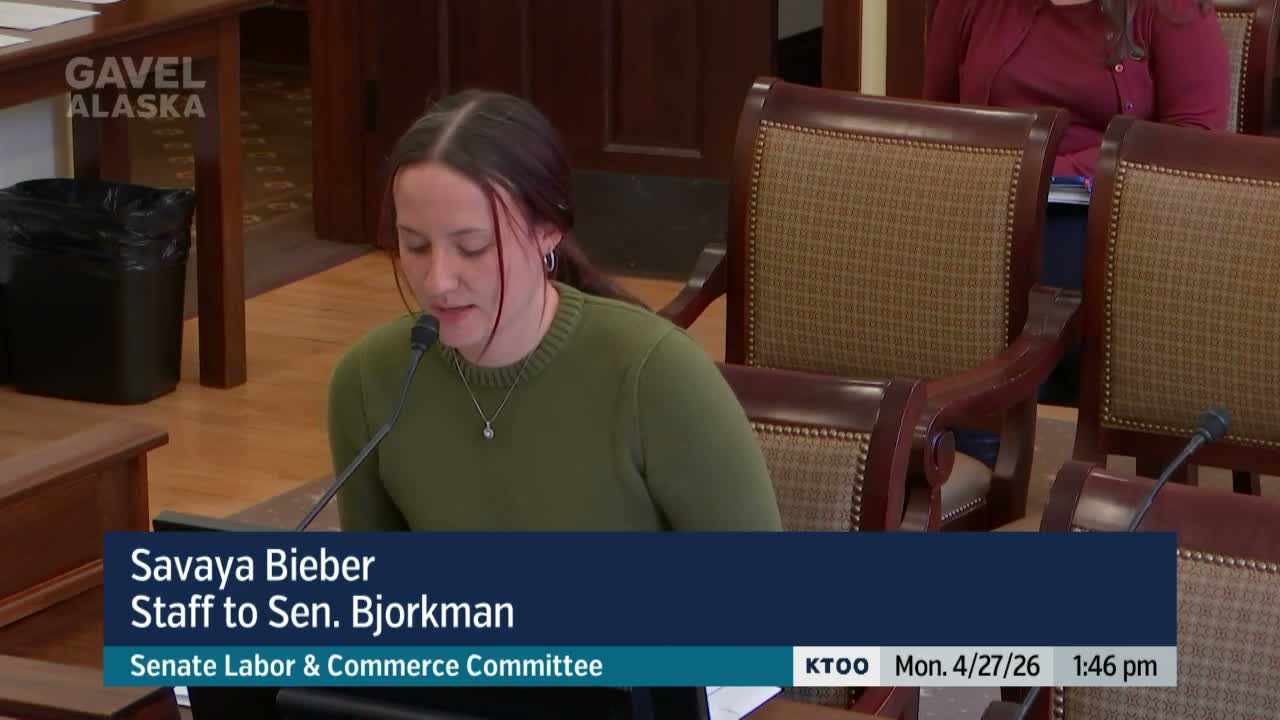
The Senate Labor and Commerce Committee on April 27 reported a committee substitute for Senate Bill 259, a measure that would let municipalities enact ordinances capping annual increases in property assessment values at a rate between 3% and 10% and require a 10-year true-up to align values with market conditions.
Sevea Bieber, staff to Chair Bjorkman, told the committee the bill would "provide municipalities with the authority to cap yearly increases and assess property values by 3 to 10%" and that the cap "would reflect full and true value" with a required true-up every 10 years or sooner on transfer or removal. After public testimony, a committee member moved to report the committee substitute with individual recommendations and an indeterminate fiscal note; with no objections, the substitute was reported from committee.
Public commenters and a professional association urged caution. Ed Martin Jr., a resident of Kenai, told the committee, "It's the mill rate, and you folks know this," arguing that rising taxes reflect mill rates rather than assessed value alone and urging the committee to re-read statutes under Title 29 before advancing the bill. Aaron Lambich, president of the Alaska Association of Assessing Officers, cautioned that assessment caps "create long term inequities," shift tax burdens to new buyers and slower-growth areas, and add administrative complexity; he recommended targeted relief such as homestead exemptions, circuit breakers or deferral programs and improved sales disclosure and oversight.
Chair Bjorkman, addressing concerns about caps, said the committee substitute is not a hard cap but an optional smoothing mechanism intended to prevent sudden tax shocks for property owners. He emphasized the bill includes a 10-year true-up to avoid the persistent inequities associated with hard caps and argued municipalities have limited practical options for changing mill rates quickly to respond to revenue needs.
Next steps: the committee reported the substitute for SB 259 from committee and the measure will proceed to further consideration in the legislative process.
Sevea Bieber, staff to Chair Bjorkman, told the committee the bill would "provide municipalities with the authority to cap yearly increases and assess property values by 3 to 10%" and that the cap "would reflect full and true value" with a required true-up every 10 years or sooner on transfer or removal. After public testimony, a committee member moved to report the committee substitute with individual recommendations and an indeterminate fiscal note; with no objections, the substitute was reported from committee.
Public commenters and a professional association urged caution. Ed Martin Jr., a resident of Kenai, told the committee, "It's the mill rate, and you folks know this," arguing that rising taxes reflect mill rates rather than assessed value alone and urging the committee to re-read statutes under Title 29 before advancing the bill. Aaron Lambich, president of the Alaska Association of Assessing Officers, cautioned that assessment caps "create long term inequities," shift tax burdens to new buyers and slower-growth areas, and add administrative complexity; he recommended targeted relief such as homestead exemptions, circuit breakers or deferral programs and improved sales disclosure and oversight.
Chair Bjorkman, addressing concerns about caps, said the committee substitute is not a hard cap but an optional smoothing mechanism intended to prevent sudden tax shocks for property owners. He emphasized the bill includes a 10-year true-up to avoid the persistent inequities associated with hard caps and argued municipalities have limited practical options for changing mill rates quickly to respond to revenue needs.
Next steps: the committee reported the substitute for SB 259 from committee and the measure will proceed to further consideration in the legislative process.
Don't Miss a Word: See the Full Meeting!
Go beyond summaries. Unlock every video, transcript, and key insight with a Founder Membership.
✓
Get instant access to full meeting videos
✓
Search and clip any phrase from complete transcripts
✓
Receive AI-powered summaries & custom alerts
✓
Enjoy lifetime, unrestricted access to government data
30-day money-back guarantee
