Senate committee hears details of SB66 to pilot state-tribal education compacts; bill held for further work
April 27, 2026 | 2026 Legislature Alaska, Alaska
This article was created by AI summarizing key points discussed. AI makes mistakes, so for full details and context, please refer to the video of the full meeting. Please report any errors so we can fix them. Report an error »
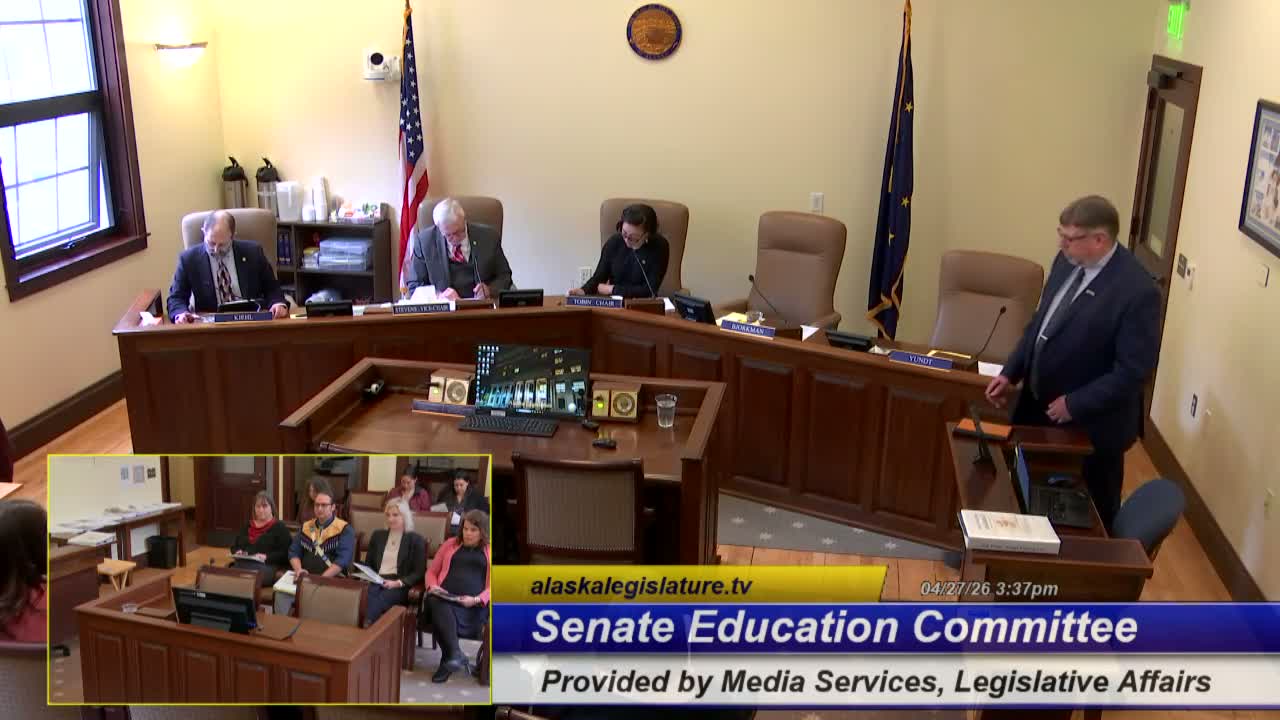
Chair Tobin opened a second hearing on SB66, which would authorize a demonstration program allowing the Department of Education and Early Development to negotiate and execute state-tribal education compacts that create tribally compacted public schools operating as local education agencies.
Joel Isaac, compacting consultant for the department, walked the committee through the bill’s uncodified structure and practical mechanics. He said the demonstration uses a seven-year window — two years for startup and five years of operation — and that compacts must be in effect by June 30, 2028. "Is this what's best for kids?" Isaac said was a guiding question during negotiations.
Commissioner Dina Bishop described certification provisions in the bill and how they interact with existing state rules. She explained that some certificate types may be requested by individuals while other types (Type I and Type M in the bill text) require a school district request after hiring. Bishop also confirmed that the bill ties many operational requirements to Title 14 obligations — including compulsory attendance, fiscal audits, non-discrimination, school safety, special education obligations and teacher retirement participation — while using an uncodified mechanism to limit or specify which parts of Title 14 apply.
The bill designates a federally recognized tribe or tribal organization as the school district for purposes of providing appropriate services, establishes a tribal governing body or school board for compacted schools, and requires compacted schools to meet public-access, health, safety and fire-code standards. It also authorizes the legislature to appropriate funds to compacted schools in the same manner as a regional education attendance area and aligns the schools with federal LEA terminology so they remain eligible for federal funds under the Every Student Succeeds Act.
Heather Heineken, director of finance and support services for the department, presented three fiscal notes prepared by the department. Using a 2027 base student allocation (BSA) of $6,660 and projected average daily membership (ADM) from five tribes that have expressed interest, the department estimated a 2027 one-time startup grant total of $5,960,700, foundation-formula funding totaling $13,277,900 and combined 2027 costs of $19,238,600. Ongoing foundation funding for 2028–2032 was projected at about $13,277,000 annually. Heineken said transportation grants would be allocated per pupil and are expected to be neutral to the public education fund because payments to compacted schools would be offset by corresponding decreases to the associated districts.
Committee members pressed presenters on local fiscal impacts and hold-harmless protections. Chair Tobin raised concerns that students moving into a compacted LEA could reduce funding and staffing for the originating district (Nome was used as an example). Isaac and Bishop said the department has discussed shared-use agreements and potential hold-harmless mechanisms with superintendents and tribal partners; they noted those arrangements and exact fiscal impacts are dependent on enrollment distribution and the legislature’s policy decisions. Heineken agreed to attempt further modeling and provide additional numbers for members.
Members also sought clarification about correspondence programs and geographic limits; presenters said a compacted correspondence school must be headquartered in Alaska and that correspondence arrangements should be negotiated as part of the compact. Isaac pointed to existing correspondence programs and tribal-run charters (examples discussed in Mat-Su and North Slope) as models informing the pilot’s design.
The committee did not take final action on SB66. Chair Tobin said legislative legal staff identified drafting issues and statutory citation fixes that must be resolved; the committee held the bill to a future meeting and asked the department to work with the chair’s office on amendments and additional fiscal detail.
The committee scheduled follow-up work and noted the pilot is intended as a research step to test funding, governance and instructional arrangements before any move to permanence.
Joel Isaac, compacting consultant for the department, walked the committee through the bill’s uncodified structure and practical mechanics. He said the demonstration uses a seven-year window — two years for startup and five years of operation — and that compacts must be in effect by June 30, 2028. "Is this what's best for kids?" Isaac said was a guiding question during negotiations.
Commissioner Dina Bishop described certification provisions in the bill and how they interact with existing state rules. She explained that some certificate types may be requested by individuals while other types (Type I and Type M in the bill text) require a school district request after hiring. Bishop also confirmed that the bill ties many operational requirements to Title 14 obligations — including compulsory attendance, fiscal audits, non-discrimination, school safety, special education obligations and teacher retirement participation — while using an uncodified mechanism to limit or specify which parts of Title 14 apply.
The bill designates a federally recognized tribe or tribal organization as the school district for purposes of providing appropriate services, establishes a tribal governing body or school board for compacted schools, and requires compacted schools to meet public-access, health, safety and fire-code standards. It also authorizes the legislature to appropriate funds to compacted schools in the same manner as a regional education attendance area and aligns the schools with federal LEA terminology so they remain eligible for federal funds under the Every Student Succeeds Act.
Heather Heineken, director of finance and support services for the department, presented three fiscal notes prepared by the department. Using a 2027 base student allocation (BSA) of $6,660 and projected average daily membership (ADM) from five tribes that have expressed interest, the department estimated a 2027 one-time startup grant total of $5,960,700, foundation-formula funding totaling $13,277,900 and combined 2027 costs of $19,238,600. Ongoing foundation funding for 2028–2032 was projected at about $13,277,000 annually. Heineken said transportation grants would be allocated per pupil and are expected to be neutral to the public education fund because payments to compacted schools would be offset by corresponding decreases to the associated districts.
Committee members pressed presenters on local fiscal impacts and hold-harmless protections. Chair Tobin raised concerns that students moving into a compacted LEA could reduce funding and staffing for the originating district (Nome was used as an example). Isaac and Bishop said the department has discussed shared-use agreements and potential hold-harmless mechanisms with superintendents and tribal partners; they noted those arrangements and exact fiscal impacts are dependent on enrollment distribution and the legislature’s policy decisions. Heineken agreed to attempt further modeling and provide additional numbers for members.
Members also sought clarification about correspondence programs and geographic limits; presenters said a compacted correspondence school must be headquartered in Alaska and that correspondence arrangements should be negotiated as part of the compact. Isaac pointed to existing correspondence programs and tribal-run charters (examples discussed in Mat-Su and North Slope) as models informing the pilot’s design.
The committee did not take final action on SB66. Chair Tobin said legislative legal staff identified drafting issues and statutory citation fixes that must be resolved; the committee held the bill to a future meeting and asked the department to work with the chair’s office on amendments and additional fiscal detail.
The committee scheduled follow-up work and noted the pilot is intended as a research step to test funding, governance and instructional arrangements before any move to permanence.
Don't Miss a Word: See the Full Meeting!
Go beyond summaries. Unlock every video, transcript, and key insight with a Founder Membership.
✓
Get instant access to full meeting videos
✓
Search and clip any phrase from complete transcripts
✓
Receive AI-powered summaries & custom alerts
✓
Enjoy lifetime, unrestricted access to government data
30-day money-back guarantee
