Senate committee hears wide-ranging fiscal analysis of SB 280’s AKLNG tax changes
April 27, 2026 | 2026 Legislature Alaska, Alaska
This article was created by AI summarizing key points discussed. AI makes mistakes, so for full details and context, please refer to the video of the full meeting. Please report any errors so we can fix them. Report an error »
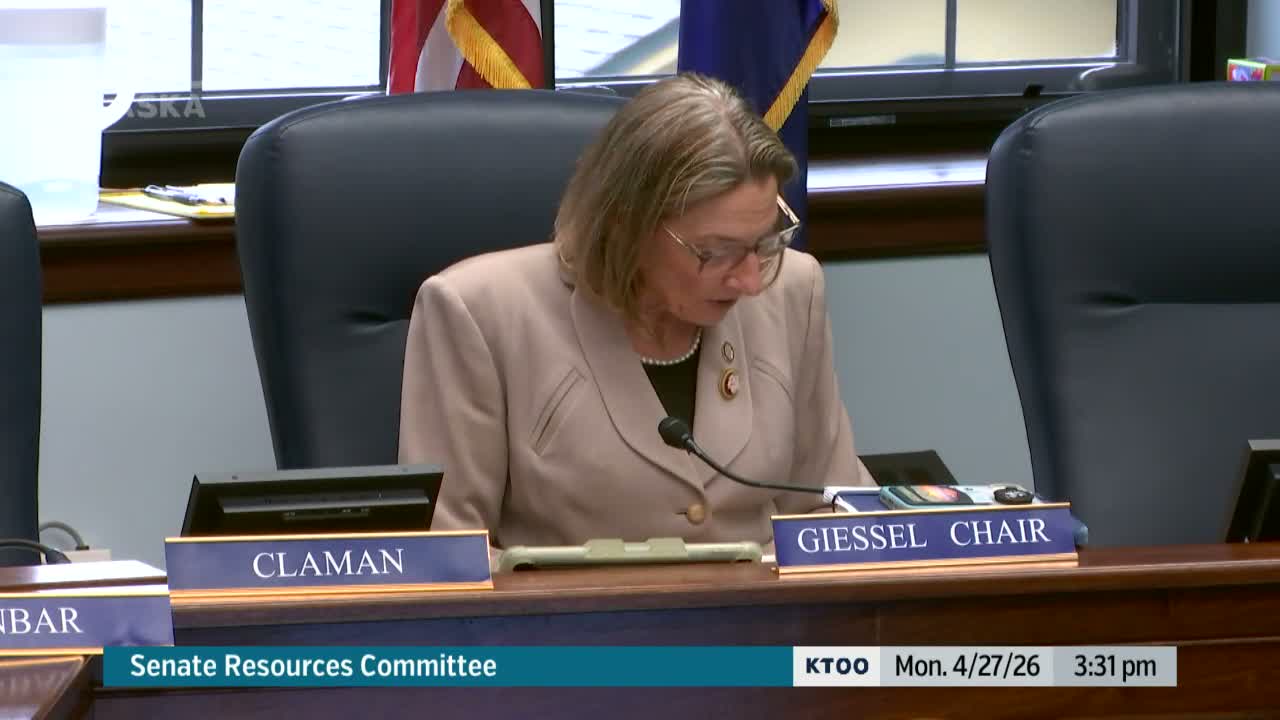
The Senate Resources Committee on April 27 heard a detailed presentation from the Department of Revenue about the committee substitute to Senate Bill 280, which would recast how the proposed Alaska natural gas project (AKLNG) is taxed and valued. Dan Stickel, chief economist in DOR’s tax division, led the briefing and framed the analysis as preliminary and highly dependent on future regulations.
Stickel told the committee “this bill would exempt the entire Alaska natural gas project from state and local property taxes,” and said the exemption would repeal if construction does not commence before 2028 or commercial operations do not begin before 2032. He said DOR’s fiscal note treats many provisions separately and that “it’s a very complex bill” whose ultimate revenue impacts hinge on regulatory choices.
Why it matters: the bill would shift the state’s approach to AKLNG revenue — removing a traditional property-tax base in favor of new levies and reporting duties that could change how much income flows to the state general fund, how municipalities are compensated, and how the state enforces tax and royalty collection.
Major provisions and DOR estimates
- Alternative volumetric tax: The committee substitute would permit an alternative volumetric levy in place of property tax. Stickel described rates of $0.15 per thousand cubic feet for the treatment plant and pipeline and $0.25 per thousand cubic feet for the LNG plant, fixed for 10 years and thereafter adjusted by the Anchorage CPI; under the substitute the state would levy the tax and share a portion with municipalities.
- Community impact fee: The bill would impose a $1,000,000 fee per mile of main pipeline installed prior to commercial operations. DOR modeled a phase‑1 pipeline of 739 miles and estimated, under certain interpretations, a maximum one-time revenue of about $739 million to fund DCCED-administered grants for impacted communities.
- Pass-through entity tax: The substitute would tax pass‑through oil and gas entities (S corporations, partnerships, LLCs) retroactive to the start of 2026, with brackets beginning at 5% and a top marginal rate aligned at roughly 9.4%. DOR gave a wide current-operations revenue range of $0 to $100 million per year, citing limited filing data and company‑specific uncertainty.
- Disallowance of gas lease expenditures: The bill would disallow lease expenditures deemed to be for gas (retroactive to 01/01/2026), a technical change that would require regulations to apportion costs between oil and gas and could affect current operators if broadly applied. Stickel said implementing such allocations could be administratively complex.
- Prevailing-value reporting and valuation: The bill would require DOR to base oil and gas valuation on fair market value for production-tax purposes and publish a monthly report by field, unit or area. DOR acknowledged industry concerns that detailed public valuation could raise antitrust or competitive issues and said regulations would be needed to specify methodology and limits of disclosure.
Lawmakers’ concerns and exchanges
Committee members repeatedly pressed DOR on (a) the legal and litigation risk from greater public reporting and new valuation rules, (b) whether the proposed tax structure leaves too much discretion to regulators, and (c) the practical effect on existing producers and on future investment decisions. Senator Cindy Myers asked whether the bill would increase the chance of lawsuits; Stickel replied that DOR believes “that’s a likelihood, or at least a distinct possibility” because of disputes over allocations and disclosure.
Senator Wilikowski repeatedly pressed for narrower revenue estimates and called DOR’s $0–$100 million annual range for the pass-through tax “quite a range.” Stickel said the wide interval reflects both the small number of potentially affected taxpayers and the lack of detailed tax-filing data available to DOR at this stage.
Several senators, including Senator Dunbar, said they are drafting amendments to clarify that the disallowance of gas lease expenditures should apply only to costs directly tied to gas sold into the AKLNG project — a change DOR said could reduce some impacts but would add regulatory complexity because it forces regulators to distinguish AKLNG‑related costs from ordinary operations.
Modeling assumptions and DOR capacity request
DOR described modeling assumptions used for scenario analysis. For example, DOR assumed that half of incremental upstream lease expenditures attributable to AKLNG would be deemed gas costs and that under that scenario incremental revenue could run between $0 and $50 million per year during most modeled years. Stickel emphasized those are modeling assumptions, not regulatory determinations.
Because the bill would add valuation, reporting and analytic responsibilities — and could require audits and litigation — Stickel said DOR expects to request additional resources to implement the bill’s requirements and to support the legislature in any state equity analysis.
Next steps
DOR agreed to return to the committee for further discussion and additional slides; the chair said the committee will continue the hearing Wednesday and will hear outside consultants (Gaffney Klein) the following morning. The committee adjourned at 5:01 p.m.
Provenance: This article is based on Department of Revenue testimony and committee exchanges in the Senate Resources Committee hearing on April 27, 2026; DOR presentation text and lawmakers’ questions were the primary sources.
Stickel told the committee “this bill would exempt the entire Alaska natural gas project from state and local property taxes,” and said the exemption would repeal if construction does not commence before 2028 or commercial operations do not begin before 2032. He said DOR’s fiscal note treats many provisions separately and that “it’s a very complex bill” whose ultimate revenue impacts hinge on regulatory choices.
Why it matters: the bill would shift the state’s approach to AKLNG revenue — removing a traditional property-tax base in favor of new levies and reporting duties that could change how much income flows to the state general fund, how municipalities are compensated, and how the state enforces tax and royalty collection.
Major provisions and DOR estimates
- Alternative volumetric tax: The committee substitute would permit an alternative volumetric levy in place of property tax. Stickel described rates of $0.15 per thousand cubic feet for the treatment plant and pipeline and $0.25 per thousand cubic feet for the LNG plant, fixed for 10 years and thereafter adjusted by the Anchorage CPI; under the substitute the state would levy the tax and share a portion with municipalities.
- Community impact fee: The bill would impose a $1,000,000 fee per mile of main pipeline installed prior to commercial operations. DOR modeled a phase‑1 pipeline of 739 miles and estimated, under certain interpretations, a maximum one-time revenue of about $739 million to fund DCCED-administered grants for impacted communities.
- Pass-through entity tax: The substitute would tax pass‑through oil and gas entities (S corporations, partnerships, LLCs) retroactive to the start of 2026, with brackets beginning at 5% and a top marginal rate aligned at roughly 9.4%. DOR gave a wide current-operations revenue range of $0 to $100 million per year, citing limited filing data and company‑specific uncertainty.
- Disallowance of gas lease expenditures: The bill would disallow lease expenditures deemed to be for gas (retroactive to 01/01/2026), a technical change that would require regulations to apportion costs between oil and gas and could affect current operators if broadly applied. Stickel said implementing such allocations could be administratively complex.
- Prevailing-value reporting and valuation: The bill would require DOR to base oil and gas valuation on fair market value for production-tax purposes and publish a monthly report by field, unit or area. DOR acknowledged industry concerns that detailed public valuation could raise antitrust or competitive issues and said regulations would be needed to specify methodology and limits of disclosure.
Lawmakers’ concerns and exchanges
Committee members repeatedly pressed DOR on (a) the legal and litigation risk from greater public reporting and new valuation rules, (b) whether the proposed tax structure leaves too much discretion to regulators, and (c) the practical effect on existing producers and on future investment decisions. Senator Cindy Myers asked whether the bill would increase the chance of lawsuits; Stickel replied that DOR believes “that’s a likelihood, or at least a distinct possibility” because of disputes over allocations and disclosure.
Senator Wilikowski repeatedly pressed for narrower revenue estimates and called DOR’s $0–$100 million annual range for the pass-through tax “quite a range.” Stickel said the wide interval reflects both the small number of potentially affected taxpayers and the lack of detailed tax-filing data available to DOR at this stage.
Several senators, including Senator Dunbar, said they are drafting amendments to clarify that the disallowance of gas lease expenditures should apply only to costs directly tied to gas sold into the AKLNG project — a change DOR said could reduce some impacts but would add regulatory complexity because it forces regulators to distinguish AKLNG‑related costs from ordinary operations.
Modeling assumptions and DOR capacity request
DOR described modeling assumptions used for scenario analysis. For example, DOR assumed that half of incremental upstream lease expenditures attributable to AKLNG would be deemed gas costs and that under that scenario incremental revenue could run between $0 and $50 million per year during most modeled years. Stickel emphasized those are modeling assumptions, not regulatory determinations.
Because the bill would add valuation, reporting and analytic responsibilities — and could require audits and litigation — Stickel said DOR expects to request additional resources to implement the bill’s requirements and to support the legislature in any state equity analysis.
Next steps
DOR agreed to return to the committee for further discussion and additional slides; the chair said the committee will continue the hearing Wednesday and will hear outside consultants (Gaffney Klein) the following morning. The committee adjourned at 5:01 p.m.
Provenance: This article is based on Department of Revenue testimony and committee exchanges in the Senate Resources Committee hearing on April 27, 2026; DOR presentation text and lawmakers’ questions were the primary sources.
Don't Miss a Word: See the Full Meeting!
Go beyond summaries. Unlock every video, transcript, and key insight with a Founder Membership.
✓
Get instant access to full meeting videos
✓
Search and clip any phrase from complete transcripts
✓
Receive AI-powered summaries & custom alerts
✓
Enjoy lifetime, unrestricted access to government data
30-day money-back guarantee
