House Resources committee adopts substitute for HB 381, rewrites tax treatment for Alaska LNG project
April 27, 2026 | 2026 Legislature Alaska, Alaska
This article was created by AI summarizing key points discussed. AI makes mistakes, so for full details and context, please refer to the video of the full meeting. Please report any errors so we can fix them. Report an error »
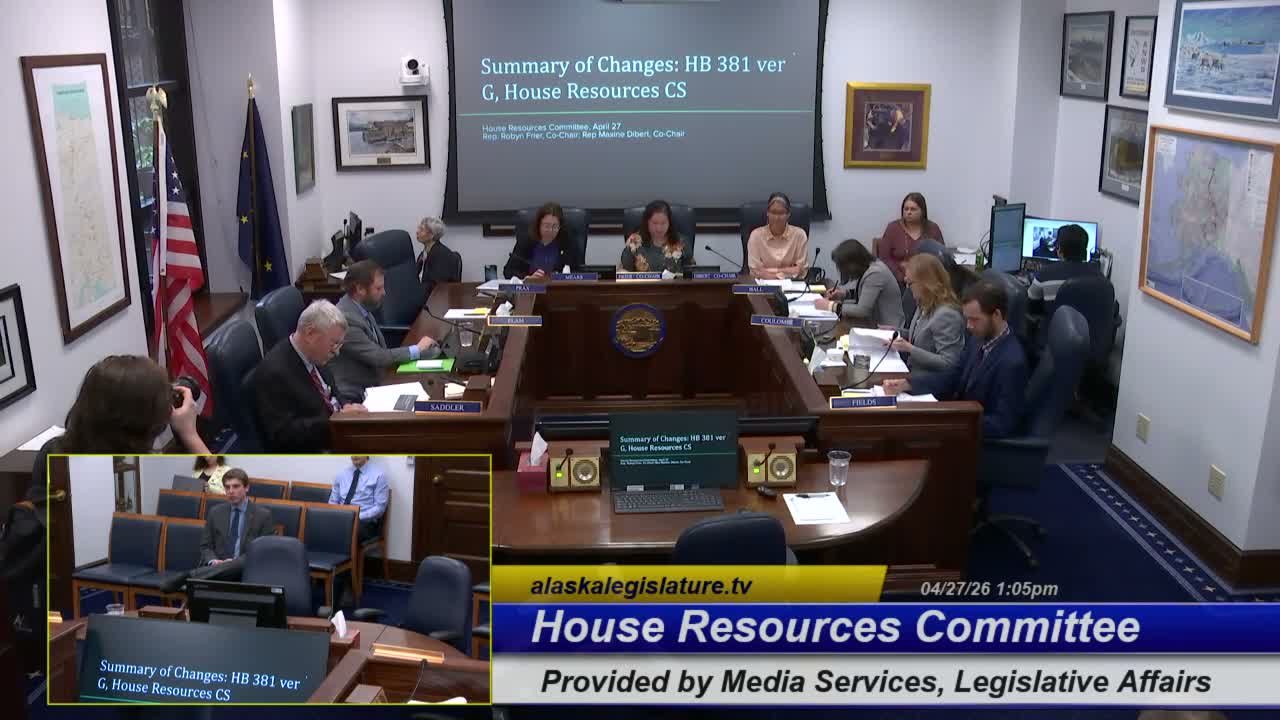
The House Resources Committee on Monday adopted a committee substitute for House Bill 381 that redesigns how the Alaska LNG project would be taxed and gives two impacted boroughs options to take equity in the project in lieu of property taxes.
Co‑Chair Representative Divert moved to adopt the committee substitute (version G) as the working document; Chair Co‑Chair Representative Freer removed her objection after staff briefed the committee and members agreed to extend the amendment deadline to 4:30 p.m. on Friday, May 1.
The substitute creates an alternative volumetric tax (AVT) and treats three major project components separately: the North Slope gas treatment plant, the pipeline, and the LNG liquefaction facility. "This committee substitute taxes the three major project components separately," said Calvin Zulo, staff to Rep. Freer, summarizing the CS. The bill replaces broad property‑tax exemptions with a ramp‑up abatement that lasts six years or until the project reaches an average daily throughput threshold (250,000,000 cubic feet), at which point the AVT would apply.
Under the CS, the pipeline AVT is set at 5¢ per 1,000 cubic feet of throughput; 50% of that revenue would be distributed proportionally to municipalities based on miles of pipeline within their tax jurisdiction and the other 50% would be distributed by population using a formula modeled on the community assistance fund. The gas treatment plant and LNG facility AVT rates are set separately in the bill (staff said one component is 5¢ and another 10¢ as drafted). "The intent of the bill is to have that revenue directed to the borough government that would make the election either AVT or equity," Zulo said.
The CS also creates an option for the North Slope Borough and the Kenai Peninsula Borough to receive either a share of state‑collected AVT or an equity interest in the project in lieu of municipal property taxes on facilities within their boroughs. Staff said that equity would generally be received as a trade for foregone property tax revenue rather than as a direct cash payment.
Several committee members pressed staff and witnesses on the CS's conditional‑effect provisions, which make most of the act contingent on the commissioner of revenue determining that the developer has committed to: enter into community benefit agreements (CBAs) with borough governments within 50 miles of the pipeline corridor, create an impact fund for direct community costs, negotiate a project labor agreement (PLA), and begin spur‑line construction to Fairbanks within two years after the first 750 miles of pipeline are complete. "We use the language 'committed to' — we took that from the project labor agreement language in EGEA," Zulo said. He noted that the commissioner of revenue would make determinations required for the conditional sections to take effect; the bill as drafted contains no statutory appeal route for those determinations.
Representatives raised several concerns in committee: Representative Sadler asked whether a commissioner determination could be appealed and whether CBAs would be binding contracts; staff replied there is no appeal mechanism in the CS and the intent is that CBAs would be binding once entered into. Representative Prox and others asked whether municipalities have provided itemized cost estimates for expected impacts; staff said CBAs must include estimates of "actual and direct costs" negotiated with the developer but that many municipalities are still negotiating and the committee plans to invite borough mayors back for more detail.
Legal staff advised the committee that the CS does not define "per capita" for the population‑based distribution. Emily Naumann of Legislative Legal Services said the Department of Revenue will likely determine how to calculate population for distribution and could look to the statute used for the community assistance fund, but that the legislature retains appropriation authority and could alter the calculation.
Industry witnesses warned the committee that tax rates and municipal options can affect project financing. "It adds a slight bit of risk to the investor," said Matt Kissinger, commercial director for the Alaska Gasline Development Corporation (AGDC), when asked whether conditional requirements and municipal options would complicate finance. Kissinger added that while a Fairbanks spur line should be financeable, it will require separate financing and cannot simply be rolled into mainline financing. Frank Richards, president of AGDC, told the committee the substitute "has moved a long way in the right direction" but said higher rates or additional obligations could "create more of a challenge in terms of the economics of the project." Both witnesses emphasized urgency and the narrow window for a financeable structure.
Procedure and next steps: the committee adopted the CS as its working document and reset the amendment deadline to 4:30 p.m. on Friday, May 1. Members asked staff to return with more technical detail, to invite borough mayors and the Regulatory Commission of Alaska (RCA) for questions about administrative responsibilities, and to request updated revenue modeling from the Department of Revenue and Gaffney‑Klein at a scheduled follow‑up meeting on April 29.
The committee adjourned at 2:58 p.m.
Co‑Chair Representative Divert moved to adopt the committee substitute (version G) as the working document; Chair Co‑Chair Representative Freer removed her objection after staff briefed the committee and members agreed to extend the amendment deadline to 4:30 p.m. on Friday, May 1.
The substitute creates an alternative volumetric tax (AVT) and treats three major project components separately: the North Slope gas treatment plant, the pipeline, and the LNG liquefaction facility. "This committee substitute taxes the three major project components separately," said Calvin Zulo, staff to Rep. Freer, summarizing the CS. The bill replaces broad property‑tax exemptions with a ramp‑up abatement that lasts six years or until the project reaches an average daily throughput threshold (250,000,000 cubic feet), at which point the AVT would apply.
Under the CS, the pipeline AVT is set at 5¢ per 1,000 cubic feet of throughput; 50% of that revenue would be distributed proportionally to municipalities based on miles of pipeline within their tax jurisdiction and the other 50% would be distributed by population using a formula modeled on the community assistance fund. The gas treatment plant and LNG facility AVT rates are set separately in the bill (staff said one component is 5¢ and another 10¢ as drafted). "The intent of the bill is to have that revenue directed to the borough government that would make the election either AVT or equity," Zulo said.
The CS also creates an option for the North Slope Borough and the Kenai Peninsula Borough to receive either a share of state‑collected AVT or an equity interest in the project in lieu of municipal property taxes on facilities within their boroughs. Staff said that equity would generally be received as a trade for foregone property tax revenue rather than as a direct cash payment.
Several committee members pressed staff and witnesses on the CS's conditional‑effect provisions, which make most of the act contingent on the commissioner of revenue determining that the developer has committed to: enter into community benefit agreements (CBAs) with borough governments within 50 miles of the pipeline corridor, create an impact fund for direct community costs, negotiate a project labor agreement (PLA), and begin spur‑line construction to Fairbanks within two years after the first 750 miles of pipeline are complete. "We use the language 'committed to' — we took that from the project labor agreement language in EGEA," Zulo said. He noted that the commissioner of revenue would make determinations required for the conditional sections to take effect; the bill as drafted contains no statutory appeal route for those determinations.
Representatives raised several concerns in committee: Representative Sadler asked whether a commissioner determination could be appealed and whether CBAs would be binding contracts; staff replied there is no appeal mechanism in the CS and the intent is that CBAs would be binding once entered into. Representative Prox and others asked whether municipalities have provided itemized cost estimates for expected impacts; staff said CBAs must include estimates of "actual and direct costs" negotiated with the developer but that many municipalities are still negotiating and the committee plans to invite borough mayors back for more detail.
Legal staff advised the committee that the CS does not define "per capita" for the population‑based distribution. Emily Naumann of Legislative Legal Services said the Department of Revenue will likely determine how to calculate population for distribution and could look to the statute used for the community assistance fund, but that the legislature retains appropriation authority and could alter the calculation.
Industry witnesses warned the committee that tax rates and municipal options can affect project financing. "It adds a slight bit of risk to the investor," said Matt Kissinger, commercial director for the Alaska Gasline Development Corporation (AGDC), when asked whether conditional requirements and municipal options would complicate finance. Kissinger added that while a Fairbanks spur line should be financeable, it will require separate financing and cannot simply be rolled into mainline financing. Frank Richards, president of AGDC, told the committee the substitute "has moved a long way in the right direction" but said higher rates or additional obligations could "create more of a challenge in terms of the economics of the project." Both witnesses emphasized urgency and the narrow window for a financeable structure.
Procedure and next steps: the committee adopted the CS as its working document and reset the amendment deadline to 4:30 p.m. on Friday, May 1. Members asked staff to return with more technical detail, to invite borough mayors and the Regulatory Commission of Alaska (RCA) for questions about administrative responsibilities, and to request updated revenue modeling from the Department of Revenue and Gaffney‑Klein at a scheduled follow‑up meeting on April 29.
The committee adjourned at 2:58 p.m.
Don't Miss a Word: See the Full Meeting!
Go beyond summaries. Unlock every video, transcript, and key insight with a Founder Membership.
✓
Get instant access to full meeting videos
✓
Search and clip any phrase from complete transcripts
✓
Receive AI-powered summaries & custom alerts
✓
Enjoy lifetime, unrestricted access to government data
30-day money-back guarantee
