House committee hears testimony on bill to codify 'Ready, Set, Go' evacuation messaging statewide
April 28, 2026 | 2026 Legislature Alaska, Alaska
This article was created by AI summarizing key points discussed. AI makes mistakes, so for full details and context, please refer to the video of the full meeting. Please report any errors so we can fix them. Report an error »
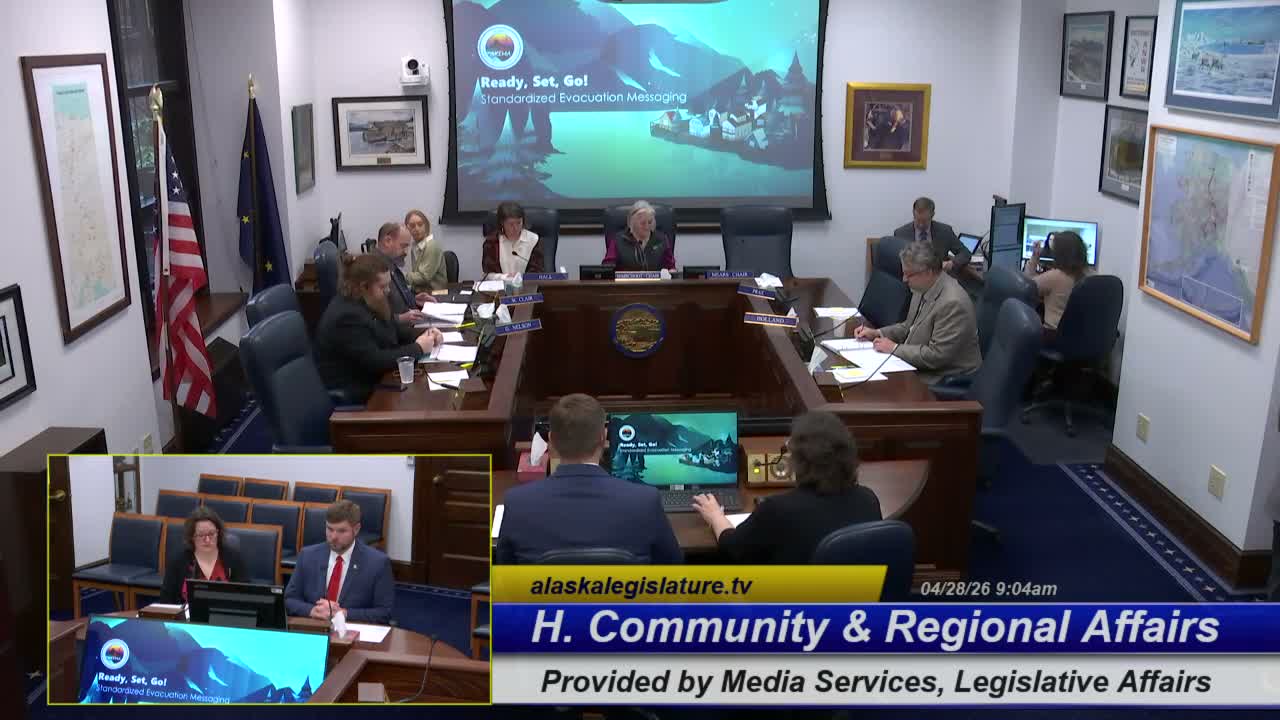
Senator Jesse Bjorkman urged the House Community and Regional Affairs Committee to adopt Senate Bill 192, saying the bill would establish a uniform "ready, set, go" color designation (green/yellow/red) for statewide evacuation messaging and clarify what Alaskans should do when an evacuation is necessary. "This would clarify that Alaskans need to act decisively and what they need to do in an emergency when an evacuation is necessary," Bjorkman said during the bill's first hearing.
Brenda Alberg, the Kenai Peninsula Borough emergency manager and a board member of the Alaska Emergency Managers Association, testified in support and walked members through the three levels. She said "ready" is an ongoing preparedness state; "set" (level 2) signals people who need extra time—those with mobility challenges, livestock, recreational vehicles or long egress routes—to evaluate leaving; and "go" (level 3) indicates people are in harm's way and need to leave immediately. "It is direct messaging that they are in harm's way, and they need to evacuate," Alberg said, adding that the designations are not mandatory but are intended to be clear and actionable.
Alberg told the committee the proposal grew from local campaigns and operational lessons, citing the 2022 Clear Fire as a notable example where inconsistent map coloring around a fire perimeter "created a lot of confusion for the public." She said the Kenai Peninsula Borough adopted the approach by resolution and that the Alaska Emergency Managers Association, Alaska Fire Chiefs Association and state fire and emergency management divisions have aligned informally behind the model.
Members pressed presenters on several practical issues. Representative Steve St. Clair asked whether the bill applied only to wildfires; Alberg said the language targets "all hazard responses" and that the latest amendment would amend a section of the Disaster Act (as read into the record) to require state and political‑subdivision evacuation plans to incorporate the standard. Alberg recommended codifying the language into statute rather than relying solely on regulation so that standard operating procedures and local practices can be developed and sustained.
Several lawmakers raised concerns about operational handoffs and how the public would find timely, authoritative information during an incident. Representative Holland asked how the system would improve coordination when responsibility shifts from local response to an incident management team or to the Division of Forestry. Alberg described the Kenai Peninsula's decade of outreach—close relationships with local radio, an online operational map that shades affected areas dynamically, and interagency exercises—and said codification would create an "evergreen" reference so new responders and agencies understand local parameters.
Lawmakers also asked about pre‑fire planning, community outreach, and how the model would work in rural and coastal areas prone to tsunamis or with limited internet access. Alberg said those gaps are addressed through local partnerships, the "All Lands All Hands" interagency group, community leaders and targeted outreach during "blue sky" periods when there is time to prepare.
On timing and legal detail, Senator Bjorkman said the bill contains no special effective‑date clause and would follow the typical process for bills without a clause (becoming effective after the standard statutory period unless amended). The committee set an amendment deadline of Wednesday, April 29 at noon and scheduled further consideration of SB 192 for the next committee meeting. No public testimony was offered in person or online during the session.
The bill's supporters told the committee they view codification as a way to reduce confusion, align operational maps and messaging across jurisdictions, and improve public adherence to evacuation guidance. The committee agreed to accept amendments by the stated deadline and to continue consideration at the next scheduled hearing.
Brenda Alberg, the Kenai Peninsula Borough emergency manager and a board member of the Alaska Emergency Managers Association, testified in support and walked members through the three levels. She said "ready" is an ongoing preparedness state; "set" (level 2) signals people who need extra time—those with mobility challenges, livestock, recreational vehicles or long egress routes—to evaluate leaving; and "go" (level 3) indicates people are in harm's way and need to leave immediately. "It is direct messaging that they are in harm's way, and they need to evacuate," Alberg said, adding that the designations are not mandatory but are intended to be clear and actionable.
Alberg told the committee the proposal grew from local campaigns and operational lessons, citing the 2022 Clear Fire as a notable example where inconsistent map coloring around a fire perimeter "created a lot of confusion for the public." She said the Kenai Peninsula Borough adopted the approach by resolution and that the Alaska Emergency Managers Association, Alaska Fire Chiefs Association and state fire and emergency management divisions have aligned informally behind the model.
Members pressed presenters on several practical issues. Representative Steve St. Clair asked whether the bill applied only to wildfires; Alberg said the language targets "all hazard responses" and that the latest amendment would amend a section of the Disaster Act (as read into the record) to require state and political‑subdivision evacuation plans to incorporate the standard. Alberg recommended codifying the language into statute rather than relying solely on regulation so that standard operating procedures and local practices can be developed and sustained.
Several lawmakers raised concerns about operational handoffs and how the public would find timely, authoritative information during an incident. Representative Holland asked how the system would improve coordination when responsibility shifts from local response to an incident management team or to the Division of Forestry. Alberg described the Kenai Peninsula's decade of outreach—close relationships with local radio, an online operational map that shades affected areas dynamically, and interagency exercises—and said codification would create an "evergreen" reference so new responders and agencies understand local parameters.
Lawmakers also asked about pre‑fire planning, community outreach, and how the model would work in rural and coastal areas prone to tsunamis or with limited internet access. Alberg said those gaps are addressed through local partnerships, the "All Lands All Hands" interagency group, community leaders and targeted outreach during "blue sky" periods when there is time to prepare.
On timing and legal detail, Senator Bjorkman said the bill contains no special effective‑date clause and would follow the typical process for bills without a clause (becoming effective after the standard statutory period unless amended). The committee set an amendment deadline of Wednesday, April 29 at noon and scheduled further consideration of SB 192 for the next committee meeting. No public testimony was offered in person or online during the session.
The bill's supporters told the committee they view codification as a way to reduce confusion, align operational maps and messaging across jurisdictions, and improve public adherence to evacuation guidance. The committee agreed to accept amendments by the stated deadline and to continue consideration at the next scheduled hearing.
View the Full Meeting & All Its Details
This article offers just a summary. Unlock complete video, transcripts, and insights as a Founder Member.
✓
Watch full, unedited meeting videos
✓
Search every word spoken in unlimited transcripts
✓
AI summaries & real-time alerts (all government levels)
✓
Permanent access to expanding government content
30-day money-back guarantee
