House Finance debates whether FY25 financial statement shows spendable surplus; OMB urges caution
April 27, 2026 | 2026 Legislature Alaska, Alaska
This article was created by AI summarizing key points discussed. AI makes mistakes, so for full details and context, please refer to the video of the full meeting. Please report any errors so we can fix them. Report an error »
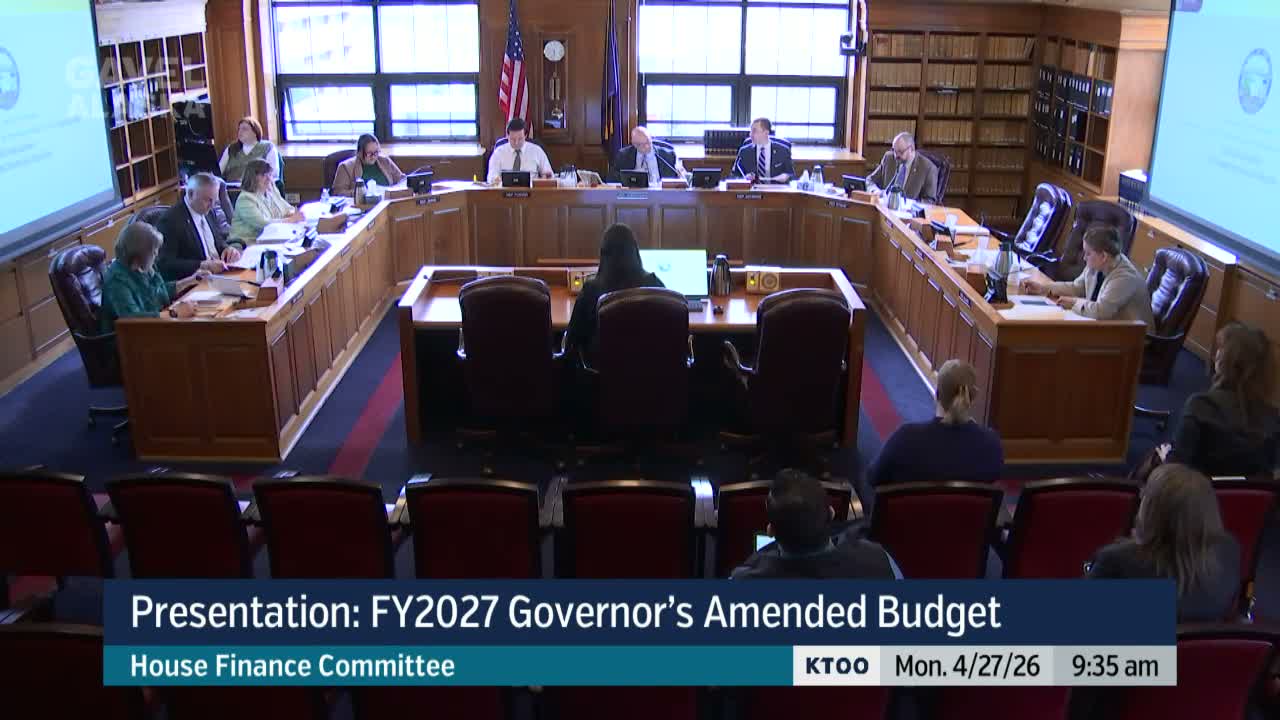
On April 27 members of the House Finance Committee pressed the Office of Management and Budget over whether the state had an uncommitted, spendable balance available in FY26 after the release of the FY25 Comprehensive Annual Financial Report (ACFAR).
Representative Josephson said the ACFAR indicated about $290,000,000 of available monies that might be spendable in FY26. Lacey Sanders responded that accounting documents and budgeting processes do not align: "Budgets and accounting are not the same, and they do not align in the same mash manner," she said, explaining that the ACFAR does not separate receipts by the fund codes the budget uses and that some receipts counted in accounting include federal reimbursements and prior-year encumbrance releases that the budget does not treat as new unrestricted general fund revenue.
Sanders told members that when OMB compares total appropriations to unrestricted general fund revenue the office still sees a deficit and that she is "not in agreement that there is a surplus of general fund revenue available to spend in the current year." She and committee members agreed OMB and accounting staff must continue reconciling differences.
Lehi Painter of the Legislative Finance Division told the committee the spring revenue forecast used a $91-per-barrel oil assumption; recent prices have averaged roughly $10 above that level so far. Painter said, however, that making the budget arithmetic work for existing appropriations would require prices to stay above roughly $80 per barrel for the remainder of the fiscal year, and that short-term swings and corporate tax timing make precise short-term revenue estimates uncertain.
The exchange highlighted a procedural distinction: the ACFAR is an accounting statement that can show receipts posted to the general fund after year-end, while the budget process focuses on unrestricted general fund revenues that can lawfully be appropriated in the current budget year. OMB said it is working with the Department of Revenue and the state's accounting teams to reconcile these figures and will report back to the committee; no change to appropriations was made during the meeting.
Representative Josephson said the ACFAR indicated about $290,000,000 of available monies that might be spendable in FY26. Lacey Sanders responded that accounting documents and budgeting processes do not align: "Budgets and accounting are not the same, and they do not align in the same mash manner," she said, explaining that the ACFAR does not separate receipts by the fund codes the budget uses and that some receipts counted in accounting include federal reimbursements and prior-year encumbrance releases that the budget does not treat as new unrestricted general fund revenue.
Sanders told members that when OMB compares total appropriations to unrestricted general fund revenue the office still sees a deficit and that she is "not in agreement that there is a surplus of general fund revenue available to spend in the current year." She and committee members agreed OMB and accounting staff must continue reconciling differences.
Lehi Painter of the Legislative Finance Division told the committee the spring revenue forecast used a $91-per-barrel oil assumption; recent prices have averaged roughly $10 above that level so far. Painter said, however, that making the budget arithmetic work for existing appropriations would require prices to stay above roughly $80 per barrel for the remainder of the fiscal year, and that short-term swings and corporate tax timing make precise short-term revenue estimates uncertain.
The exchange highlighted a procedural distinction: the ACFAR is an accounting statement that can show receipts posted to the general fund after year-end, while the budget process focuses on unrestricted general fund revenues that can lawfully be appropriated in the current budget year. OMB said it is working with the Department of Revenue and the state's accounting teams to reconcile these figures and will report back to the committee; no change to appropriations was made during the meeting.
Don't Miss a Word: See the Full Meeting!
Go beyond summaries. Unlock every video, transcript, and key insight with a Founder Membership.
✓
Get instant access to full meeting videos
✓
Search and clip any phrase from complete transcripts
✓
Receive AI-powered summaries & custom alerts
✓
Enjoy lifetime, unrestricted access to government data
30-day money-back guarantee
