Senate lays over ALPR privacy bill after lengthy debate on warrants and surveillance safeguards
April 29, 2026 | 2026 Legislature CO, Colorado
This article was created by AI summarizing key points discussed. AI makes mistakes, so for full details and context, please refer to the video of the full meeting. Please report any errors so we can fix them. Report an error »
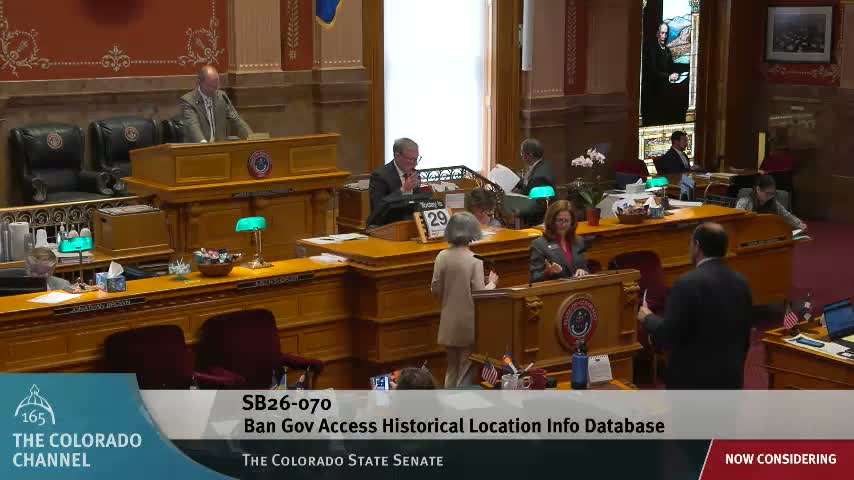
Senate Bill 70, a measure to restrict government access to databases that store historical location information and to impose judicial oversight on certain license-plate–reader (ALPR) uses, was the subject of extended debate on the Colorado Senate floor before senators voted to lay the bill over until July 4, 2026.
Sponsor Senator Zamora Wilson opened floor remarks by framing the bill as a constitutional privacy safeguard and citing U.S. Supreme Court precedent, including United States v. Jones and Carpenter v. United States, to argue that warrantless bulk location tracking risks Fourth Amendment violations. "Requiring a warrant simply restores the balance between law enforcement authority and individual liberty," she said, urging colleagues to weigh the privacy and data-security risks of centralized tracking systems.
Senator Mavalley, a co-sponsor, described the bill as an effort to provide "basic common-sense guardrails" for ALPR data and to protect Coloradans from pervasive tracking. He said advocates declined to accept watered-down alternatives and pledged to continue advocacy after the layover. "The decision to lay the bill over doesn't come lightly ... We will come back next year," he said.
Senator Henriksen, speaking in support of privacy protections, gave examples of reported harms tied to unregulated ALPR use and algorithmic flags that have led to costly legal fights for individuals; he urged the chamber to consider the potential for abuse when vehicle-location information is aggregated and used without strict limits.
Supporters said the bill would preserve investigative tools for emergencies and legitimate public-safety uses while adding judicial oversight, vendor controls and protections against sharing with immigration enforcement — provisions they argued are increasingly urgent as ALPR deployment expands.
Opponents included law enforcement organizations and the executive branch; senators on the floor reported sustained vocal opposition from police groups and noted the governor’s office warned it would veto a bill containing a warrant requirement. That opposition, along with the scope of differences among senators, preceded the motion to lay the bill over. Majority Leader Julia Rodriguez moved the layover; the chamber approved the motion.
Outcome: the Senate voted to lay SB 70 over until July 4, 2026, retaining its place on the calendar. Sponsors pledged to continue work with stakeholders and to return with revised language or renewed political support.
What happens next: SB 70 remains on the Senate calendar, dated for consideration on July 4, 2026, unless sponsors or leadership place it sooner. Advocates said they will press local governments and the public to push for guardrails at the municipal level in the interim.
Quotes used in this article are taken from the Senate floor transcript and are attributed to the senators who spoke on the record.
Sponsor Senator Zamora Wilson opened floor remarks by framing the bill as a constitutional privacy safeguard and citing U.S. Supreme Court precedent, including United States v. Jones and Carpenter v. United States, to argue that warrantless bulk location tracking risks Fourth Amendment violations. "Requiring a warrant simply restores the balance between law enforcement authority and individual liberty," she said, urging colleagues to weigh the privacy and data-security risks of centralized tracking systems.
Senator Mavalley, a co-sponsor, described the bill as an effort to provide "basic common-sense guardrails" for ALPR data and to protect Coloradans from pervasive tracking. He said advocates declined to accept watered-down alternatives and pledged to continue advocacy after the layover. "The decision to lay the bill over doesn't come lightly ... We will come back next year," he said.
Senator Henriksen, speaking in support of privacy protections, gave examples of reported harms tied to unregulated ALPR use and algorithmic flags that have led to costly legal fights for individuals; he urged the chamber to consider the potential for abuse when vehicle-location information is aggregated and used without strict limits.
Supporters said the bill would preserve investigative tools for emergencies and legitimate public-safety uses while adding judicial oversight, vendor controls and protections against sharing with immigration enforcement — provisions they argued are increasingly urgent as ALPR deployment expands.
Opponents included law enforcement organizations and the executive branch; senators on the floor reported sustained vocal opposition from police groups and noted the governor’s office warned it would veto a bill containing a warrant requirement. That opposition, along with the scope of differences among senators, preceded the motion to lay the bill over. Majority Leader Julia Rodriguez moved the layover; the chamber approved the motion.
Outcome: the Senate voted to lay SB 70 over until July 4, 2026, retaining its place on the calendar. Sponsors pledged to continue work with stakeholders and to return with revised language or renewed political support.
What happens next: SB 70 remains on the Senate calendar, dated for consideration on July 4, 2026, unless sponsors or leadership place it sooner. Advocates said they will press local governments and the public to push for guardrails at the municipal level in the interim.
Quotes used in this article are taken from the Senate floor transcript and are attributed to the senators who spoke on the record.
View the Full Meeting & All Its Details
This article offers just a summary. Unlock complete video, transcripts, and insights as a Founder Member.
✓
Watch full, unedited meeting videos
✓
Search every word spoken in unlimited transcripts
✓
AI summaries & real-time alerts (all government levels)
✓
Permanent access to expanding government content
30-day money-back guarantee
