City staff outlines two annexation requests; council asks for modified boundaries and consultant-funding options
April 27, 2026 | Enumclaw, King County, Washington
This article was created by AI summarizing key points discussed. AI makes mistakes, so for full details and context, please refer to the video of the full meeting. Please report any errors so we can fix them. Report an error »
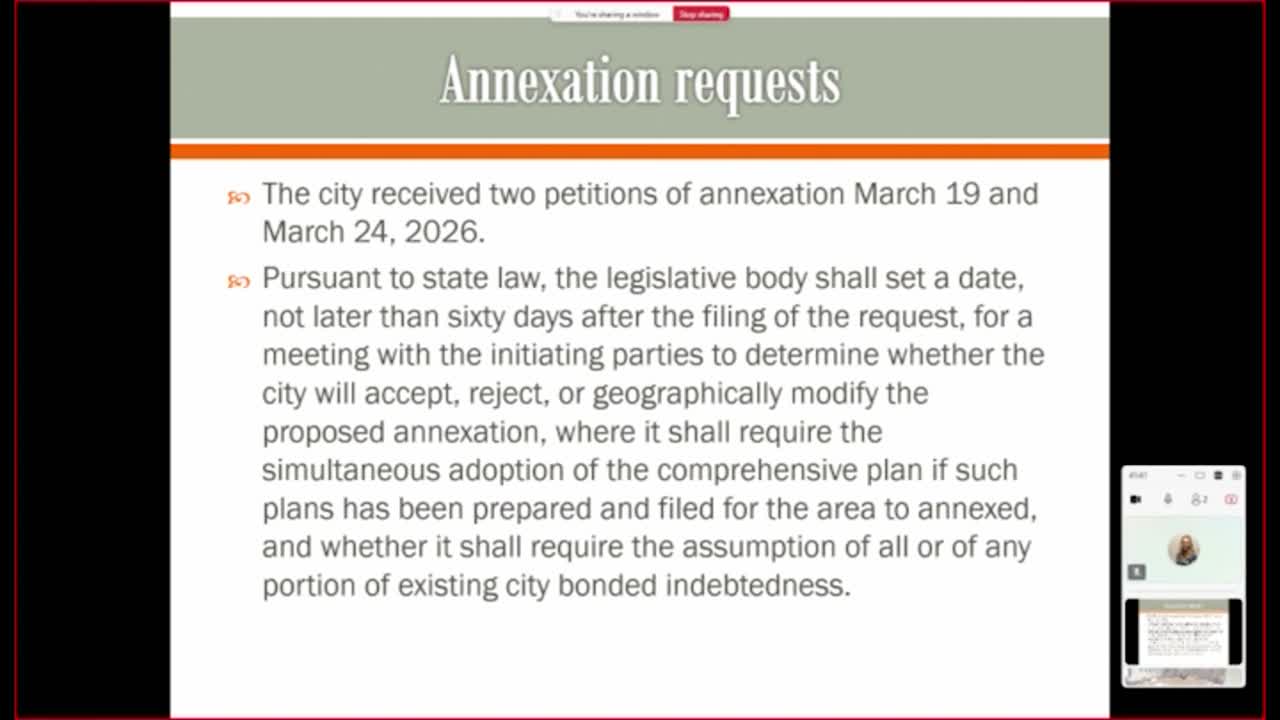
City staff briefed the Enumclaw City Council on April 27 on two annexation petitions submitted in March, and council members signaled support for staff to prepare formal resolutions and to seek legal guidance on conditions for processing.
"We have the city has recently received two annexation requests," Community Development Director Chris Massenet told the council, describing one request on the west side near the Roosevelt roundabout and another on the east side adjacent to the county fairgrounds. He said the petitions cover five vacant residentially zoned parcels totaling about 18 acres and that staff recommended modifying the proposed boundaries to include additional parcels to make the city boundary more regular.
Massenet outlined the state’s 60% petition method for annexation: after the city receives a notice of intent, the legislative body must set a meeting date with petitioners within 60 days; petitioners then must secure signatures representing 60% of the assessed valuation of the area proposed for annexation before proceeding to the county and ultimately the Boundary Review Board. He said that if the two areas were combined with the additional parcels staff showed, the total would be about 38 acres with an assessed valuation of roughly $8.5 million.
Council members debated whether to process the requests together or separately. One council member asked staff to check with the city attorney about whether applicants could be required to pay for a consultant to support annexation processing, noting staff capacity concerns. Another member said running the two annexations separately could be fairer to individual parcel owners and reduce the risk of a 60% valuation outcome that overwhelms minority property owners.
Council direction and next steps: Council members expressed general openness to preparing modified resolutions (likely two separate resolutions per staff recommendation) and asked staff to bring back proposed resolutions and attorney advice. Community Development staff said they would return with additional details within the 60-day statutory window.
Why it matters: Annexation changes the city boundary, zoning applied to properties, utility access, and which government provides services. The council’s choice to modify boundaries and the question of requiring applicants to fund consultants will affect processing time and staff workload.
What happens next: Staff will consult the city attorney on possible conditions (including payment for consultants) and prepare resolutions for council consideration at upcoming meetings within the statutory 60-day timeline.
"We have the city has recently received two annexation requests," Community Development Director Chris Massenet told the council, describing one request on the west side near the Roosevelt roundabout and another on the east side adjacent to the county fairgrounds. He said the petitions cover five vacant residentially zoned parcels totaling about 18 acres and that staff recommended modifying the proposed boundaries to include additional parcels to make the city boundary more regular.
Massenet outlined the state’s 60% petition method for annexation: after the city receives a notice of intent, the legislative body must set a meeting date with petitioners within 60 days; petitioners then must secure signatures representing 60% of the assessed valuation of the area proposed for annexation before proceeding to the county and ultimately the Boundary Review Board. He said that if the two areas were combined with the additional parcels staff showed, the total would be about 38 acres with an assessed valuation of roughly $8.5 million.
Council members debated whether to process the requests together or separately. One council member asked staff to check with the city attorney about whether applicants could be required to pay for a consultant to support annexation processing, noting staff capacity concerns. Another member said running the two annexations separately could be fairer to individual parcel owners and reduce the risk of a 60% valuation outcome that overwhelms minority property owners.
Council direction and next steps: Council members expressed general openness to preparing modified resolutions (likely two separate resolutions per staff recommendation) and asked staff to bring back proposed resolutions and attorney advice. Community Development staff said they would return with additional details within the 60-day statutory window.
Why it matters: Annexation changes the city boundary, zoning applied to properties, utility access, and which government provides services. The council’s choice to modify boundaries and the question of requiring applicants to fund consultants will affect processing time and staff workload.
What happens next: Staff will consult the city attorney on possible conditions (including payment for consultants) and prepare resolutions for council consideration at upcoming meetings within the statutory 60-day timeline.
Don't Miss a Word: See the Full Meeting!
Go beyond summaries. Unlock every video, transcript, and key insight with a Founder Membership.
✓
Get instant access to full meeting videos
✓
Search and clip any phrase from complete transcripts
✓
Receive AI-powered summaries & custom alerts
✓
Enjoy lifetime, unrestricted access to government data
30-day money-back guarantee
