Clay County Public Health outlines program growth, opioid response and prevention gains
April 29, 2026 | Clay County, Minnesota
This article was created by AI summarizing key points discussed. AI makes mistakes, so for full details and context, please refer to the video of the full meeting. Please report any errors so we can fix them. Report an error »
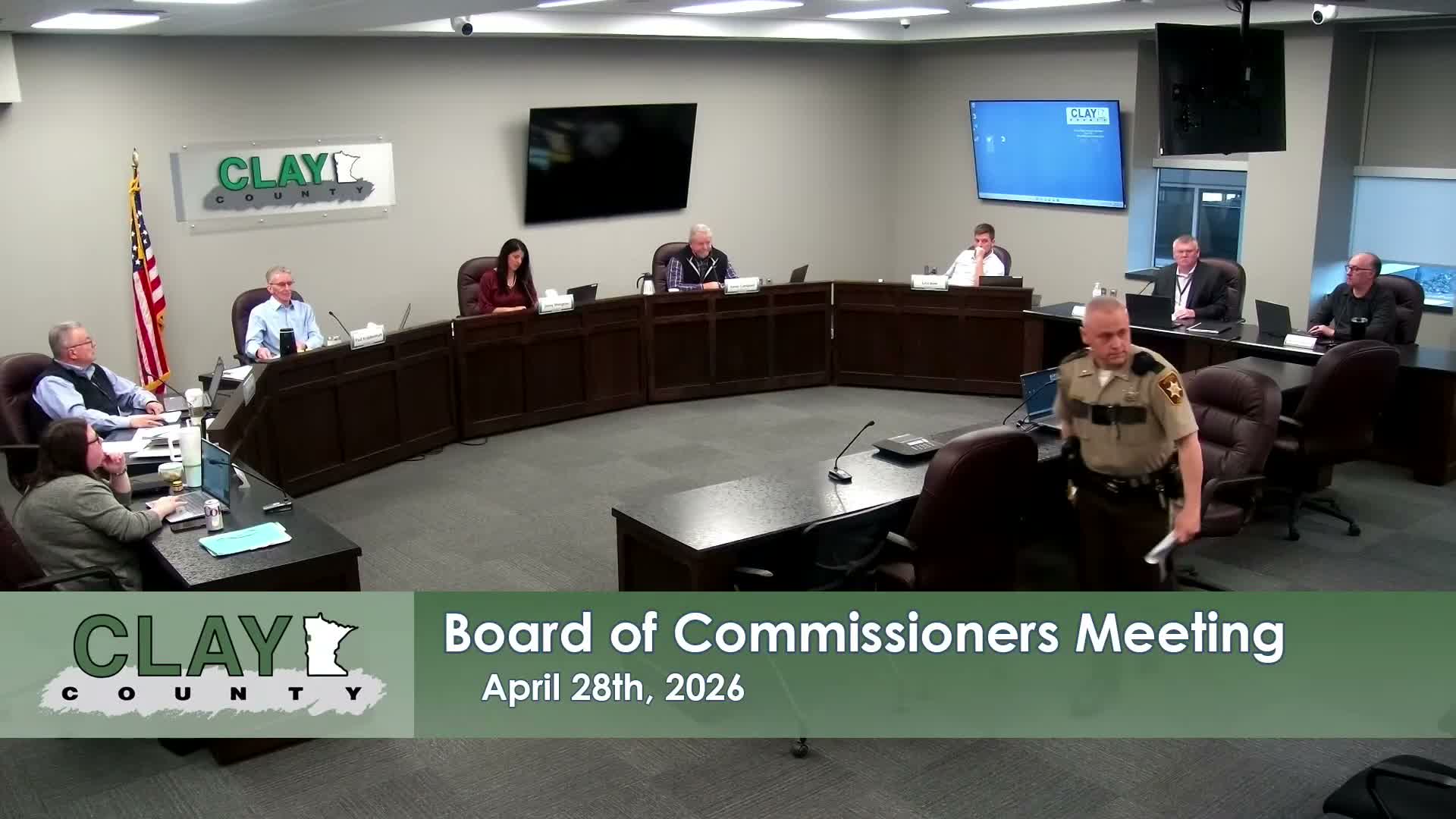
Clay County Public Health delivered its 2025 annual report to the Board of Commissioners on April 28, highlighting increased service volumes, staffing and several grant‑funded prevention initiatives.
Jessica, public-health director, said the department’s mission is to “assure optimal health for all Clay County residents” and described a seven-unit structure that includes adult health, family health, environmental health, health promotion, finance, WIC and emergency preparedness. She said Clay County now participates in a two-county community health board with Becker County.
Susie (adult health) said the unit serves roughly 1,650 Clay County clients in long‑term services and supports and averages about 62 clients per care coordinator. Liz (family health) described family home visiting — a voluntary, evidence-based program for prenatal and early-childhood support — and outlined disease surveillance and school nursing responsibilities; she noted funding through state grants, TANF and local public-health dollars.
Rory (health promotion) highlighted grant-funded prevention results: youth vaping fell from 24% to 7% (2019→2025) and alcohol and cannabis survey measures also declined. Rory also described an opioid response team formed with Moorhead Fire Department and Beth’s Place Treatment Center that followed up with 31 overdose-treated individuals in 2025; staff successfully contacted about two‑thirds and referred many to treatment (42% accepted referral; 38% completed assessments).
Kent (environmental health) reported increased septic permitting and inspections and added that a new hire, Olivia Ohm, strengthens septic inspection capacity. Brandon Nelson (finance) said Clay County public-health expenses were about $10,360,000 for 2025 (Clay County-only). Sarah reported WIC participation averaging about 1,488 women, infants and children with farmers‑market nutrition coupons distributed to roughly 300 families.
Savannah Stoma (emergency preparedness) said the department updated response plans, inventory tracking (Salamanca Life), distributed nearly 500 emergency “go bags” to partners, and trained staff and volunteers in community readiness and POD planning. Several supervisors thanked staff for flexibility and cross‑unit support.
Board members asked questions about county partnerships, range of services, and the department’s plans for fee reviews and the 2027 budget. The presentation concluded with the board expressing appreciation for the staff’s work.
Jessica, public-health director, said the department’s mission is to “assure optimal health for all Clay County residents” and described a seven-unit structure that includes adult health, family health, environmental health, health promotion, finance, WIC and emergency preparedness. She said Clay County now participates in a two-county community health board with Becker County.
Susie (adult health) said the unit serves roughly 1,650 Clay County clients in long‑term services and supports and averages about 62 clients per care coordinator. Liz (family health) described family home visiting — a voluntary, evidence-based program for prenatal and early-childhood support — and outlined disease surveillance and school nursing responsibilities; she noted funding through state grants, TANF and local public-health dollars.
Rory (health promotion) highlighted grant-funded prevention results: youth vaping fell from 24% to 7% (2019→2025) and alcohol and cannabis survey measures also declined. Rory also described an opioid response team formed with Moorhead Fire Department and Beth’s Place Treatment Center that followed up with 31 overdose-treated individuals in 2025; staff successfully contacted about two‑thirds and referred many to treatment (42% accepted referral; 38% completed assessments).
Kent (environmental health) reported increased septic permitting and inspections and added that a new hire, Olivia Ohm, strengthens septic inspection capacity. Brandon Nelson (finance) said Clay County public-health expenses were about $10,360,000 for 2025 (Clay County-only). Sarah reported WIC participation averaging about 1,488 women, infants and children with farmers‑market nutrition coupons distributed to roughly 300 families.
Savannah Stoma (emergency preparedness) said the department updated response plans, inventory tracking (Salamanca Life), distributed nearly 500 emergency “go bags” to partners, and trained staff and volunteers in community readiness and POD planning. Several supervisors thanked staff for flexibility and cross‑unit support.
Board members asked questions about county partnerships, range of services, and the department’s plans for fee reviews and the 2027 budget. The presentation concluded with the board expressing appreciation for the staff’s work.
View the Full Meeting & All Its Details
This article offers just a summary. Unlock complete video, transcripts, and insights as a Founder Member.
✓
Watch full, unedited meeting videos
✓
Search every word spoken in unlimited transcripts
✓
AI summaries & real-time alerts (all government levels)
✓
Permanent access to expanding government content
30-day money-back guarantee
