Police present real‑time intelligence center grant; council presses vendors on data security and LPR hacking claims
April 29, 2026 | Asheville City, Buncombe County, North Carolina
This article was created by AI summarizing key points discussed. AI makes mistakes, so for full details and context, please refer to the video of the full meeting. Please report any errors so we can fix them. Report an error »
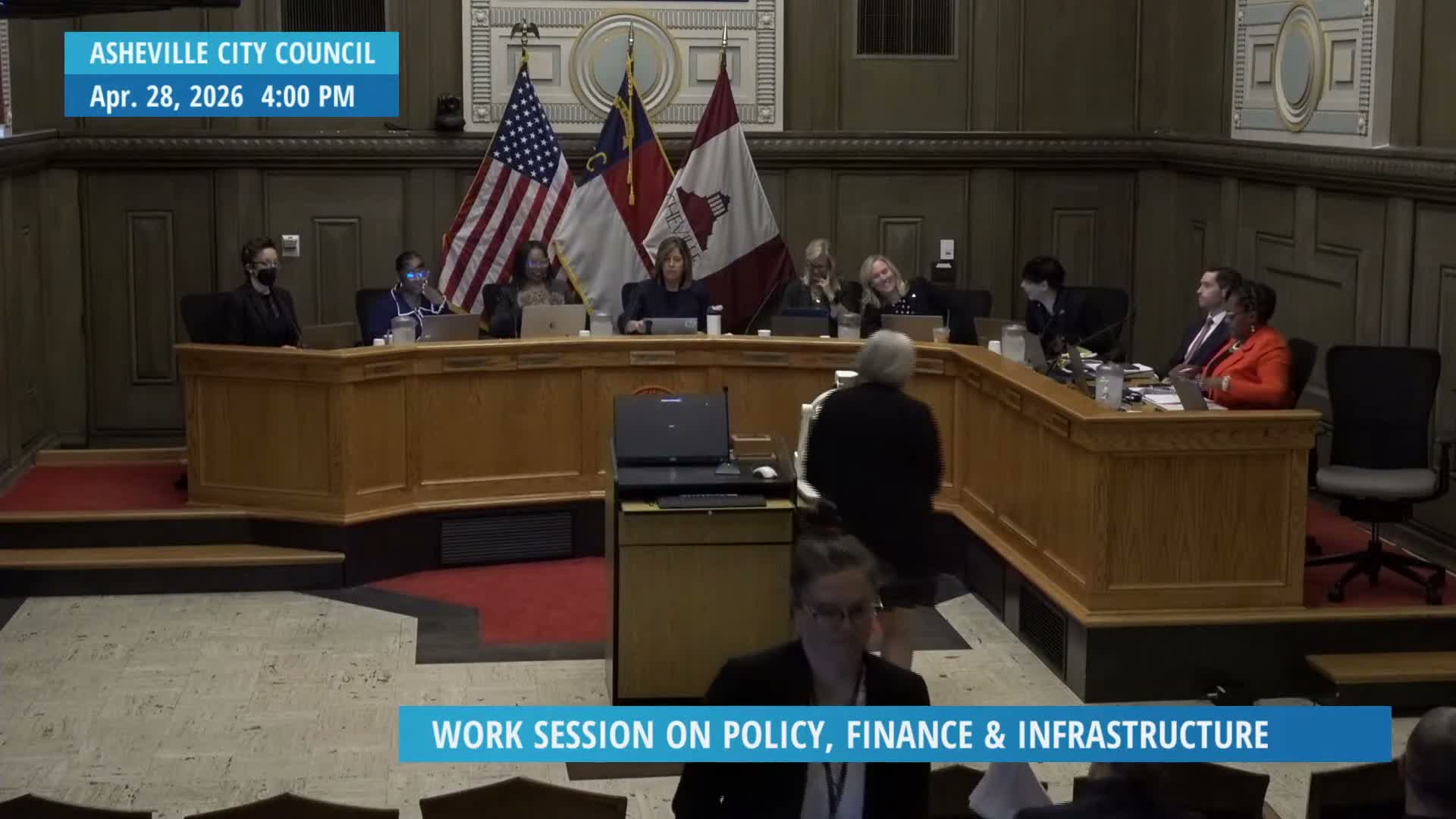
Interim Police Chief Jackie Stepp presented the committee with the proposal to accept community‑project funding to stand up a real‑time intelligence center (RTIC) and explained the technology, timeline and intended public‑safety uses.
Stepp acknowledged community concerns about surveillance and privacy and said the department’s approach is intended to be grounded in trust, clear guidelines and accountability. She recounted prior steps: a 2022 MOU with the Buncombe County Sheriff’s Office to use a FUSUS platform, installation of Axon fleet cameras (with LPR capability) and a February 2025 contract with Flock Safety for 11 automated license‑plate readers (LPRs). She said the city already has limited access to a FUSUS instance and that the current grant would fund a long‑term FUSUS license, a video wall, and construction of RTIC workspace.
Council members raised several concerns. Some cited social‑media reports and recent municipal decisions in other cities to reduce or cancel Flock contracts, and asked whether the cameras and LPR systems had been documented as “hackable.” Stepp deferred technical answers to vendor representatives and reiterated that the department owns its data and that vendors do not have unfettered access. She also emphasized that FUSUS, as described by the vendor, aggregates live feeds and does not itself store data; storage remains with each camera system and evidence management platform.
Andrea Swan of Axon explained conditional sharing and integration options: camera owners can register cameras or opt for full integration via a small 'core' device that enables live view under owner‑set parameters; every access is auditable. Axon described FUSUS as a pane‑of‑glass aggregator that will not ingest vendor facial‑recognition outputs; evidence is retained per evidence.com policies tied to statutory retention schedules.
Holly Bealin of Flock Safety addressed 'hacking' allegations, saying most publicized incidents have involved device‑level compromises (for example, cameras left at factory defaults or misconfigured) and not breaches of Flock’s cloud environment. She said Flock employs adversarial testing (Bishop Fox) and maintains audit trails and search‑reason requirements to detect misuse. Vendors and staff stated retention schedules in the discussion: Flock LPRs retain ~30 days by default; Axon/evidence.com data retention follows state law (90 days for general records, longer if tied to a criminal case).
Council asked for full copies of the proposed Axon and Flock contracts and for a specific legal opinion on contested contract language (including any perpetual or training‑data license language). City staff and counsel agreed to provide the contracts and a legal memo before the council considers acceptance of the grant; staff said there is no immediate statutory deadline on the grant and that the item would return to council in May for formal action.
The committee did not take a final vote in this meeting; members said they want more time to review contracts and vendor assurances before a public vote.
Stepp acknowledged community concerns about surveillance and privacy and said the department’s approach is intended to be grounded in trust, clear guidelines and accountability. She recounted prior steps: a 2022 MOU with the Buncombe County Sheriff’s Office to use a FUSUS platform, installation of Axon fleet cameras (with LPR capability) and a February 2025 contract with Flock Safety for 11 automated license‑plate readers (LPRs). She said the city already has limited access to a FUSUS instance and that the current grant would fund a long‑term FUSUS license, a video wall, and construction of RTIC workspace.
Council members raised several concerns. Some cited social‑media reports and recent municipal decisions in other cities to reduce or cancel Flock contracts, and asked whether the cameras and LPR systems had been documented as “hackable.” Stepp deferred technical answers to vendor representatives and reiterated that the department owns its data and that vendors do not have unfettered access. She also emphasized that FUSUS, as described by the vendor, aggregates live feeds and does not itself store data; storage remains with each camera system and evidence management platform.
Andrea Swan of Axon explained conditional sharing and integration options: camera owners can register cameras or opt for full integration via a small 'core' device that enables live view under owner‑set parameters; every access is auditable. Axon described FUSUS as a pane‑of‑glass aggregator that will not ingest vendor facial‑recognition outputs; evidence is retained per evidence.com policies tied to statutory retention schedules.
Holly Bealin of Flock Safety addressed 'hacking' allegations, saying most publicized incidents have involved device‑level compromises (for example, cameras left at factory defaults or misconfigured) and not breaches of Flock’s cloud environment. She said Flock employs adversarial testing (Bishop Fox) and maintains audit trails and search‑reason requirements to detect misuse. Vendors and staff stated retention schedules in the discussion: Flock LPRs retain ~30 days by default; Axon/evidence.com data retention follows state law (90 days for general records, longer if tied to a criminal case).
Council asked for full copies of the proposed Axon and Flock contracts and for a specific legal opinion on contested contract language (including any perpetual or training‑data license language). City staff and counsel agreed to provide the contracts and a legal memo before the council considers acceptance of the grant; staff said there is no immediate statutory deadline on the grant and that the item would return to council in May for formal action.
The committee did not take a final vote in this meeting; members said they want more time to review contracts and vendor assurances before a public vote.
View the Full Meeting & All Its Details
This article offers just a summary. Unlock complete video, transcripts, and insights as a Founder Member.
✓
Watch full, unedited meeting videos
✓
Search every word spoken in unlimited transcripts
✓
AI summaries & real-time alerts (all government levels)
✓
Permanent access to expanding government content
30-day money-back guarantee
