Denver councilmembers outline budget priorities ahead of May workshop, including $3M community safety grant pilot
April 27, 2026 | Denver (Consolidated County and City), Colorado
This article was created by AI summarizing key points discussed. AI makes mistakes, so for full details and context, please refer to the video of the full meeting. Please report any errors so we can fix them. Report an error »
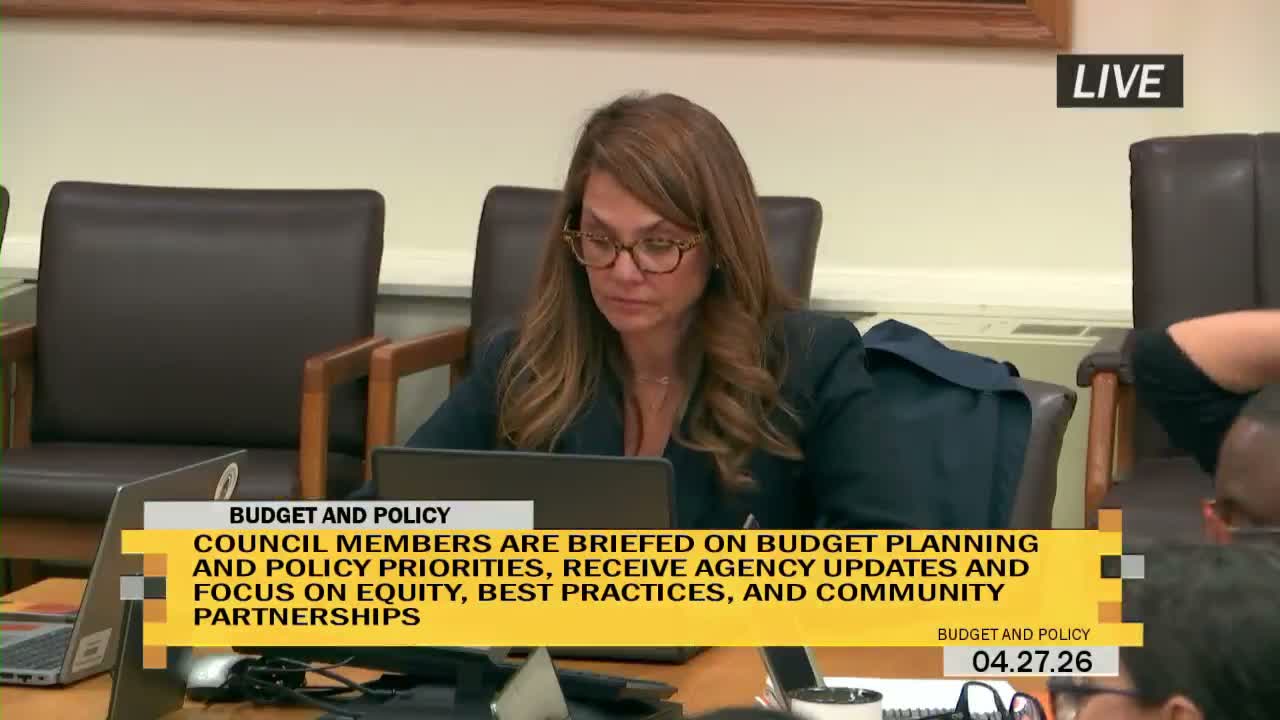
Denver City Council members used a biweekly Budget & Policy Committee meeting on April 27 to present a broad slate of budget priorities ahead of a May 14 workshop, highlighting a proposed $3 million Community Led Safety Grant pilot and multiple calls to restore basic city services.
Luke Palmisano, senior policy analyst for the council, opened the session and explained the process for members to present new proposals: “Each council member will have the same amount of time, 8 minutes,” Palmisano said, and asked members to reserve questions until the end or discuss details offline.
Councilmember Kevin Flynn urged the committee to use projected revenues to “restore those basic services,” citing recent disruptions at Motor Vehicle offices and ongoing street-paving shortfalls. Flynn said restoring staffing at revenue-generating offices such as the DMV and at functions that support tax collections and permitting should be a priority so residents can access required services without long delays.
Councilwoman Forrest requested the committee support a Community Led Safety Grant pilot that would distribute $3,000,000 from the Broncos fund in its first year and asked the council to pursue a matching $3,000,000 in 2028 to sustain the program. “This is to get out that $3,000,000 into local nonprofits and really try to address some of the deepest and heavily unaddressed issues regarding youth and involvement with the criminal justice system,” she said.
Forrest also urged the city not to cut the immigrant legal services allocation for 2027, noting the fund currently receives $750,000 from the city, and called for beginning the reauthorization process for the Healthy Food for Denver Kids sales tax, which sunsets and stops collections in 2028 with final distributions in 2029.
Council pro tem Ramiro Campbell outlined a package of infrastructure and service items, including increasing the number of neighborhood planning initiatives, restoring liaisons and project-staff FTE in the Department of Transportation & Infrastructure (DOTTI), and restoring positions in Denver Parks and Recreation after an approximately 18% reduction in FTE cited for 2026. Campbell also proposed raising funding for traffic studies to reduce a backlog members said currently takes nine months to a year to address. On climate-related work, he asked for expanded education and a request to increase CASR-funded outreach around drought-tolerant landscaping.
Other members raised cross-cutting priorities: Councilmember Alvidrez called for additional funding for the crime lab and recommended investments to address a rise in domestic violence; she also cited foreclosure statistics and urged creation of foreclosure prevention services after reporting Denver had 677 foreclosures in 2025 (up from 560 in 2024). Councilmember Lewis proposed procurement changes to enable more in-house labor to reduce costs (citing a $76,000 outsourced kitchen renovation at a fire station as an example) and urged evaluation of COFAX BRT impacts once the line is operational.
Several members asked the administration to preserve participatory budgeting funding, advance Neighborhood Priority Initiatives so more are completed by 2030, and consider funding to help families and shelter operators respond to anticipated federal changes to Medicaid eligibility. Multiple presenters urged specificity in budget requests (FTE counts, consultant costs or exact dollar figures) to make the mayor’s budget review more actionable.
Staff set schedule and next steps: Palmisano said he would circulate grouped proposals and asked members to submit edits by end of day Tuesday, May 5; he also noted a materials completion milestone on May 10 and confirmed the workshop for May 14 from 8:30 a.m. to 4:30 p.m.
The committee did not take formal votes during the session; members used the meeting to flag priorities and request that staff and the administration prepare budget detail ahead of the May workshop.
Luke Palmisano, senior policy analyst for the council, opened the session and explained the process for members to present new proposals: “Each council member will have the same amount of time, 8 minutes,” Palmisano said, and asked members to reserve questions until the end or discuss details offline.
Councilmember Kevin Flynn urged the committee to use projected revenues to “restore those basic services,” citing recent disruptions at Motor Vehicle offices and ongoing street-paving shortfalls. Flynn said restoring staffing at revenue-generating offices such as the DMV and at functions that support tax collections and permitting should be a priority so residents can access required services without long delays.
Councilwoman Forrest requested the committee support a Community Led Safety Grant pilot that would distribute $3,000,000 from the Broncos fund in its first year and asked the council to pursue a matching $3,000,000 in 2028 to sustain the program. “This is to get out that $3,000,000 into local nonprofits and really try to address some of the deepest and heavily unaddressed issues regarding youth and involvement with the criminal justice system,” she said.
Forrest also urged the city not to cut the immigrant legal services allocation for 2027, noting the fund currently receives $750,000 from the city, and called for beginning the reauthorization process for the Healthy Food for Denver Kids sales tax, which sunsets and stops collections in 2028 with final distributions in 2029.
Council pro tem Ramiro Campbell outlined a package of infrastructure and service items, including increasing the number of neighborhood planning initiatives, restoring liaisons and project-staff FTE in the Department of Transportation & Infrastructure (DOTTI), and restoring positions in Denver Parks and Recreation after an approximately 18% reduction in FTE cited for 2026. Campbell also proposed raising funding for traffic studies to reduce a backlog members said currently takes nine months to a year to address. On climate-related work, he asked for expanded education and a request to increase CASR-funded outreach around drought-tolerant landscaping.
Other members raised cross-cutting priorities: Councilmember Alvidrez called for additional funding for the crime lab and recommended investments to address a rise in domestic violence; she also cited foreclosure statistics and urged creation of foreclosure prevention services after reporting Denver had 677 foreclosures in 2025 (up from 560 in 2024). Councilmember Lewis proposed procurement changes to enable more in-house labor to reduce costs (citing a $76,000 outsourced kitchen renovation at a fire station as an example) and urged evaluation of COFAX BRT impacts once the line is operational.
Several members asked the administration to preserve participatory budgeting funding, advance Neighborhood Priority Initiatives so more are completed by 2030, and consider funding to help families and shelter operators respond to anticipated federal changes to Medicaid eligibility. Multiple presenters urged specificity in budget requests (FTE counts, consultant costs or exact dollar figures) to make the mayor’s budget review more actionable.
Staff set schedule and next steps: Palmisano said he would circulate grouped proposals and asked members to submit edits by end of day Tuesday, May 5; he also noted a materials completion milestone on May 10 and confirmed the workshop for May 14 from 8:30 a.m. to 4:30 p.m.
The committee did not take formal votes during the session; members used the meeting to flag priorities and request that staff and the administration prepare budget detail ahead of the May workshop.
View the Full Meeting & All Its Details
This article offers just a summary. Unlock complete video, transcripts, and insights as a Founder Member.
✓
Watch full, unedited meeting videos
✓
Search every word spoken in unlimited transcripts
✓
AI summaries & real-time alerts (all government levels)
✓
Permanent access to expanding government content
30-day money-back guarantee
