Denver budget office kicks off 2027 process, flags flat revenues and $30M franchise uncertainty
April 28, 2026 | Denver (Consolidated County and City), Colorado
This article was created by AI summarizing key points discussed. AI makes mistakes, so for full details and context, please refer to the video of the full meeting. Please report any errors so we can fix them. Report an error »
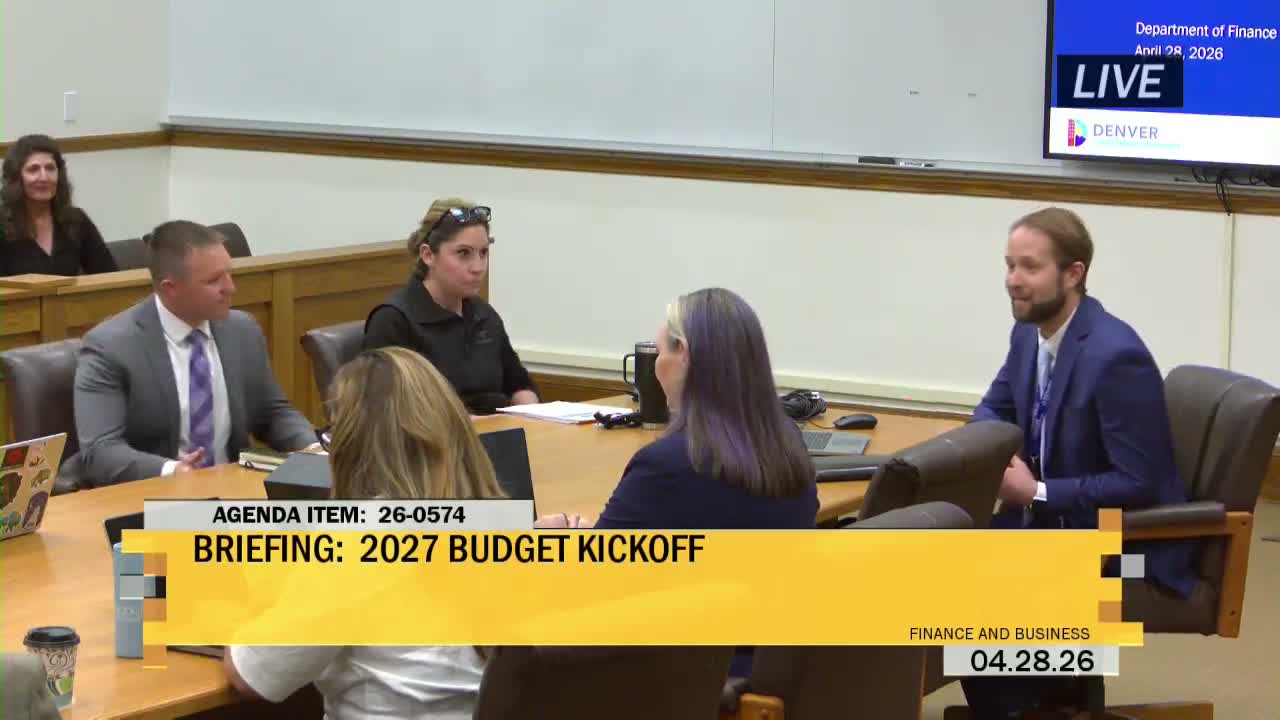
City budget officials on April 28 used the Finance & Business Committee meeting to formally kick off the 2027 budget process and to outline the city's near-term fiscal picture, saying the City ended 2025 with reserves slightly better than projected but that revenue risks remain.
Justin Sykes, director of the Budget and Management Office, told the committee the 2025 books are preliminarily closed and unaudited but showed revenues roughly $2 million below last fall's revised forecast and expenditures materially below budget, producing a year-end fund balance reported at $197,000,000 — about 11.5% of revenues — versus the prior projection of $179,000,000. "Our revised revenue projections that were released in September were extremely accurate. They came in within $2,000,000," Sykes said.
Finance staff noted that credit-rating agencies reaffirmed Denver's AAA grade, citing strong fiscal management and resilience, but they emphasized those positives are partly one-time and that ongoing structural pressures remain: relatively flat sales-tax collections, inflationary cost pressures for health insurance and contracts, and the potential for 1–2% revenue downside in 2026.
Lisa Martinez Templeton, the city's chief economist, said the local economy shows mixed indicators and downside risks. "Our economy is on edge," Templeton told the committee, pointing to higher energy prices, geopolitical risk and uncertainty about AI-driven demand that complicates near-term forecasts. She reported Denver-metro CPI up about 4.2% year over year and said core inflation and other components suggest limited near-term relief.
Staff outlined preliminary guidance for agencies preparing 2027 requests: plan on flat revenues and be ready to identify offsets for any new investments. Finance also said it will merge the six-year capital improvement plan update with the 2027 budget cycle and will release a proposed 2027 budget in September following agency-level calibrations.
A specific near-term fiscal issue flagged to the committee concerns the franchise agreement with Xcel Energy, which expires at year-end. Finance said the franchise fee revenues currently generate roughly $30,000,000 annually and that the administration is evaluating how to handle the potential loss of that revenue if a franchise extension is not referred and approved by voters.
Committee members asked technical follow-ups on sales-tax composition and online collections, requested the first-quarter expenditure report (scheduled for May 14), and raised concerns about prior years' overspending and the level of transparency the council receives; Finance committed to providing more detailed follow-up materials and the quarterly report.
What happens next: Finance staff will hold agency briefings, present quarterly results on May 14 and return to committee and council during the summer and fall as the 2027 proposed budget is developed and released in September.
Justin Sykes, director of the Budget and Management Office, told the committee the 2025 books are preliminarily closed and unaudited but showed revenues roughly $2 million below last fall's revised forecast and expenditures materially below budget, producing a year-end fund balance reported at $197,000,000 — about 11.5% of revenues — versus the prior projection of $179,000,000. "Our revised revenue projections that were released in September were extremely accurate. They came in within $2,000,000," Sykes said.
Finance staff noted that credit-rating agencies reaffirmed Denver's AAA grade, citing strong fiscal management and resilience, but they emphasized those positives are partly one-time and that ongoing structural pressures remain: relatively flat sales-tax collections, inflationary cost pressures for health insurance and contracts, and the potential for 1–2% revenue downside in 2026.
Lisa Martinez Templeton, the city's chief economist, said the local economy shows mixed indicators and downside risks. "Our economy is on edge," Templeton told the committee, pointing to higher energy prices, geopolitical risk and uncertainty about AI-driven demand that complicates near-term forecasts. She reported Denver-metro CPI up about 4.2% year over year and said core inflation and other components suggest limited near-term relief.
Staff outlined preliminary guidance for agencies preparing 2027 requests: plan on flat revenues and be ready to identify offsets for any new investments. Finance also said it will merge the six-year capital improvement plan update with the 2027 budget cycle and will release a proposed 2027 budget in September following agency-level calibrations.
A specific near-term fiscal issue flagged to the committee concerns the franchise agreement with Xcel Energy, which expires at year-end. Finance said the franchise fee revenues currently generate roughly $30,000,000 annually and that the administration is evaluating how to handle the potential loss of that revenue if a franchise extension is not referred and approved by voters.
Committee members asked technical follow-ups on sales-tax composition and online collections, requested the first-quarter expenditure report (scheduled for May 14), and raised concerns about prior years' overspending and the level of transparency the council receives; Finance committed to providing more detailed follow-up materials and the quarterly report.
What happens next: Finance staff will hold agency briefings, present quarterly results on May 14 and return to committee and council during the summer and fall as the 2027 proposed budget is developed and released in September.
View the Full Meeting & All Its Details
This article offers just a summary. Unlock complete video, transcripts, and insights as a Founder Member.
✓
Watch full, unedited meeting videos
✓
Search every word spoken in unlimited transcripts
✓
AI summaries & real-time alerts (all government levels)
✓
Permanent access to expanding government content
30-day money-back guarantee
