Denver committee hears briefing on Ryan White HIV services, funding pressures and gaps in viral suppression
April 29, 2026 | Denver (Consolidated County and City), Colorado
This article was created by AI summarizing key points discussed. AI makes mistakes, so for full details and context, please refer to the video of the full meeting. Please report any errors so we can fix them. Report an error »
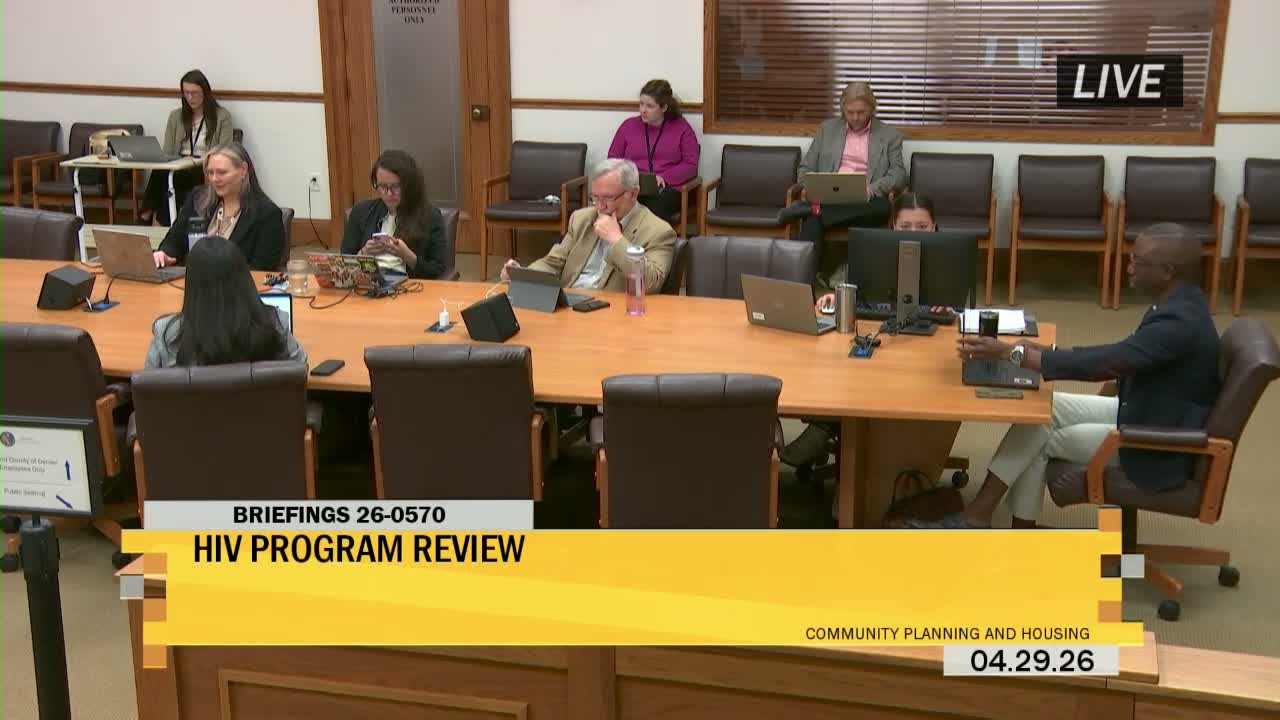
Robert George, HIV Resources Section Manager at the Denver Department of Public Health & Environment, and Kelly Brevard, Program Development Administrator for Ryan White Part A, briefed the Health and Safety Committee on the citys HIV care programs and regional coordination.
The presenters framed the discussion around the Colorado HIV/AIDS Strategy (COHAS), a draft strategic plan they described as a 99-page document that will guide a five-year approach starting in 2027. "It's a 99-page document," George said, and staff will share the finalized sections with council members when available.
George said Denvers Ryan White Part A award for 2025 totaled $7,400,000, a 4.35% drop from the prior year, and that the program currently serves a little more than 5,000 people through 12 funded providers across 10 service categories. He said planning decisions are guided by a Planning Council that must include at least 33% people with lived experience of HIV.
The briefing highlighted racial, ethnic and age disparities in new diagnoses and long-term prevalence. George told the committee there are approximately 15,700 people living with HIV in Colorado, about 70% of whom live in the six-county Denver metropolitan area. He reported 487 new diagnoses statewide in 2024 and said Hispanic/Latino men accounted for roughly 42% of those diagnoses while Black non-Hispanic people made up about 15% of new diagnoses, "and 32% of those new diagnoses were women in that community," he said. George added that, by one measure presented, Black/African American women have an HIV rate 18 times that of white non-Hispanic women.
The presentation contrasted local suppression outcomes with federal benchmarks. George said the statewide viral-suppression rate calculated from clinical data is about 68%, and that clients who receive Ryan White services have an 80% suppression rate; by comparison, HRSA reports roughly a 90% suppression rate among Ryan White clients nationally. Kelly Brevard and George said differences in measurement and client engagement explain some of the gap and stressed a renewed focus on reengagement for people who have fallen out of care.
Council members pressed for more granular data. "Age 50 seems to be a tipping point," Councilmember Kevin Flynn said, asking whether staff can break out new-diagnosis rates by age cohort to better tailor services. George said age-specific sections will be included in the final COHAS and staff can provide those excerpts.
Survey findings and service needs drew sustained attention. George said COHAS collected a quality-of-life survey with 395 respondents (48% in Denver County, average age 48). He said about three in five respondents reported housing stability concerns; 72% said they were satisfied or very satisfied with life; and just over half reported usually having the social or emotional support they need. The committee discussed housing as a major barrier to health care access and retention in care.
On housing assistance, Brevard said the local Ryan White program provides up to $1,500 per client per fiscal year for rent or deposit assistance and coordinates roughly $2,000,000 a year in direct financial assistance in partnership with state resources. George said HOPWA funds administered by HOST also provide eviction-prevention support and housing subsidies for people with HIV, but warned that parts of the federal budget proposed by the president would eliminate HOPWA and other targeted HIV funding streams.
Committee members raised concerns about federal Medicaid changes and work requirements. Several members asked whether clients will be able to keep up with more frequent renewals or new paperwork requirements; George said providers and case managers will need additional capacity to help clients remain enrolled and that the department is preparing outreach and support strategies.
The briefing covered prevention and harm-reduction topics as well: George and Brevard said prevention services (PrEP access, post-exposure prophylaxis training for providers, community-based testing and syringe access programs) are largely state-managed by CDPHE and its prevention partners, and they noted funding pressures for syringe access programs.
George and Brevard named local providers that receive targeted funding for women and communities of color, including Womens AIDS Project, It Takes a Village (Aurora) and Servicios de la Raza.
There were no formal votes or motions at the meeting. Chair Daryl Watts closed by thanking the presenters and moving the consent item; he then adjourned the committee.
Next steps the presenters offered included sharing the COHAS draft sections on age cohorts and following up with CDPHE about drivers of rising identification rates in Denver.
The presenters framed the discussion around the Colorado HIV/AIDS Strategy (COHAS), a draft strategic plan they described as a 99-page document that will guide a five-year approach starting in 2027. "It's a 99-page document," George said, and staff will share the finalized sections with council members when available.
George said Denvers Ryan White Part A award for 2025 totaled $7,400,000, a 4.35% drop from the prior year, and that the program currently serves a little more than 5,000 people through 12 funded providers across 10 service categories. He said planning decisions are guided by a Planning Council that must include at least 33% people with lived experience of HIV.
The briefing highlighted racial, ethnic and age disparities in new diagnoses and long-term prevalence. George told the committee there are approximately 15,700 people living with HIV in Colorado, about 70% of whom live in the six-county Denver metropolitan area. He reported 487 new diagnoses statewide in 2024 and said Hispanic/Latino men accounted for roughly 42% of those diagnoses while Black non-Hispanic people made up about 15% of new diagnoses, "and 32% of those new diagnoses were women in that community," he said. George added that, by one measure presented, Black/African American women have an HIV rate 18 times that of white non-Hispanic women.
The presentation contrasted local suppression outcomes with federal benchmarks. George said the statewide viral-suppression rate calculated from clinical data is about 68%, and that clients who receive Ryan White services have an 80% suppression rate; by comparison, HRSA reports roughly a 90% suppression rate among Ryan White clients nationally. Kelly Brevard and George said differences in measurement and client engagement explain some of the gap and stressed a renewed focus on reengagement for people who have fallen out of care.
Council members pressed for more granular data. "Age 50 seems to be a tipping point," Councilmember Kevin Flynn said, asking whether staff can break out new-diagnosis rates by age cohort to better tailor services. George said age-specific sections will be included in the final COHAS and staff can provide those excerpts.
Survey findings and service needs drew sustained attention. George said COHAS collected a quality-of-life survey with 395 respondents (48% in Denver County, average age 48). He said about three in five respondents reported housing stability concerns; 72% said they were satisfied or very satisfied with life; and just over half reported usually having the social or emotional support they need. The committee discussed housing as a major barrier to health care access and retention in care.
On housing assistance, Brevard said the local Ryan White program provides up to $1,500 per client per fiscal year for rent or deposit assistance and coordinates roughly $2,000,000 a year in direct financial assistance in partnership with state resources. George said HOPWA funds administered by HOST also provide eviction-prevention support and housing subsidies for people with HIV, but warned that parts of the federal budget proposed by the president would eliminate HOPWA and other targeted HIV funding streams.
Committee members raised concerns about federal Medicaid changes and work requirements. Several members asked whether clients will be able to keep up with more frequent renewals or new paperwork requirements; George said providers and case managers will need additional capacity to help clients remain enrolled and that the department is preparing outreach and support strategies.
The briefing covered prevention and harm-reduction topics as well: George and Brevard said prevention services (PrEP access, post-exposure prophylaxis training for providers, community-based testing and syringe access programs) are largely state-managed by CDPHE and its prevention partners, and they noted funding pressures for syringe access programs.
George and Brevard named local providers that receive targeted funding for women and communities of color, including Womens AIDS Project, It Takes a Village (Aurora) and Servicios de la Raza.
There were no formal votes or motions at the meeting. Chair Daryl Watts closed by thanking the presenters and moving the consent item; he then adjourned the committee.
Next steps the presenters offered included sharing the COHAS draft sections on age cohorts and following up with CDPHE about drivers of rising identification rates in Denver.
View the Full Meeting & All Its Details
This article offers just a summary. Unlock complete video, transcripts, and insights as a Founder Member.
✓
Watch full, unedited meeting videos
✓
Search every word spoken in unlimited transcripts
✓
AI summaries & real-time alerts (all government levels)
✓
Permanent access to expanding government content
30-day money-back guarantee
