Director Cleveland outlines curriculum and program review progress, Read Act training and new course offerings
April 29, 2026 | ROSEVILLE PUBLIC SCHOOL DISTRICT, School Boards, Minnesota
This article was created by AI summarizing key points discussed. AI makes mistakes, so for full details and context, please refer to the video of the full meeting. Please report any errors so we can fix them. Report an error »
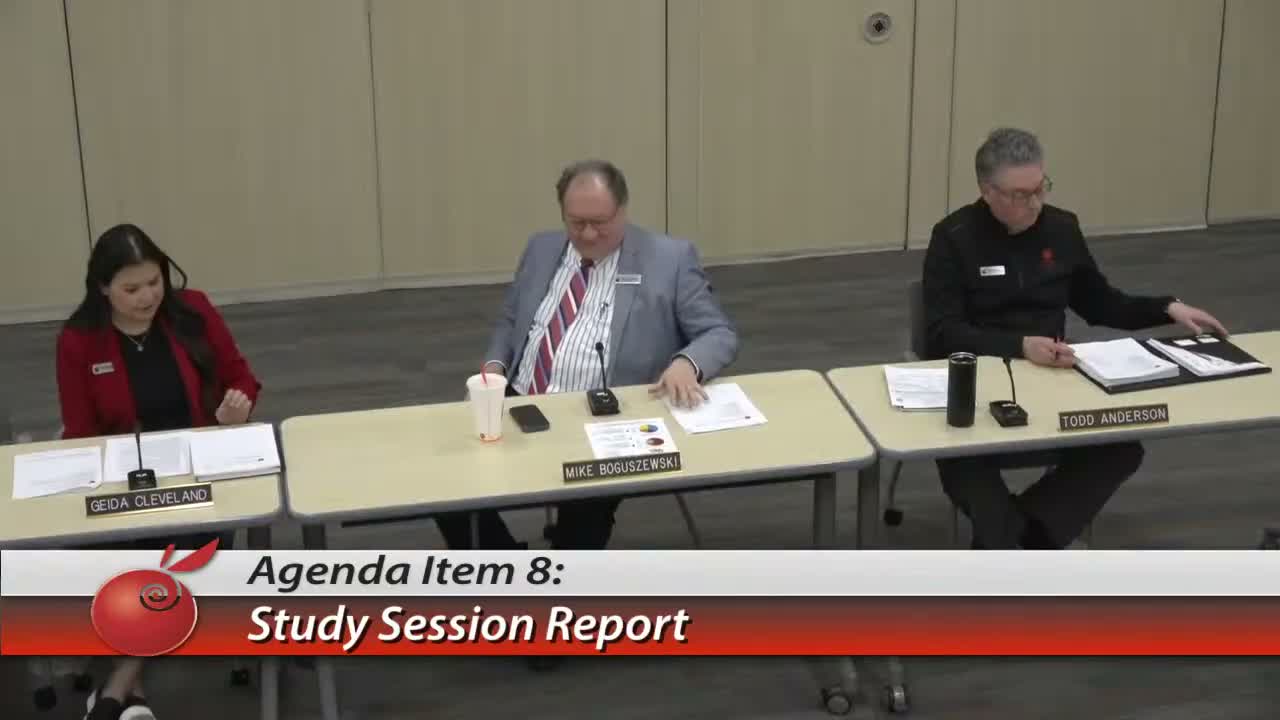
Director Cleveland summarized the district’s curriculum and program review work for the board, describing progress across departments and several implementation items tied to state standards.
Cleveland told the board that departments move through four program-review phases—installation, sustainability, program evaluation and program design—and that visual arts, trade and industry, world languages and other teams have advanced through those phases. The district has added or is preparing new courses, including a cybersecurity course in business and computer technology and a personal finance class (“Managing Your Money”) to meet a new state graduation requirement.
On literacy, Cleveland highlighted the district’s focus on Minnesota’s Read Act: about 120 paraprofessionals and 60 teachers completed the required Read Act training this year; the district will offer the training again in the fall for new staff. Secondary teams will begin a second phase emphasizing morphology and cross‑content vocabulary next year. In social sciences, K–6 teams are reviewing inquiry-based curricula aligned to the 2021 standards, and 7–12 teams completed textbook purchases in preparation for full implementation in the 2026–27 school year, Cleveland said.
Cleveland also described program evaluation and alignment work in multilingual learning, dual-language immersion, media specialist equitable budgeting, and a newly required ninth-grade Earth and Space science course listed as a graduation requirement. He closed by noting Operation MetroSearch and other partnerships that support families and students.
The board received the study-session summary and no public vote was required that evening; Cleveland said more detailed materials and follow-ups will come as departments advance through evaluation and design phases.
Cleveland told the board that departments move through four program-review phases—installation, sustainability, program evaluation and program design—and that visual arts, trade and industry, world languages and other teams have advanced through those phases. The district has added or is preparing new courses, including a cybersecurity course in business and computer technology and a personal finance class (“Managing Your Money”) to meet a new state graduation requirement.
On literacy, Cleveland highlighted the district’s focus on Minnesota’s Read Act: about 120 paraprofessionals and 60 teachers completed the required Read Act training this year; the district will offer the training again in the fall for new staff. Secondary teams will begin a second phase emphasizing morphology and cross‑content vocabulary next year. In social sciences, K–6 teams are reviewing inquiry-based curricula aligned to the 2021 standards, and 7–12 teams completed textbook purchases in preparation for full implementation in the 2026–27 school year, Cleveland said.
Cleveland also described program evaluation and alignment work in multilingual learning, dual-language immersion, media specialist equitable budgeting, and a newly required ninth-grade Earth and Space science course listed as a graduation requirement. He closed by noting Operation MetroSearch and other partnerships that support families and students.
The board received the study-session summary and no public vote was required that evening; Cleveland said more detailed materials and follow-ups will come as departments advance through evaluation and design phases.
Don't Miss a Word: See the Full Meeting!
Go beyond summaries. Unlock every video, transcript, and key insight with a Founder Membership.
✓
Get instant access to full meeting videos
✓
Search and clip any phrase from complete transcripts
✓
Receive AI-powered summaries & custom alerts
✓
Enjoy lifetime, unrestricted access to government data
30-day money-back guarantee
