Residents urge stronger bicycle and pedestrian protections as Richardson proclaims Bike Month
April 27, 2026 | Richardson, Dallas County, Texas
This article was created by AI summarizing key points discussed. AI makes mistakes, so for full details and context, please refer to the video of the full meeting. Please report any errors so we can fix them. Report an error »
Mayor Amir Omar proclaimed May 2026 as Bike Month for the City of Richardson and invited members of the Richardson Bicycle Coalition and the Bicycle and Pedestrian Advisory Commission to the dais for a commemorative photo.
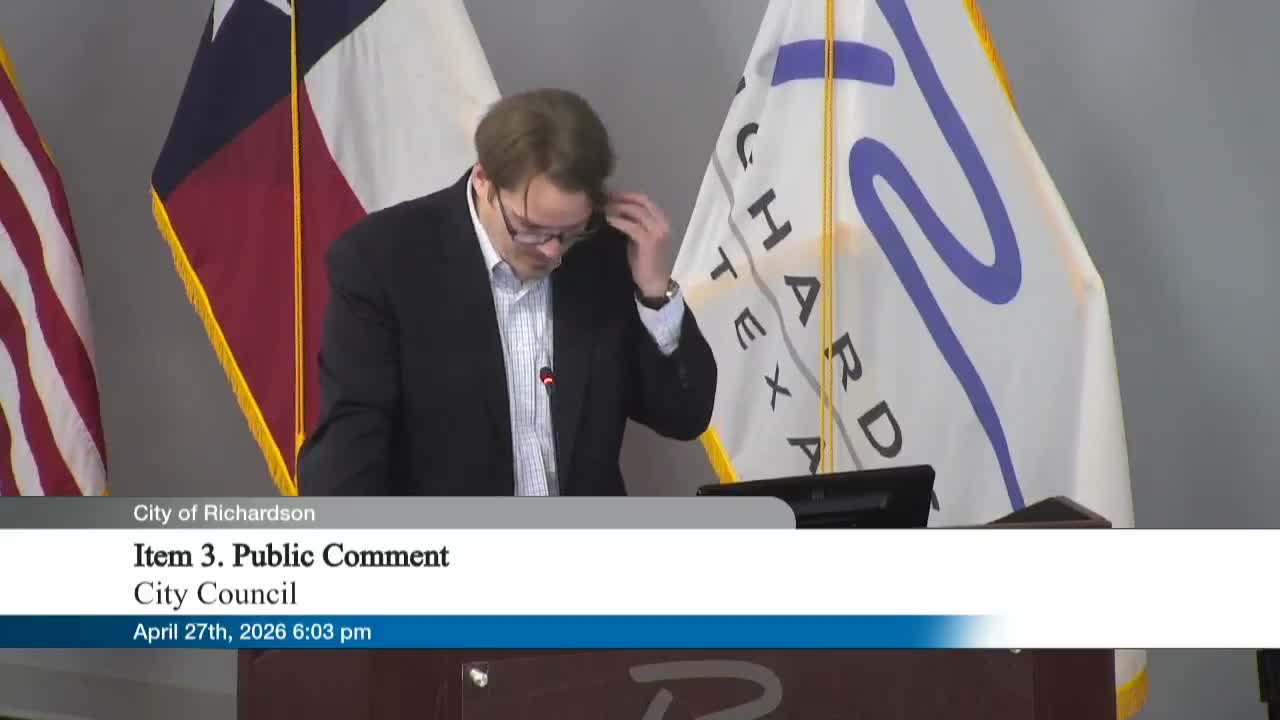
During initial public comment, Matt Peyton of the Richardson Bicycle Coalition thanked the council for the proclamation and pressed elected officials to pursue stronger safety measures. Peyton said the proclamation ‘‘matters’’ because it signals that ‘‘safe cycling and active transportation are community priorities,’’ and he urged action after recent cycling fatalities. He asked the council to support restoring a vulnerable road‑user statute, adopt a statewide three‑foot passing minimum for motorists, strengthen driver education, expand local authority to set 25 mph speed limits on residential streets, and create a quick‑build safety fund for paint, posts and signal timing adjustments that can be deployed in weeks rather than years.
A visiting rider, Gregory Maassen of a Johns Hopkins‑affiliated awareness campaign, praised Richardson’s biking infrastructure after riding into the city. Maassen said he felt ‘‘extremely safe cycling in your city’’ and called the proclamation ‘‘not a symbolic issue’’ but a statement about the kind of city Richardson aims to be.
Marcus Batson, a Richardson Bicycle Coalition board member, highlighted three technical priorities: eliminate signal conflicts where flashing yellow left‑turn arrows overlap pedestrian walk phases, evaluate or temporarily close bypass/slip lanes to measure safety impacts, and accelerate the city’s Vision Zero target (currently a 2050 target) toward an earlier timeline.
The mayor and staff acknowledged the coalition’s work and the council did not take immediate policy action during the meeting; the items were presented as community comments accompanying the proclamation. Council and staff have previously indicated ongoing collaboration with the Bicycle and Pedestrian Advisory Commission and regional partners on protected intersections and trail connectivity.
The council meeting record shows no formal vote or directive tied directly to the public comments; staff invited continued partnership with local advocates and flagged upcoming agenda items and briefings related to the city’s safer‑streets planning.
During initial public comment, Matt Peyton of the Richardson Bicycle Coalition thanked the council for the proclamation and pressed elected officials to pursue stronger safety measures. Peyton said the proclamation ‘‘matters’’ because it signals that ‘‘safe cycling and active transportation are community priorities,’’ and he urged action after recent cycling fatalities. He asked the council to support restoring a vulnerable road‑user statute, adopt a statewide three‑foot passing minimum for motorists, strengthen driver education, expand local authority to set 25 mph speed limits on residential streets, and create a quick‑build safety fund for paint, posts and signal timing adjustments that can be deployed in weeks rather than years.
A visiting rider, Gregory Maassen of a Johns Hopkins‑affiliated awareness campaign, praised Richardson’s biking infrastructure after riding into the city. Maassen said he felt ‘‘extremely safe cycling in your city’’ and called the proclamation ‘‘not a symbolic issue’’ but a statement about the kind of city Richardson aims to be.
Marcus Batson, a Richardson Bicycle Coalition board member, highlighted three technical priorities: eliminate signal conflicts where flashing yellow left‑turn arrows overlap pedestrian walk phases, evaluate or temporarily close bypass/slip lanes to measure safety impacts, and accelerate the city’s Vision Zero target (currently a 2050 target) toward an earlier timeline.
The mayor and staff acknowledged the coalition’s work and the council did not take immediate policy action during the meeting; the items were presented as community comments accompanying the proclamation. Council and staff have previously indicated ongoing collaboration with the Bicycle and Pedestrian Advisory Commission and regional partners on protected intersections and trail connectivity.
The council meeting record shows no formal vote or directive tied directly to the public comments; staff invited continued partnership with local advocates and flagged upcoming agenda items and briefings related to the city’s safer‑streets planning.
View the Full Meeting & All Its Details
This article offers just a summary. Unlock complete video, transcripts, and insights as a Founder Member.
✓
Watch full, unedited meeting videos
✓
Search every word spoken in unlimited transcripts
✓
AI summaries & real-time alerts (all government levels)
✓
Permanent access to expanding government content
30-day money-back guarantee
