Cotati staff outline EIFD feasibility study to unlock infrastructure funding, caution county participation could constrain local control
April 29, 2026 | Cotati City, Sonoma County, California
This article was created by AI summarizing key points discussed. AI makes mistakes, so for full details and context, please refer to the video of the full meeting. Please report any errors so we can fix them. Report an error »
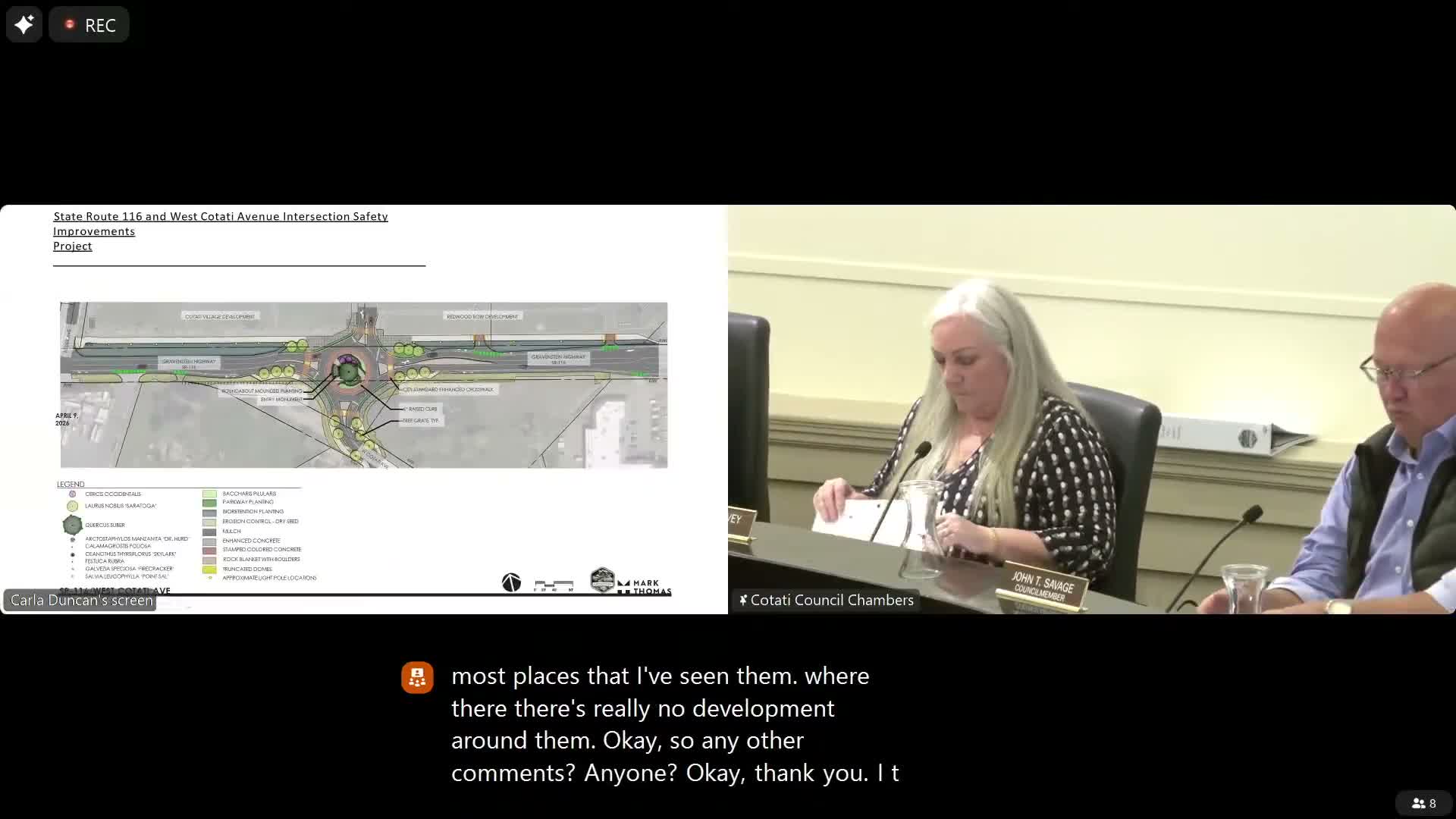
Staff presented an initial feasibility study for an Enhanced Infrastructure Financing District (EIFD) intended to fund infrastructure that would unlock stalled development in Cotati. The proposal covers priority areas including the Gravenstein Corridor, downtown specific-plan area and the train-depot/TOD zone — roughly 185 acres or about 15% of the city — and would aggregate tax-increment from underdeveloped parcels to support projects like sewer/water capacity improvements, roadway work (including the Highway 116 project), and potentially affordable housing.
Staff walked the council through tax-increment mechanics under current state law, emphasizing that school districts are excluded from post-redevelopment tax increment; county contribution would be negotiated separately and the county has established policy principles and a fiscal-review requirement. Initial high-level fiscal outputs included five-year capacity and long-term present-value scenarios (staff cited a roughly $33.7 million five-year capacity figure and larger 50-year nominal totals in staff slides), but staff stressed those numbers are preliminary and depend on pipeline projects and buildout timing.
Councilmembers asked whether a multi-jurisdictional district could result in Cotati funds being used primarily for another jurisdiction’s projects; staff explained districts can be structured with separate project-area accounting and that single-jurisdiction EFIDs are more common. Staff also described potential public-finance authority governance options and said the county and Rohnert Park have been engaged early in parallel conversations. Staff stated the next step is a detailed fiscal analysis; if favorable, council would consider a resolution of intention and the formation process later in the year.
The council provided feedback supportive of pursuing detailed fiscal analysis but raised caution about joint governance except where infrastructure projects cross jurisdictions.
Staff walked the council through tax-increment mechanics under current state law, emphasizing that school districts are excluded from post-redevelopment tax increment; county contribution would be negotiated separately and the county has established policy principles and a fiscal-review requirement. Initial high-level fiscal outputs included five-year capacity and long-term present-value scenarios (staff cited a roughly $33.7 million five-year capacity figure and larger 50-year nominal totals in staff slides), but staff stressed those numbers are preliminary and depend on pipeline projects and buildout timing.
Councilmembers asked whether a multi-jurisdictional district could result in Cotati funds being used primarily for another jurisdiction’s projects; staff explained districts can be structured with separate project-area accounting and that single-jurisdiction EFIDs are more common. Staff also described potential public-finance authority governance options and said the county and Rohnert Park have been engaged early in parallel conversations. Staff stated the next step is a detailed fiscal analysis; if favorable, council would consider a resolution of intention and the formation process later in the year.
The council provided feedback supportive of pursuing detailed fiscal analysis but raised caution about joint governance except where infrastructure projects cross jurisdictions.
View the Full Meeting & All Its Details
This article offers just a summary. Unlock complete video, transcripts, and insights as a Founder Member.
✓
Watch full, unedited meeting videos
✓
Search every word spoken in unlimited transcripts
✓
AI summaries & real-time alerts (all government levels)
✓
Permanent access to expanding government content
30-day money-back guarantee
