Committee backs tightened prison population management and reporting to avert overcrowding
April 28, 2026 | 2026 Legislature CO, Colorado
This article was created by AI summarizing key points discussed. AI makes mistakes, so for full details and context, please refer to the video of the full meeting. Please report any errors so we can fix them. Report an error »
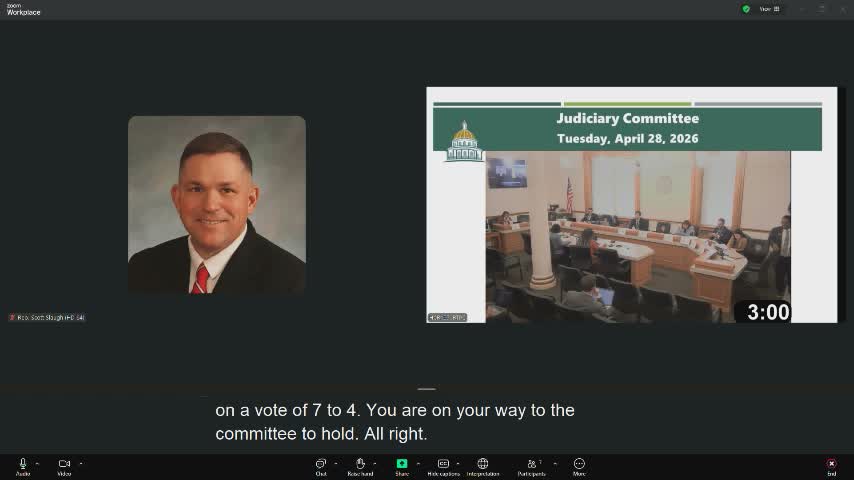
The House Judiciary Committee advanced Senate Bill 2636 (referred to in the hearing as SB36/SB2636), a bill to strengthen Colorado’s prison population management trigger and create clearer timelines, reporting and coordination to avoid overcrowding and costly prison expansion. The committee voted to send the bill to Appropriations by approximately 7–4.
Sponsors said the measure fixes gaps in the 2018 trigger law by clarifying notification duties, shortening response timelines, and directing a working group to prioritize eligible people for parole review or community corrections placement. "Rather than buying another building, we have almost 5,000 people that we can be moving toward a direction of out behind the walls," one sponsor said, arguing the bill saves money and improves safety for staff and those incarcerated.
Support came from DOC allies and reentry organizations. Leo Janes of Healthier Colorado and Josef Lopez of Servicios de la Raza said the bill redirects focus to reentry services and avoiding expansion that diverts funds from health and human services.
Opponents reiterated concerns raised in other panels that the package of bills could lead to earlier releases of people some consider high risk; Missy Espinosa testified the package would harm neighborhoods and urged members to vote no.
Sponsors said the bill targets low‑level and technical violation cases for expedited processing, includes guardrails excluding recent disciplinary infractions, and requires agencies to coordinate daily bed counts and placement availability. The committee moved the bill to Appropriations with a favorable recommendation.
Sponsors said the measure fixes gaps in the 2018 trigger law by clarifying notification duties, shortening response timelines, and directing a working group to prioritize eligible people for parole review or community corrections placement. "Rather than buying another building, we have almost 5,000 people that we can be moving toward a direction of out behind the walls," one sponsor said, arguing the bill saves money and improves safety for staff and those incarcerated.
Support came from DOC allies and reentry organizations. Leo Janes of Healthier Colorado and Josef Lopez of Servicios de la Raza said the bill redirects focus to reentry services and avoiding expansion that diverts funds from health and human services.
Opponents reiterated concerns raised in other panels that the package of bills could lead to earlier releases of people some consider high risk; Missy Espinosa testified the package would harm neighborhoods and urged members to vote no.
Sponsors said the bill targets low‑level and technical violation cases for expedited processing, includes guardrails excluding recent disciplinary infractions, and requires agencies to coordinate daily bed counts and placement availability. The committee moved the bill to Appropriations with a favorable recommendation.
View the Full Meeting & All Its Details
This article offers just a summary. Unlock complete video, transcripts, and insights as a Founder Member.
✓
Watch full, unedited meeting videos
✓
Search every word spoken in unlimited transcripts
✓
AI summaries & real-time alerts (all government levels)
✓
Permanent access to expanding government content
30-day money-back guarantee
