Senate hearing examines proposal to create statewide educator insurance pool; cost concerns raised
April 28, 2026 | 2026 Legislature MN, Minnesota
This article was created by AI summarizing key points discussed. AI makes mistakes, so for full details and context, please refer to the video of the full meeting. Please report any errors so we can fix them. Report an error »
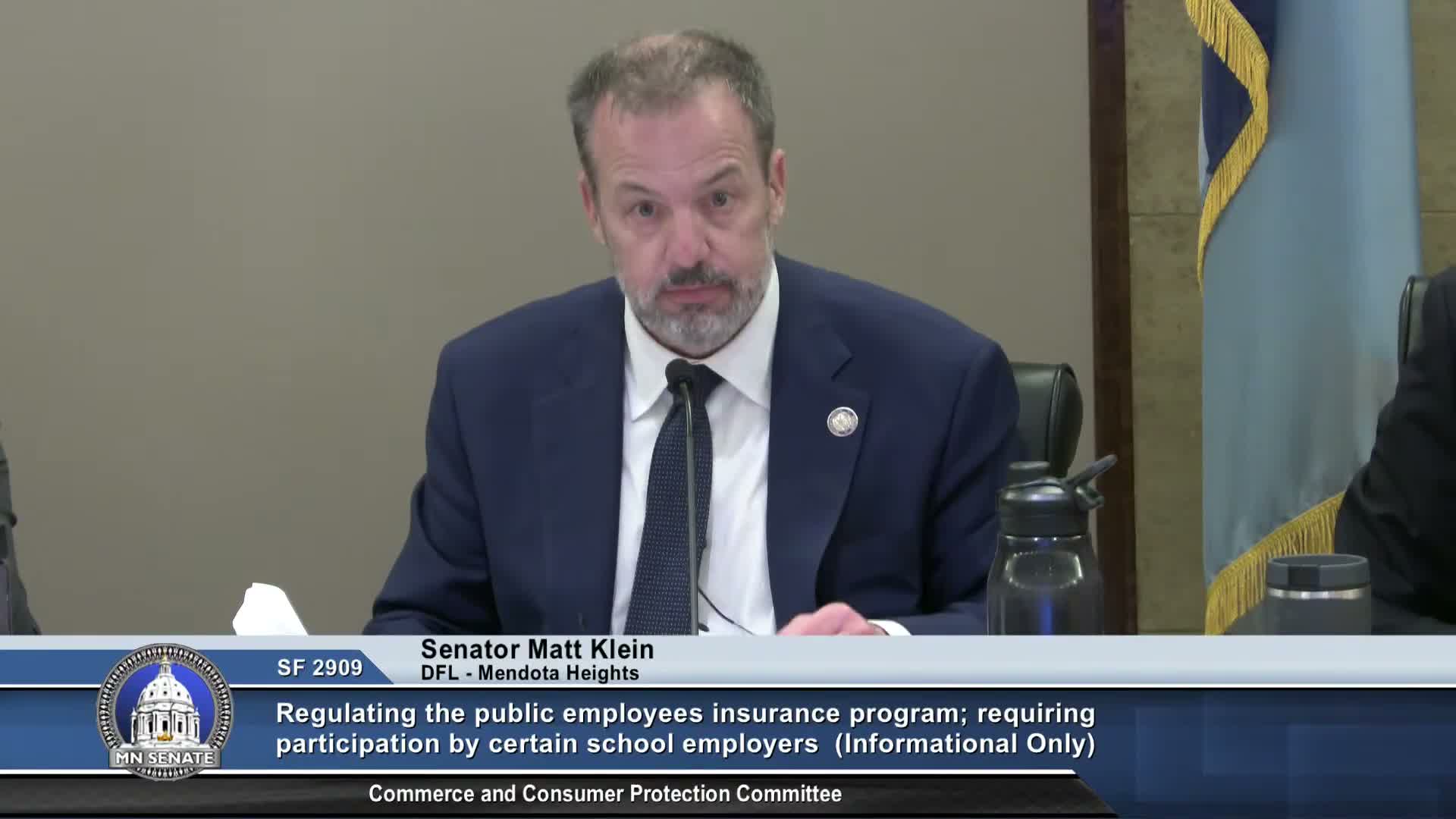
Senate File 2909, which would create a statewide Educator Group Insurance Program (EGIP) and allow school employees to move into a single self‑insured pool, drew lengthy testimony about escalating health‑insurance costs for educators and the tradeoffs of centralizing coverage.
Adam Janiak of Education Minnesota said EGIP would spread risk across all districts, reduce administrative duplication and give the state bargaining leverage similar to the State Employees Group Insurance Program. John Wolpachter (president of a local union) and classroom educators detailed large premium increases in recent years — including district averages of 22% and specific examples of unaffordable family premiums — and said EGIP could stabilize and make coverage affordable for more school employees.
School administrators and the Minnesota School Boards Association warned the committee that the proposal would transfer significant costs to the state and remove local flexibility in plan design. Kirk Schneider, executive director of the Minnesota School Boards Association, estimated on the record that state supplementation for EGIP could be on the order of $1,000,000,000, and he urged a full independent fiscal analysis before advancing the proposal.
Testimony also covered program design details found in the bill: eligibility for employees working at least 14 hours per week, mandated minimum employer contribution levels (95% single, 85% family in the bill text as presented), and a state aid stream (section 14) intended to offset district costs. School‑side witnesses argued these contribution requirements would be disruptive and could reduce locally negotiated salary or benefit tradeoffs.
The committee treated SF 2909 as informational, acknowledged the need for a full fiscal note and a study, and asked for comparative alternatives including stop‑loss programs, governance design, and actuarial modeling.
Adam Janiak of Education Minnesota said EGIP would spread risk across all districts, reduce administrative duplication and give the state bargaining leverage similar to the State Employees Group Insurance Program. John Wolpachter (president of a local union) and classroom educators detailed large premium increases in recent years — including district averages of 22% and specific examples of unaffordable family premiums — and said EGIP could stabilize and make coverage affordable for more school employees.
School administrators and the Minnesota School Boards Association warned the committee that the proposal would transfer significant costs to the state and remove local flexibility in plan design. Kirk Schneider, executive director of the Minnesota School Boards Association, estimated on the record that state supplementation for EGIP could be on the order of $1,000,000,000, and he urged a full independent fiscal analysis before advancing the proposal.
Testimony also covered program design details found in the bill: eligibility for employees working at least 14 hours per week, mandated minimum employer contribution levels (95% single, 85% family in the bill text as presented), and a state aid stream (section 14) intended to offset district costs. School‑side witnesses argued these contribution requirements would be disruptive and could reduce locally negotiated salary or benefit tradeoffs.
The committee treated SF 2909 as informational, acknowledged the need for a full fiscal note and a study, and asked for comparative alternatives including stop‑loss programs, governance design, and actuarial modeling.
View the Full Meeting & All Its Details
This article offers just a summary. Unlock complete video, transcripts, and insights as a Founder Member.
✓
Watch full, unedited meeting videos
✓
Search every word spoken in unlimited transcripts
✓
AI summaries & real-time alerts (all government levels)
✓
Permanent access to expanding government content
30-day money-back guarantee
