Lynn Haven reviews early designs and costs for two "living shorelines" to slow erosion
April 29, 2026 | Lynn Haven, Bay County, Florida
This article was created by AI summarizing key points discussed. AI makes mistakes, so for full details and context, please refer to the video of the full meeting. Please report any errors so we can fix them. Report an error »
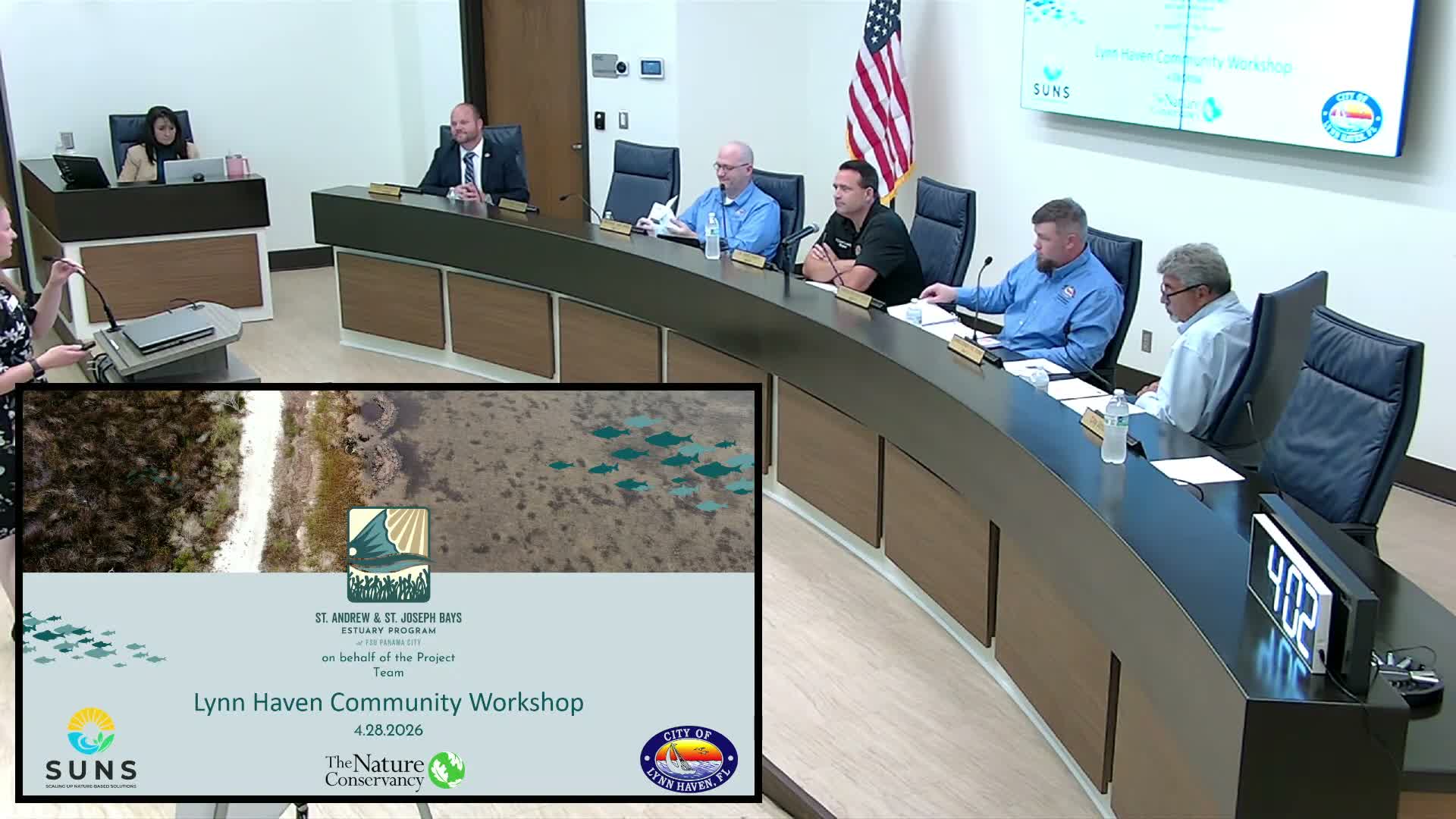
Lynn Haven commissioners on Tuesday received an information-only briefing on two early-stage "living shoreline" projects aimed at slowing shoreline erosion and restoring marsh habitat along the bay.
Dr. Jessica Graham, who led the community outreach and project identification steps, said the Nature Conservancy helped identify 72 initial candidate projects across the estuary, and the city is now advancing two into the feasibility and schematic-design phases: a stretch of shoreline at the wastewater treatment pond and a longer reach at Lynn Haven Bayou Park & Preserve. "We are only at that feasibility stage," Graham said, adding the team wants public feedback as design advances.
Consultants from Jacobs Engineering presented concept designs and tradeoffs among three reef-style options: quarry limestone riprap, precast interlocking "oyster castle" blocks, and precast modular "reef balls." David Bell of Jacobs described how offshore reef structures—placed roughly 50 feet from shore and set at about a foot above mean high tide in the concepts shown—would break wave energy before it reaches the bank and encourage marsh and seagrass regrowth. "They're not gonna solve for a once-in-a-generation storm," Bell said, "but they can be a very cost-effective additional layer of insurance."
Bell emphasized the designs remain schematic: Jacobs has completed site surveys and basic subsurface checks and can produce quantity takeoffs to refine cost estimates and support permit applications. He said the wastewater-site concept focuses on a critical ~300-linear-foot reach where bank loss has exposed piers and a chain-link fence; larger, fewer reef structures were recommended there because of higher wave energy behind the bank.
On costs, the consultants presented wide, order-of-magnitude ranges reflecting early-stage uncertainty and contingencies. They described approximate ranges for material options (as presented): limestone riprap, oyster-castle blocks, and reef balls, with project-level totals said to range from the low hundreds of thousands to over a million dollars depending on material choice and contingencies. Bell cautioned these figures are "very preliminary" and expected to narrow as design and permitting progress.
Commissioners asked about funding sources. Dr. Graham said Resilient Florida grants have preconstruction restrictions and higher match requirements and the city likely would not qualify for match waivers at this stage. She said both projects were submitted to the National Fish & Wildlife Foundation (NFWF) National Coastal Resilience Fund as letters of intent; the team expects to hear in May whether they will be invited to submit full proposals (mid-June deadlines for proposals were cited). "That would be a request if we're asked for a full proposal for sure," she said when commissioners asked whether a letter of support from the commission would help.
Commissioners also discussed longer-term options if the wastewater treatment plant relocates. Dr. Graham said reefs could still be appropriate but the design and allowable risk tolerances would change; she referenced the project's handout, which estimates post‑Hurricane Michael erosion at about one foot per year at that site. Commissioners noted that even if the treatment facility is moved and the pond converted to green space, the shoreline would still need protection.
A commissioner suggested displaying the presentation easels and handouts in the City Hall lobby for public review; Dr. Graham agreed. The commission asked staff to work with the city manager on drafting a letter of support should the projects be invited to full grant proposals. No formal action, vote or funding commitment was taken during the workshop.
The workshop concluded with thanks to the presenters and a note that further design work and permitting would narrow costs and support future grant applications.
Dr. Jessica Graham, who led the community outreach and project identification steps, said the Nature Conservancy helped identify 72 initial candidate projects across the estuary, and the city is now advancing two into the feasibility and schematic-design phases: a stretch of shoreline at the wastewater treatment pond and a longer reach at Lynn Haven Bayou Park & Preserve. "We are only at that feasibility stage," Graham said, adding the team wants public feedback as design advances.
Consultants from Jacobs Engineering presented concept designs and tradeoffs among three reef-style options: quarry limestone riprap, precast interlocking "oyster castle" blocks, and precast modular "reef balls." David Bell of Jacobs described how offshore reef structures—placed roughly 50 feet from shore and set at about a foot above mean high tide in the concepts shown—would break wave energy before it reaches the bank and encourage marsh and seagrass regrowth. "They're not gonna solve for a once-in-a-generation storm," Bell said, "but they can be a very cost-effective additional layer of insurance."
Bell emphasized the designs remain schematic: Jacobs has completed site surveys and basic subsurface checks and can produce quantity takeoffs to refine cost estimates and support permit applications. He said the wastewater-site concept focuses on a critical ~300-linear-foot reach where bank loss has exposed piers and a chain-link fence; larger, fewer reef structures were recommended there because of higher wave energy behind the bank.
On costs, the consultants presented wide, order-of-magnitude ranges reflecting early-stage uncertainty and contingencies. They described approximate ranges for material options (as presented): limestone riprap, oyster-castle blocks, and reef balls, with project-level totals said to range from the low hundreds of thousands to over a million dollars depending on material choice and contingencies. Bell cautioned these figures are "very preliminary" and expected to narrow as design and permitting progress.
Commissioners asked about funding sources. Dr. Graham said Resilient Florida grants have preconstruction restrictions and higher match requirements and the city likely would not qualify for match waivers at this stage. She said both projects were submitted to the National Fish & Wildlife Foundation (NFWF) National Coastal Resilience Fund as letters of intent; the team expects to hear in May whether they will be invited to submit full proposals (mid-June deadlines for proposals were cited). "That would be a request if we're asked for a full proposal for sure," she said when commissioners asked whether a letter of support from the commission would help.
Commissioners also discussed longer-term options if the wastewater treatment plant relocates. Dr. Graham said reefs could still be appropriate but the design and allowable risk tolerances would change; she referenced the project's handout, which estimates post‑Hurricane Michael erosion at about one foot per year at that site. Commissioners noted that even if the treatment facility is moved and the pond converted to green space, the shoreline would still need protection.
A commissioner suggested displaying the presentation easels and handouts in the City Hall lobby for public review; Dr. Graham agreed. The commission asked staff to work with the city manager on drafting a letter of support should the projects be invited to full grant proposals. No formal action, vote or funding commitment was taken during the workshop.
The workshop concluded with thanks to the presenters and a note that further design work and permitting would narrow costs and support future grant applications.
View the Full Meeting & All Its Details
This article offers just a summary. Unlock complete video, transcripts, and insights as a Founder Member.
✓
Watch full, unedited meeting videos
✓
Search every word spoken in unlimited transcripts
✓
AI summaries & real-time alerts (all government levels)
✓
Permanent access to expanding government content
30-day money-back guarantee
