State adds tertiary in‑state backup and reports 37% rise in 988 call volume
April 28, 2026 | Board Council Commission Agencies , Executive, Washington
This article was created by AI summarizing key points discussed. AI makes mistakes, so for full details and context, please refer to the video of the full meeting. Please report any errors so we can fix them. Report an error »
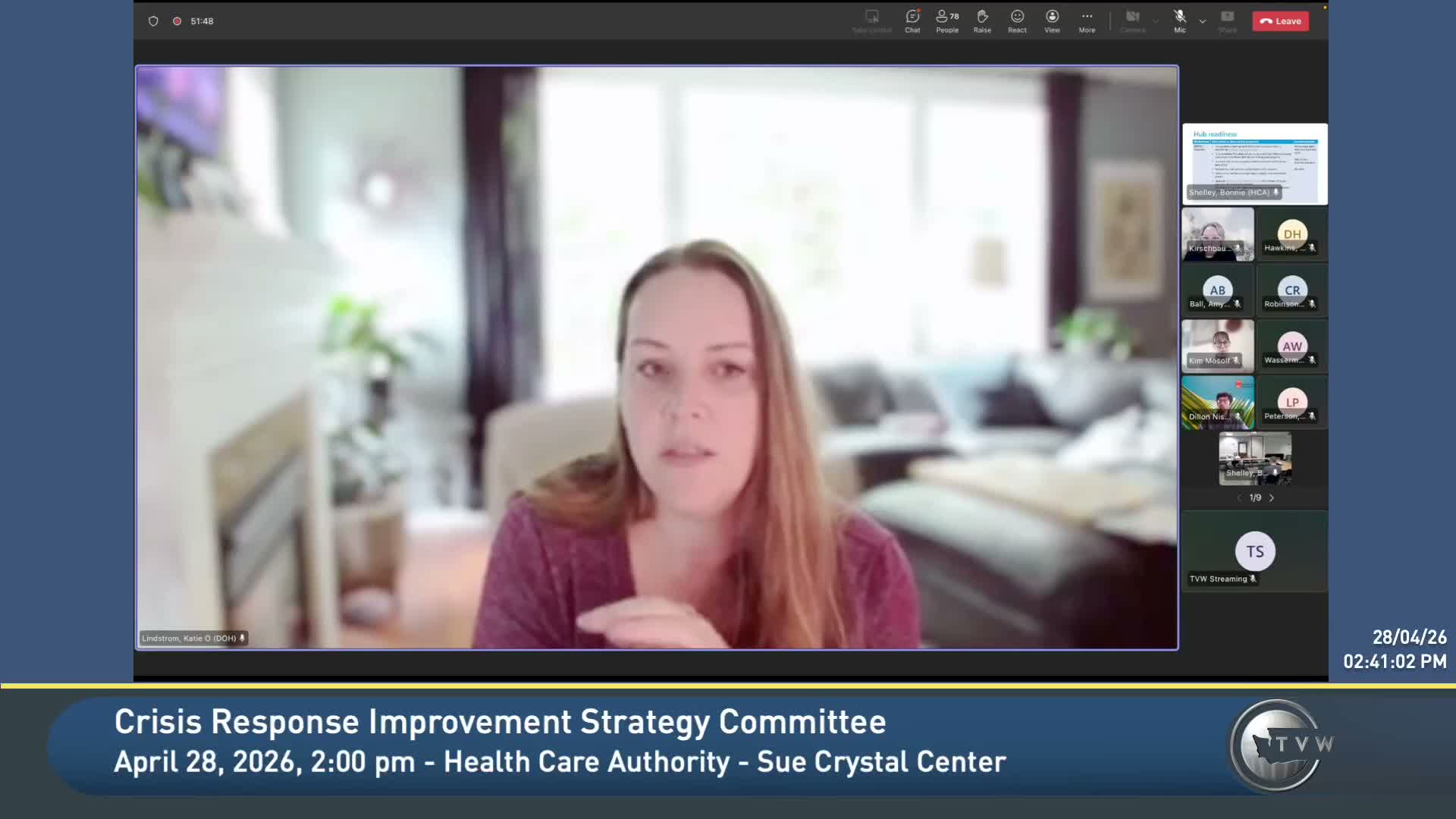
Katie Lindstrom of the Department of Health briefed the CRIS Committee that hub readiness work is on schedule for a July 1 implementation. She said readiness tools, contract orientations and required trainings are largely complete and that calls will be routed first to a primary provider, then to a backup and — starting July 1 — to a tertiary in‑state backup before going to national fallback. "We're hoping by adding this third layer, that virtually all calls are gonna be answered in state," Lindstrom said.
Lindstrom presented data that call volumes for the 988 system increased roughly 37% from 2024 to 2025, with regional variation (examples in transcript: OHS +30%, VOA +49%, Crisis Connections +28%, Frontier +66%). She and Michelle Roberts said the legislature provided additional operational funding to help hubs manage increased call volume and to expand follow‑up for specific populations, such as LGBTQ+ youth.
Staff also discussed integration opportunities where the same provider covers both 988 and regional crisis line (RCL) functions; they said integrated models can reduce transfers and improve continuity of care when vertical alignment exists between services.
Katie said routing maps were submitted to Vibrant for testing and that the extra backup layer aims to reduce national fallback routing and improve in‑state coordination for mobile crisis responses.
Lindstrom presented data that call volumes for the 988 system increased roughly 37% from 2024 to 2025, with regional variation (examples in transcript: OHS +30%, VOA +49%, Crisis Connections +28%, Frontier +66%). She and Michelle Roberts said the legislature provided additional operational funding to help hubs manage increased call volume and to expand follow‑up for specific populations, such as LGBTQ+ youth.
Staff also discussed integration opportunities where the same provider covers both 988 and regional crisis line (RCL) functions; they said integrated models can reduce transfers and improve continuity of care when vertical alignment exists between services.
Katie said routing maps were submitted to Vibrant for testing and that the extra backup layer aims to reduce national fallback routing and improve in‑state coordination for mobile crisis responses.
Don't Miss a Word: See the Full Meeting!
Go beyond summaries. Unlock every video, transcript, and key insight with a Founder Membership.
✓
Get instant access to full meeting videos
✓
Search and clip any phrase from complete transcripts
✓
Receive AI-powered summaries & custom alerts
✓
Enjoy lifetime, unrestricted access to government data
30-day money-back guarantee
