Senate Committee on Retirement advances four sheriff pension bills
April 20, 2026 | 2026 Legislature DE, Legislative, Delaware
This article was created by AI summarizing key points discussed. AI makes mistakes, so for full details and context, please refer to the video of the full meeting. Please report any errors so we can fix them. Report an error »
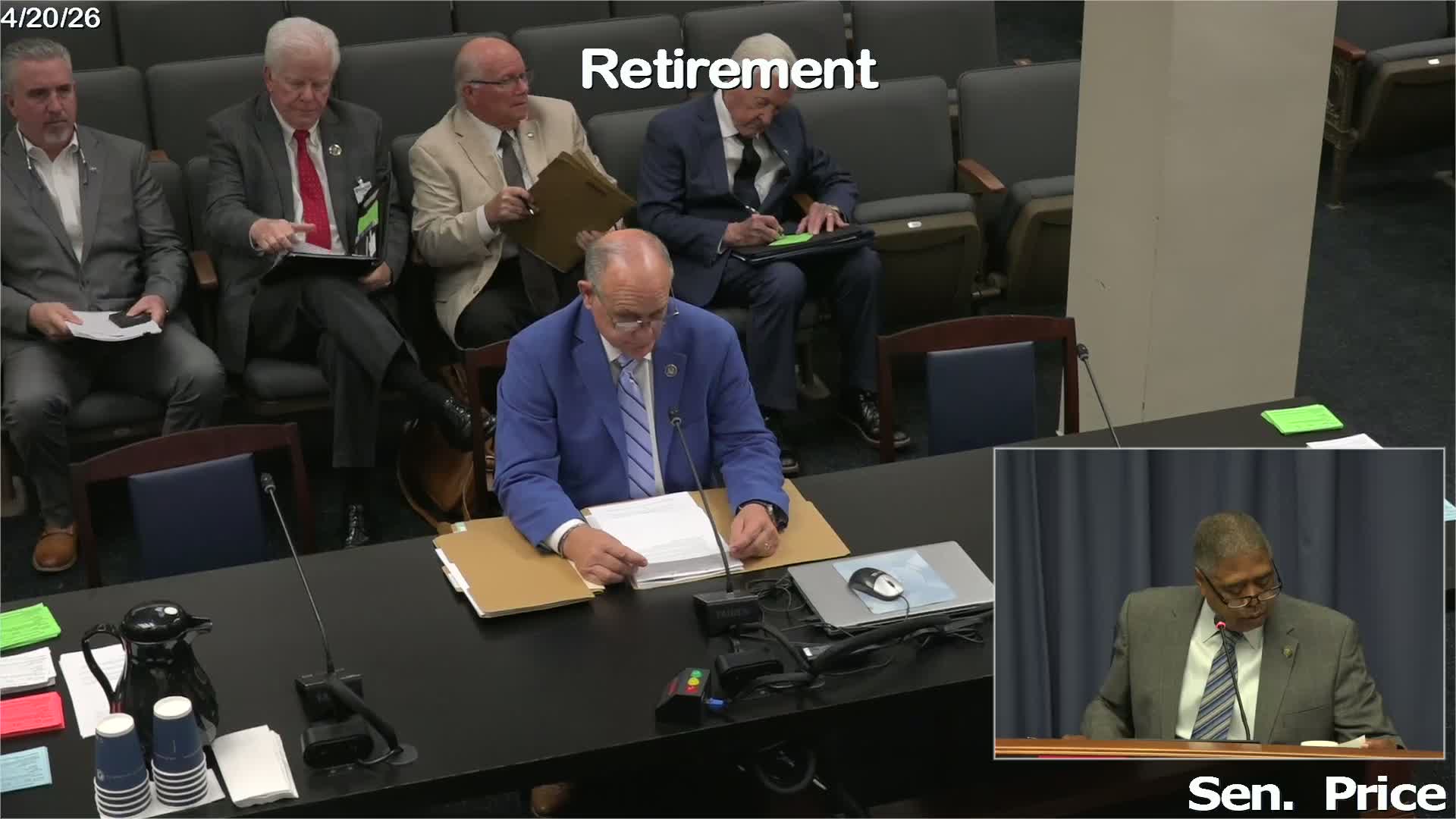
Chairman Price, chair of the Senate Committee on Retirement, presided over a April 20 committee meeting that reported four bills related to sheriff pension plans favorably, with no recorded opposition.
The bills address participation and benefit options in the Louisiana Sheriffs and Deputies Pension Plan and the sheriff pension and relief funds. Lawmakers and plan officials said the measures aim to preserve actuarial soundness while giving local boards flexibility and limited additional benefits to certain employees.
Representative Bacalhau, sponsor of House Bill 48, told the committee the bill would allow Orleans Parish deputies who serve as criers for the Louisiana Supreme Court to participate in the sheriff's pension fund. "If they're currently in another retirement system, they get the choice — they can stay in their system they're in or they can move to the sheriff's retirement system," Bacalhau said. Supporters from the sheriffs' association signaled their backing and the committee reported HB 48 favorably.
House Bill 33, presented by Representative Wiley, would extend the "backdrop" retirement option from four years at 30 years' service to a five‑year backdrop at 35 years' service. Skip McGee, executive director of the Sheriff's Pension Fund, said the change is intended to "incentivize [deputies] to stay longer and use that experience" and that the fund's board supports the proposal. McGee said the proposal would have "no state cost" and showed an estimated actuarial effect of roughly "a quarter of a percent over time." Senator Henskin asked technical questions about how the lump‑sum backdrop benefit is calculated; Greg Curran, an actuary for the plan, explained that the lump sum equals the monthly maximum benefit multiplied by the months chosen for the backdrop (for a five‑year backdrop, 60 times the monthly maximum).
House Bill 34 would adjust retirement eligibility rules in the post‑2012 tier, allowing certain members to retire at age 50 with an actuarially reduced benefit rather than waiting until 55. Plan officials said the reduction is structured to be actuarially neutral to the system. The committee moved HB 34 favorably.
House Bill 35 would permit the Sheriff's Pension Fund Board of Trustees to set the employer contribution rate up to 3 percentage points above the minimum employer contribution and place the excess in a funding deposit account. Skip McGee described the account as a "rainy day fund" that has been used previously to manage employer contribution obligations; he said the fund currently holds about $6,000,000,000 in assets and that deposits from an increased employer contribution could be used only for limited purposes such as reducing the unfunded accrued liability or paying portions of employer contributions. The statute cited in the discussion (transcribed as "RS eleven-one 105") was referenced as governing permitted uses of that account. The committee reported HB 35 favorably.
All four bills were advanced on motions and "seeing no objection" were reported favorably by the committee; no roll‑call votes were recorded in the transcript. The meeting concluded after a motion to adjourn by Senator Henskin.
What happens next: Each bill was reported favorably out of committee and will proceed according to the legislature's calendar; the transcript does not record subsequent scheduling or final floor actions.
The bills address participation and benefit options in the Louisiana Sheriffs and Deputies Pension Plan and the sheriff pension and relief funds. Lawmakers and plan officials said the measures aim to preserve actuarial soundness while giving local boards flexibility and limited additional benefits to certain employees.
Representative Bacalhau, sponsor of House Bill 48, told the committee the bill would allow Orleans Parish deputies who serve as criers for the Louisiana Supreme Court to participate in the sheriff's pension fund. "If they're currently in another retirement system, they get the choice — they can stay in their system they're in or they can move to the sheriff's retirement system," Bacalhau said. Supporters from the sheriffs' association signaled their backing and the committee reported HB 48 favorably.
House Bill 33, presented by Representative Wiley, would extend the "backdrop" retirement option from four years at 30 years' service to a five‑year backdrop at 35 years' service. Skip McGee, executive director of the Sheriff's Pension Fund, said the change is intended to "incentivize [deputies] to stay longer and use that experience" and that the fund's board supports the proposal. McGee said the proposal would have "no state cost" and showed an estimated actuarial effect of roughly "a quarter of a percent over time." Senator Henskin asked technical questions about how the lump‑sum backdrop benefit is calculated; Greg Curran, an actuary for the plan, explained that the lump sum equals the monthly maximum benefit multiplied by the months chosen for the backdrop (for a five‑year backdrop, 60 times the monthly maximum).
House Bill 34 would adjust retirement eligibility rules in the post‑2012 tier, allowing certain members to retire at age 50 with an actuarially reduced benefit rather than waiting until 55. Plan officials said the reduction is structured to be actuarially neutral to the system. The committee moved HB 34 favorably.
House Bill 35 would permit the Sheriff's Pension Fund Board of Trustees to set the employer contribution rate up to 3 percentage points above the minimum employer contribution and place the excess in a funding deposit account. Skip McGee described the account as a "rainy day fund" that has been used previously to manage employer contribution obligations; he said the fund currently holds about $6,000,000,000 in assets and that deposits from an increased employer contribution could be used only for limited purposes such as reducing the unfunded accrued liability or paying portions of employer contributions. The statute cited in the discussion (transcribed as "RS eleven-one 105") was referenced as governing permitted uses of that account. The committee reported HB 35 favorably.
All four bills were advanced on motions and "seeing no objection" were reported favorably by the committee; no roll‑call votes were recorded in the transcript. The meeting concluded after a motion to adjourn by Senator Henskin.
What happens next: Each bill was reported favorably out of committee and will proceed according to the legislature's calendar; the transcript does not record subsequent scheduling or final floor actions.
View the Full Meeting & All Its Details
This article offers just a summary. Unlock complete video, transcripts, and insights as a Founder Member.
✓
Watch full, unedited meeting videos
✓
Search every word spoken in unlimited transcripts
✓
AI summaries & real-time alerts (all government levels)
✓
Permanent access to expanding government content
30-day money-back guarantee
