Committee approves study to map food deserts, shifts mapping responsibilities to LSU AgCenter
April 27, 2026 | 2026 Legislature LA, Louisiana
This article was created by AI summarizing key points discussed. AI makes mistakes, so for full details and context, please refer to the video of the full meeting. Please report any errors so we can fix them. Report an error »
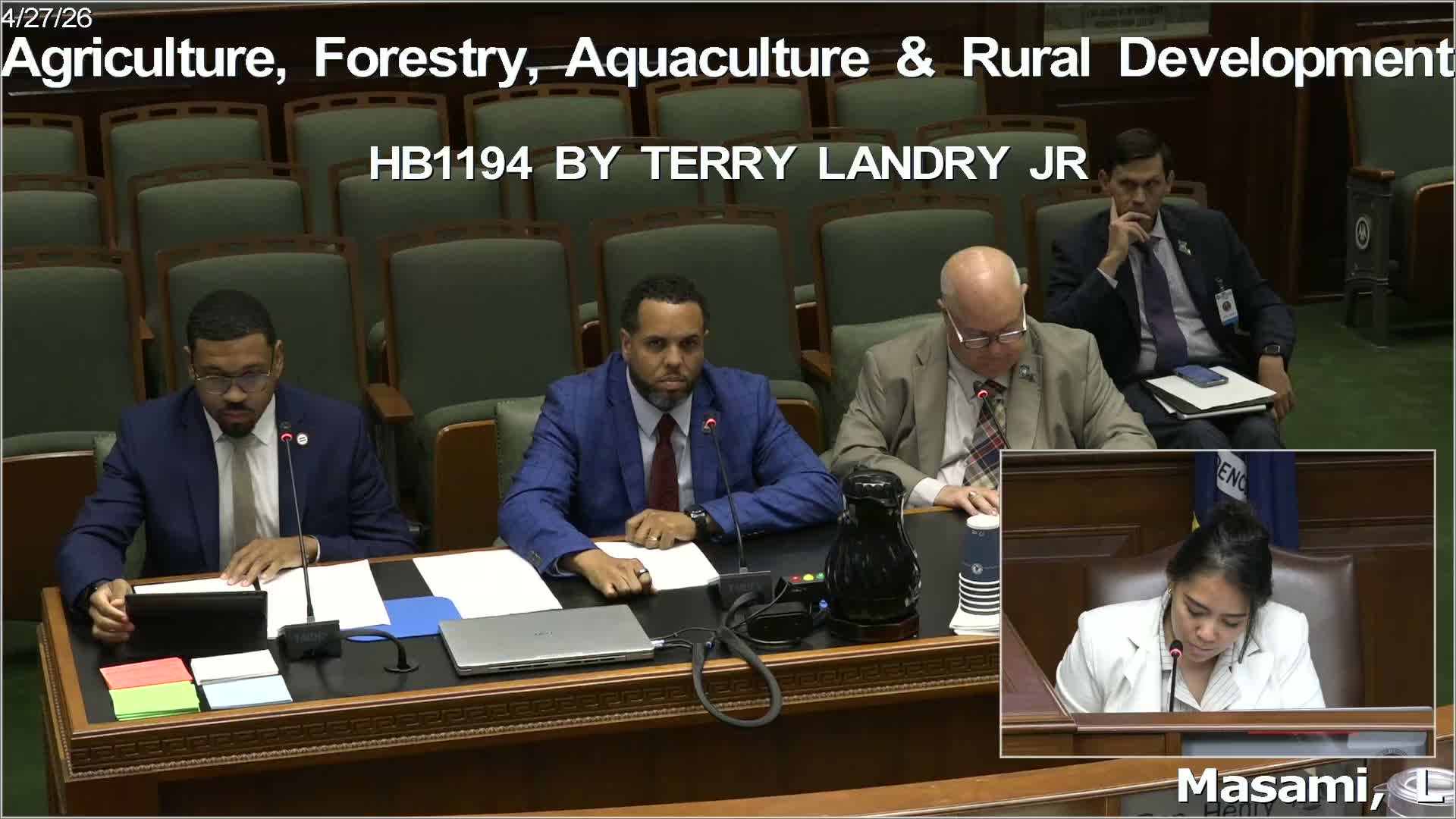
The House Agriculture Committee voted to report HB1194, an amendment package that directs the LSU AgCenter to identify and map food deserts across the state, create a public-facing geospatial database, and develop a 10‑year elimination plan with annual benchmarks.
Representative Terry Landry, sponsor of the amended bill, said the change moves technical research and mapping from the Department of Agriculture and Forestry to LSU’s research arm. "We already have the Healthy Food Retail Act," Landry said. "What we do not have is a strong definition or a definition for food deserts here in Louisiana." The bill adopts the USDA definition in its text.
The amendments (numbers 5–7 in the packet) transfer responsibility to the LSU AgCenter to identify food deserts, maintain an accessible public database and prepare the 10‑year plan; other amendments shift annual reporting duties to the AgCenter. Committee materials list a set of technical amendments as well.
Commissioner Strain and other witnesses explained how the program historically worked as a competitive grant and matching program administered through the Agriculture Finance Authority and offered examples, including the Fresh Food Financing Initiative in Pennsylvania and local projects such as the Red Stick Market and certain Whole Foods partnerships. Members raised practical questions about whether a one‑mile urban radius is sufficient for viability in every context, about funding sources and whether the program can be structured to launch stores that later become self‑sustaining.
Representative McCormick objected when the motion to report favorably was called; the secretary conducted a roll-call vote with 10 yeses and 3 noes, after which the committee reported the bill favorably.
What happens next: HB1194 is headed to the next legislative stage with the mandate for LSU AgCenter to prepare mapping, data and an elimination plan that lawmakers could use to evaluate any later appropriation requests.
Provenance: bill read and amendments described (SEG 1176–SEG 1203), sponsor presentation and Q&A (SEG 1219–SEG 1380), detailed floor-style questioning about funding and definition (SEG 1399–SEG 1760), roll-call (SEG 2160–SEG 2204).
Representative Terry Landry, sponsor of the amended bill, said the change moves technical research and mapping from the Department of Agriculture and Forestry to LSU’s research arm. "We already have the Healthy Food Retail Act," Landry said. "What we do not have is a strong definition or a definition for food deserts here in Louisiana." The bill adopts the USDA definition in its text.
The amendments (numbers 5–7 in the packet) transfer responsibility to the LSU AgCenter to identify food deserts, maintain an accessible public database and prepare the 10‑year plan; other amendments shift annual reporting duties to the AgCenter. Committee materials list a set of technical amendments as well.
Commissioner Strain and other witnesses explained how the program historically worked as a competitive grant and matching program administered through the Agriculture Finance Authority and offered examples, including the Fresh Food Financing Initiative in Pennsylvania and local projects such as the Red Stick Market and certain Whole Foods partnerships. Members raised practical questions about whether a one‑mile urban radius is sufficient for viability in every context, about funding sources and whether the program can be structured to launch stores that later become self‑sustaining.
Representative McCormick objected when the motion to report favorably was called; the secretary conducted a roll-call vote with 10 yeses and 3 noes, after which the committee reported the bill favorably.
What happens next: HB1194 is headed to the next legislative stage with the mandate for LSU AgCenter to prepare mapping, data and an elimination plan that lawmakers could use to evaluate any later appropriation requests.
Provenance: bill read and amendments described (SEG 1176–SEG 1203), sponsor presentation and Q&A (SEG 1219–SEG 1380), detailed floor-style questioning about funding and definition (SEG 1399–SEG 1760), roll-call (SEG 2160–SEG 2204).
Don't Miss a Word: See the Full Meeting!
Go beyond summaries. Unlock every video, transcript, and key insight with a Founder Membership.
✓
Get instant access to full meeting videos
✓
Search and clip any phrase from complete transcripts
✓
Receive AI-powered summaries & custom alerts
✓
Enjoy lifetime, unrestricted access to government data
30-day money-back guarantee
