NASEO, NEI tell Delaware: coordinate regionally and with the NRC as licensing rules evolve
April 20, 2026 | 2026 Legislature DE, Legislative, Delaware
This article was created by AI summarizing key points discussed. AI makes mistakes, so for full details and context, please refer to the video of the full meeting. Please report any errors so we can fix them. Report an error »
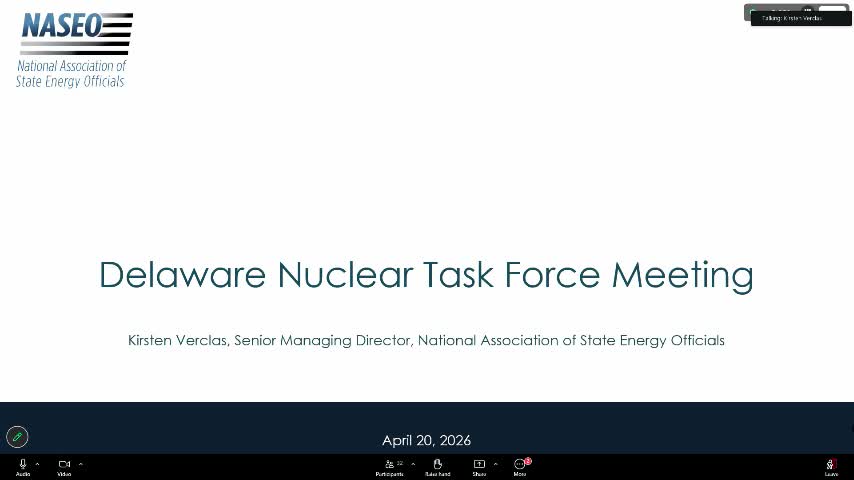
Two national organizations presented to Delaware’s task force on April 20, offering both strategic approaches used by other states and a legal overview of federal licensing authority.
Kirsten Reclas (National Association of State Energy Officials) described NASEO’s Advanced Nuclear State Collaborative and First‑Mover Initiative, which encourage states to develop roadmaps, identify site‑readiness opportunities, support workforce and supply‑chain development, and consider pilot programs or milestone‑based funding to reduce first‑of‑a‑kind risk. Reclas emphasized that states should plan for the full nuclear lifecycle, including fuel and waste disposition, and noted resources that track state permitting and legislative activity.
Martin (Marty) O'Neil (associate general counsel, Nuclear Energy Institute) summarized federal law and NRC processes. He said the Atomic Energy Act and NRC regulations make the NRC the primary regulator of reactor radiological safety and licensing, but that states control many non‑safety matters: land use, wetlands, water quality certifications, emergency planning and local zoning. O'Neil noted new regulatory activity: the NRC recently finalized a Part 53 rule intended to be technology‑inclusive and better accommodate advanced reactors, and the federal policy environment has accelerated timelines for certain licensing actions.
O'Neil cautioned that state or local laws that effectively regulate nuclear safety or operations can be preempted by federal law; he gave examples where state rules touching on safety or discharge limits produced litigation. He also reiterated that for coastal sites the coastal zone management consistency review is an important component of the NRC environmental review and can be prerequisite to early site permits.
Why it matters: the presentations framed practical steps Delaware could take — a state sites/readiness program, workforce planning, inter‑state cost‑sharing, and early coordination with the NRC and FEMA on emergency planning — while warning that ill‑targeted state safety regulations risk conflict with federal authority.
Next steps: task‑force members asked whether Delaware should join interstate initiatives as observers or participants; NASEO said observer status and use of NASEO resources are options for the state to consider.
Kirsten Reclas (National Association of State Energy Officials) described NASEO’s Advanced Nuclear State Collaborative and First‑Mover Initiative, which encourage states to develop roadmaps, identify site‑readiness opportunities, support workforce and supply‑chain development, and consider pilot programs or milestone‑based funding to reduce first‑of‑a‑kind risk. Reclas emphasized that states should plan for the full nuclear lifecycle, including fuel and waste disposition, and noted resources that track state permitting and legislative activity.
Martin (Marty) O'Neil (associate general counsel, Nuclear Energy Institute) summarized federal law and NRC processes. He said the Atomic Energy Act and NRC regulations make the NRC the primary regulator of reactor radiological safety and licensing, but that states control many non‑safety matters: land use, wetlands, water quality certifications, emergency planning and local zoning. O'Neil noted new regulatory activity: the NRC recently finalized a Part 53 rule intended to be technology‑inclusive and better accommodate advanced reactors, and the federal policy environment has accelerated timelines for certain licensing actions.
O'Neil cautioned that state or local laws that effectively regulate nuclear safety or operations can be preempted by federal law; he gave examples where state rules touching on safety or discharge limits produced litigation. He also reiterated that for coastal sites the coastal zone management consistency review is an important component of the NRC environmental review and can be prerequisite to early site permits.
Why it matters: the presentations framed practical steps Delaware could take — a state sites/readiness program, workforce planning, inter‑state cost‑sharing, and early coordination with the NRC and FEMA on emergency planning — while warning that ill‑targeted state safety regulations risk conflict with federal authority.
Next steps: task‑force members asked whether Delaware should join interstate initiatives as observers or participants; NASEO said observer status and use of NASEO resources are options for the state to consider.
View the Full Meeting & All Its Details
This article offers just a summary. Unlock complete video, transcripts, and insights as a Founder Member.
✓
Watch full, unedited meeting videos
✓
Search every word spoken in unlimited transcripts
✓
AI summaries & real-time alerts (all government levels)
✓
Permanent access to expanding government content
30-day money-back guarantee
