Task force hears history of Delaware DUI law and stepped penalties for repeat offenders
April 20, 2026 | 2026 Legislature DE, Legislative, Delaware
This article was created by AI summarizing key points discussed. AI makes mistakes, so for full details and context, please refer to the video of the full meeting. Please report any errors so we can fix them. Report an error »
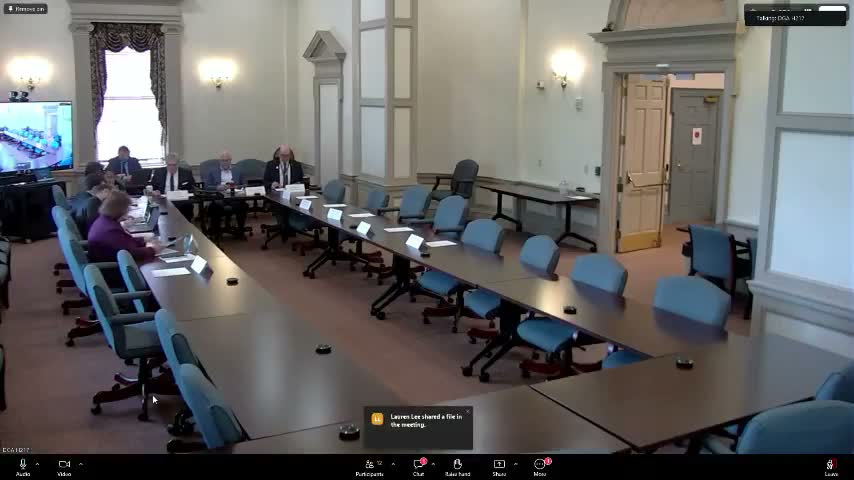
Mark Catrona, director of the Division of Legislative Services at the Delaware General Assembly, presented a chronological review of Delaware DUI law to the DUI Prevention Task Force.
"So under section 41 77 of title 21, a person commits a DUI if they drive, operate, or an actual physical control of a motor vehicle while they are impaired, while they have a blood alcohol concentration of a 0.08 or higher, or they have any amount of illicit or recreational drugs in their system," Catrona told members, citing the statute and explaining that Delaware's impairment standard allows conviction below 0.08 if impairment is proven.
Catrona traced the statute's development from the 1960s (an impairment standard without BACs) through changes that added physical-control language, created per-se BAC thresholds, and established stepped penalties for repeat offenders: first offenses treated as misdemeanors with fines and potential suspended sentences, second offenses with enhanced fines and mandatory minimum jail windows, and successive offenses escalating into felony classes with higher fines and longer prison terms. He noted statutory additions such as ignition-interlock requirements (1990s onward), child-endangerment penalties (1995), and the transfer of misdemeanor trials to a single-track process (completed by 2017).
Catrona also discussed process reforms: changes to refusal-to-test rules, creation and expansion of ignition‑interlock programs, and the 2024 codification recognizing the Superior Court Veterans Treatment Court as a qualified rehabilitation program for DUI purposes. He emphasized that some penalties and treatment-exemption rules have evolved, such as allowing required intensive treatment to be completed outside incarceration.
Members asked about technical-drafting and potential reorganization of the chapter. Joe Aronson said a legislative product may benefit from structural clarity; Catrona agreed in principle but cautioned that renumbering and reorganization could have downstream effects for agencies and existing cross-references. The task force asked staff and agency partners (including DOJ) to weigh in on drafting trade-offs.
Several members pressed on measurement of treatment effectiveness and whether statutes or program delivery require pre- and post-treatment assessments. Catrona deferred to DOJ and treatment providers for specifics, and members requested more data on treatment certification, recidivism and whether provider verification practices should be standardized.
The presentation gave the task force historical context for later discussion of DMV administrative data, ignition-interlock compliance, treatment programs and drafting choices the group may recommend as it develops its report.
"So under section 41 77 of title 21, a person commits a DUI if they drive, operate, or an actual physical control of a motor vehicle while they are impaired, while they have a blood alcohol concentration of a 0.08 or higher, or they have any amount of illicit or recreational drugs in their system," Catrona told members, citing the statute and explaining that Delaware's impairment standard allows conviction below 0.08 if impairment is proven.
Catrona traced the statute's development from the 1960s (an impairment standard without BACs) through changes that added physical-control language, created per-se BAC thresholds, and established stepped penalties for repeat offenders: first offenses treated as misdemeanors with fines and potential suspended sentences, second offenses with enhanced fines and mandatory minimum jail windows, and successive offenses escalating into felony classes with higher fines and longer prison terms. He noted statutory additions such as ignition-interlock requirements (1990s onward), child-endangerment penalties (1995), and the transfer of misdemeanor trials to a single-track process (completed by 2017).
Catrona also discussed process reforms: changes to refusal-to-test rules, creation and expansion of ignition‑interlock programs, and the 2024 codification recognizing the Superior Court Veterans Treatment Court as a qualified rehabilitation program for DUI purposes. He emphasized that some penalties and treatment-exemption rules have evolved, such as allowing required intensive treatment to be completed outside incarceration.
Members asked about technical-drafting and potential reorganization of the chapter. Joe Aronson said a legislative product may benefit from structural clarity; Catrona agreed in principle but cautioned that renumbering and reorganization could have downstream effects for agencies and existing cross-references. The task force asked staff and agency partners (including DOJ) to weigh in on drafting trade-offs.
Several members pressed on measurement of treatment effectiveness and whether statutes or program delivery require pre- and post-treatment assessments. Catrona deferred to DOJ and treatment providers for specifics, and members requested more data on treatment certification, recidivism and whether provider verification practices should be standardized.
The presentation gave the task force historical context for later discussion of DMV administrative data, ignition-interlock compliance, treatment programs and drafting choices the group may recommend as it develops its report.
View the Full Meeting & All Its Details
This article offers just a summary. Unlock complete video, transcripts, and insights as a Founder Member.
✓
Watch full, unedited meeting videos
✓
Search every word spoken in unlimited transcripts
✓
AI summaries & real-time alerts (all government levels)
✓
Permanent access to expanding government content
30-day money-back guarantee
