Moorhead council adopts updated mosquito-control policy after debate over aerial spraying
April 28, 2026 | Moorhead, Clay County, Minnesota
This article was created by AI summarizing key points discussed. AI makes mistakes, so for full details and context, please refer to the video of the full meeting. Please report any errors so we can fix them. Report an error »
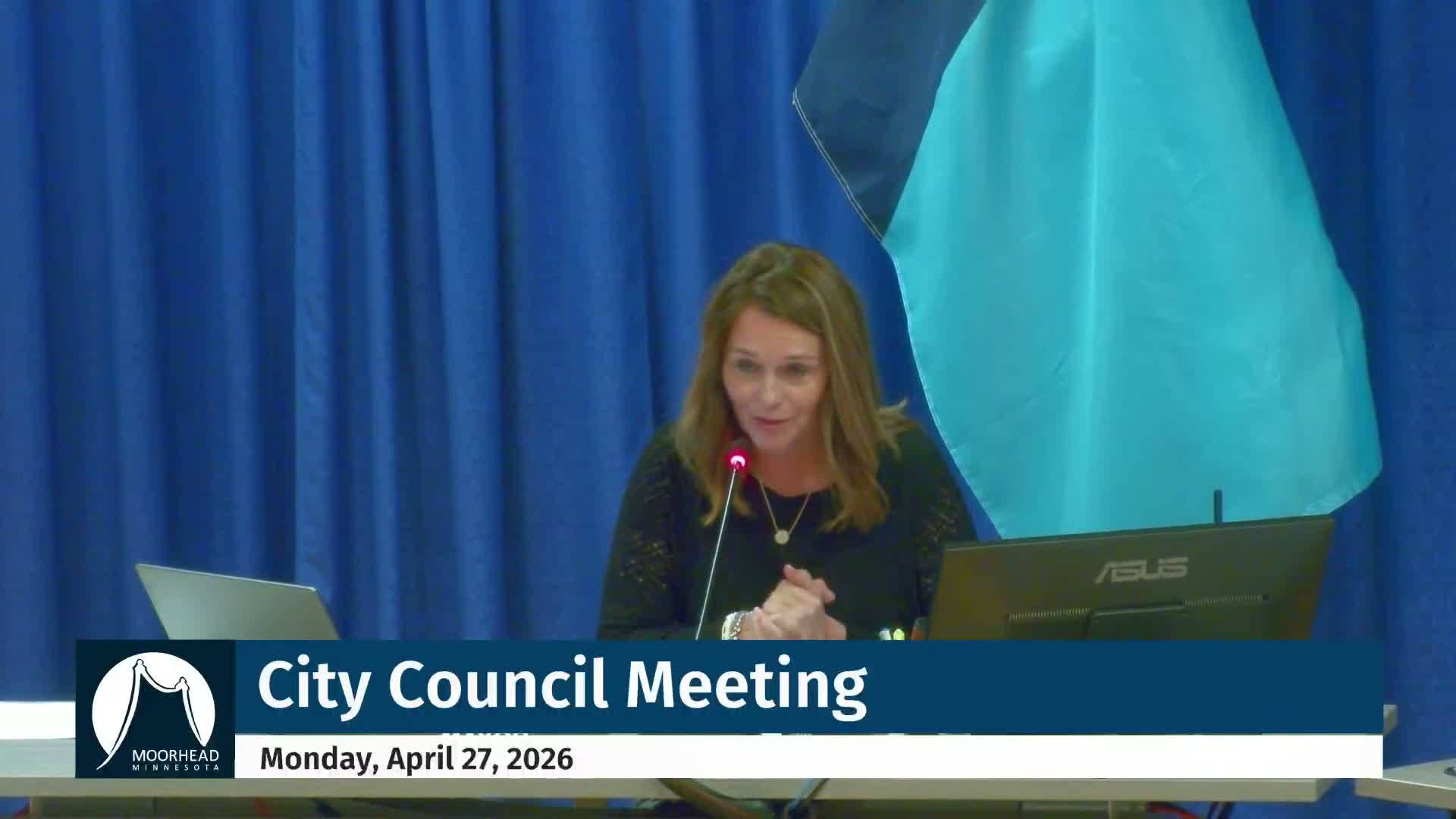
The Moorhead City Council voted April 27 to adopt a revised mosquito‑control policy and related contracts with Cass County Vector Control and Vector Disease Control International. Public Works Director Paul Feigner described a decision matrix intended to include West Nile virus risk and to reduce impacts on pollinators.
Feigner said the policy formalizes triggers for aerial spraying and increases public communication and data collection. He told the council the city will add two mosquito‑trap locations in 2026 (one near Angeles Park and another near Horizon Shores) to improve local surveillance.
Council member Deb White presented three years of Cass County Vector Control data and a standardized analysis that compared sprayed metro areas to Moorhead, which has not conducted aerial spraying during several recent events. White said the analysis shows Moorhead “never were in the top” for improvement and that, comparing regions, Moorhead only differed significantly from West Fargo. She urged the council to consider targeted truck‑mounted spraying and greater larval control.
"The point is that we are the comparison group. They sprayed and we didn't, and there isn't a difference," White said during debate, arguing for more local data and selective responses rather than broad aerial applications.
Feigner told the council the retainer for the aerial applicator is approximately $36,000, roughly the cost of one spray event, and that the retainer would not be refunded if unused; the retainer covers vendor readiness, product availability and permitting. He also said larval control will remain a priority and that permethrin resistance testing is expected to be completed in July–August 2026; staff will use the results to adjust tactics if needed.
Council members discussed canopy/landscape effects on aerial efficacy, more localized truck spraying in tree‑canopied neighborhoods, adding trap sites and strengthening public outreach and neighborhood maintenance (to remove standing water). Several members emphasized the policy is a living document and that staff would continue research and adjustments.
Council member Heather Niesemeyer moved to take items 17 a, b and c together; the motion passed by roll‑call vote and the council adopted the policy and associated contracts.
Next steps: staff will add the two trap sites in 2026, conduct resistance testing mid‑season, coordinate with the Minnesota Department of Health and Cass County Vector Control, and report back to council as results and operational needs evolve.
Feigner said the policy formalizes triggers for aerial spraying and increases public communication and data collection. He told the council the city will add two mosquito‑trap locations in 2026 (one near Angeles Park and another near Horizon Shores) to improve local surveillance.
Council member Deb White presented three years of Cass County Vector Control data and a standardized analysis that compared sprayed metro areas to Moorhead, which has not conducted aerial spraying during several recent events. White said the analysis shows Moorhead “never were in the top” for improvement and that, comparing regions, Moorhead only differed significantly from West Fargo. She urged the council to consider targeted truck‑mounted spraying and greater larval control.
"The point is that we are the comparison group. They sprayed and we didn't, and there isn't a difference," White said during debate, arguing for more local data and selective responses rather than broad aerial applications.
Feigner told the council the retainer for the aerial applicator is approximately $36,000, roughly the cost of one spray event, and that the retainer would not be refunded if unused; the retainer covers vendor readiness, product availability and permitting. He also said larval control will remain a priority and that permethrin resistance testing is expected to be completed in July–August 2026; staff will use the results to adjust tactics if needed.
Council members discussed canopy/landscape effects on aerial efficacy, more localized truck spraying in tree‑canopied neighborhoods, adding trap sites and strengthening public outreach and neighborhood maintenance (to remove standing water). Several members emphasized the policy is a living document and that staff would continue research and adjustments.
Council member Heather Niesemeyer moved to take items 17 a, b and c together; the motion passed by roll‑call vote and the council adopted the policy and associated contracts.
Next steps: staff will add the two trap sites in 2026, conduct resistance testing mid‑season, coordinate with the Minnesota Department of Health and Cass County Vector Control, and report back to council as results and operational needs evolve.
View the Full Meeting & All Its Details
This article offers just a summary. Unlock complete video, transcripts, and insights as a Founder Member.
✓
Watch full, unedited meeting videos
✓
Search every word spoken in unlimited transcripts
✓
AI summaries & real-time alerts (all government levels)
✓
Permanent access to expanding government content
30-day money-back guarantee
