Grand Junction council to reconsider Camelback Gardens resolution after public-process concerns
April 13, 2026 | Grand Junction, Mesa County, Colorado
This article was created by AI summarizing key points discussed. AI makes mistakes, so for full details and context, please refer to the video of the full meeting. Please report any errors so we can fix them. Report an error »
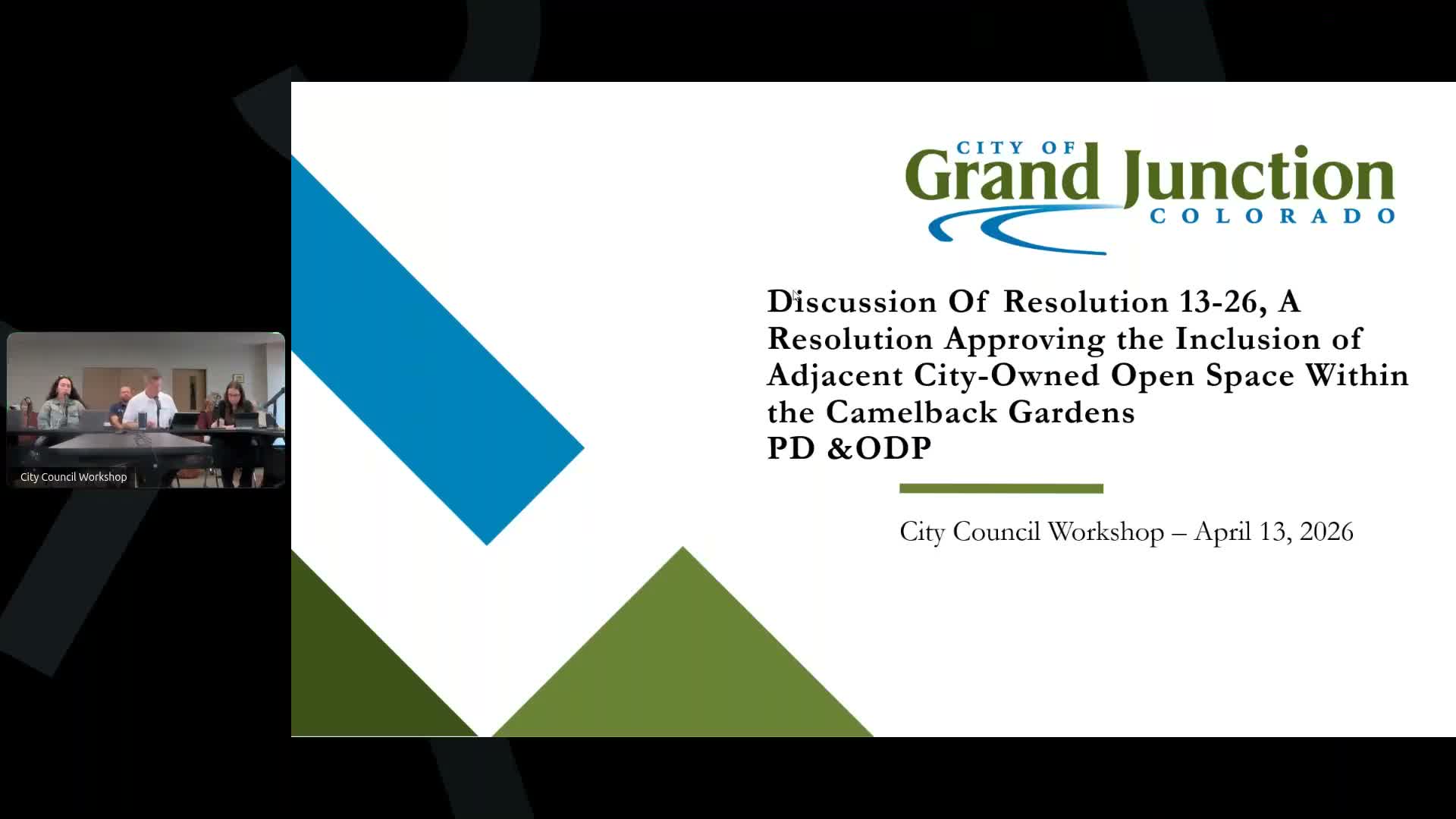
The Grand Junction City Council agreed to bring back Resolution 13-26 for reconsideration after workshop discussion on April 13 that flagged public-notice and precedent concerns.
The resolution would allow about 15 acres of city-owned open space adjacent to the privately owned Camelback Gardens parcel to be included in planning and density calculations for a planned development. Planner Daniela Costa told the council the inclusion is planning-only: it does not transfer ownership, change maintenance responsibilities or reduce public access. With the open space counted, the project’s 90 proposed dwelling units compute to roughly 3.6 dwellings per acre — within the city’s comprehensive plan “residential low” range of 2 to 5.5 dwellings per acre. Without the city land included, the same development would amount to about 8.75 dwellings per acre, which would place it in a higher-density category, Costa said.
Jeremiah, the city’s interim city attorney, cautioned council members that aspects of the larger matter may later become quasi-judicial and urged the meeting to be limited to the resolution and the question of including the open space in plan boundaries.
Several council members said they were not opposed to the concept but were troubled that the resolution route provides less formal public hearing opportunity than a comp-plan amendment or rezoning. One councilor said the approach “shortcuts” a process that typically creates more public input. City Manager Mike Bennett and staff said the policy is discretionary and pointed to code provisions that allow limited use of city property in density calculations — for example, including adjoining right-of-way in some zones — but that there is no exact precedent for the Ridges area’s unusual history of prior dedications.
After extended questions about precedent, fairness to other developers, and what the change means for neighbors, council members signaled they had sufficient concern to reconsider. The mayor and staff agreed to schedule the item for a future council meeting with explicit public comment; staff suggested a date as soon as May 6.
The council’s action at the workshop was limited to direction for a future agenda; there was no final vote on the substance of Resolution 13-26.
The resolution would allow about 15 acres of city-owned open space adjacent to the privately owned Camelback Gardens parcel to be included in planning and density calculations for a planned development. Planner Daniela Costa told the council the inclusion is planning-only: it does not transfer ownership, change maintenance responsibilities or reduce public access. With the open space counted, the project’s 90 proposed dwelling units compute to roughly 3.6 dwellings per acre — within the city’s comprehensive plan “residential low” range of 2 to 5.5 dwellings per acre. Without the city land included, the same development would amount to about 8.75 dwellings per acre, which would place it in a higher-density category, Costa said.
Jeremiah, the city’s interim city attorney, cautioned council members that aspects of the larger matter may later become quasi-judicial and urged the meeting to be limited to the resolution and the question of including the open space in plan boundaries.
Several council members said they were not opposed to the concept but were troubled that the resolution route provides less formal public hearing opportunity than a comp-plan amendment or rezoning. One councilor said the approach “shortcuts” a process that typically creates more public input. City Manager Mike Bennett and staff said the policy is discretionary and pointed to code provisions that allow limited use of city property in density calculations — for example, including adjoining right-of-way in some zones — but that there is no exact precedent for the Ridges area’s unusual history of prior dedications.
After extended questions about precedent, fairness to other developers, and what the change means for neighbors, council members signaled they had sufficient concern to reconsider. The mayor and staff agreed to schedule the item for a future council meeting with explicit public comment; staff suggested a date as soon as May 6.
The council’s action at the workshop was limited to direction for a future agenda; there was no final vote on the substance of Resolution 13-26.
Don't Miss a Word: See the Full Meeting!
Go beyond summaries. Unlock every video, transcript, and key insight with a Founder Membership.
✓
Get instant access to full meeting videos
✓
Search and clip any phrase from complete transcripts
✓
Receive AI-powered summaries & custom alerts
✓
Enjoy lifetime, unrestricted access to government data
30-day money-back guarantee
