Senate committee advances bill to ban deceptive legal lead-generation marketing
April 27, 2026 | 2026 Legislature CO, Colorado
This article was created by AI summarizing key points discussed. AI makes mistakes, so for full details and context, please refer to the video of the full meeting. Please report any errors so we can fix them. Report an error »
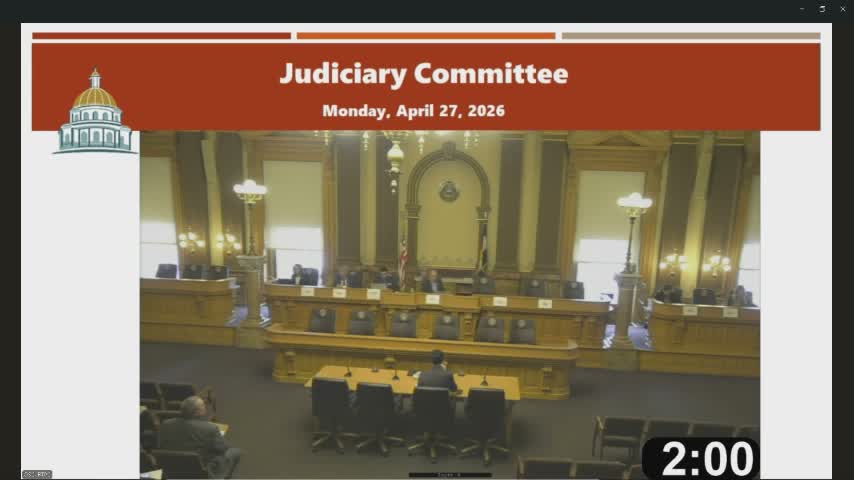
Senator Roberts, the committee's vice chair, told the Senate Judiciary Committee that Senate Bill 174 seeks to stop a growing practice in Colorado in which injured people searching for legal help are routed to lead-generation companies that misrepresent who they are. "This is a bill concerning lead generation marketing for legal services," he said, summarizing the measure's central ban and disclosure requirement.
The sponsor and a panel of witnesses described repeated patterns of deceptive online ads and call-center scripts. "Predatory lead generation companies are deliberately misleading injured and vulnerable consumers," said attorney Frank Azar, who testified that callers sometimes receive fake retainer letters and are connected to nonlawyer call centers rather than the law firm they sought.
Jason Waisocchi, identified as president of the Colorado Trial Lawyers Association, told the committee those firms collect highly sensitive data — social-security numbers, medical information and hospital details — and sell that information to whichever attorney or firm will pay for the lead.
Jeffrey Reester of the Colorado Department of Law and private investigator Peter Norell testified they had difficulty tracing ownership of many lead generators because of layered corporate structures and offshore operations, and both urged state enforcement tools. The bill would allow the attorney general or a district attorney's office to pursue civil actions under the Colorado Consumer Protection Act and, in some cases, criminal prosecutions for fraud or impersonation.
Committee members adopted sponsor amendments (L2 and L3) aimed at aligning the bill with the Colorado Supreme Court's rulemaking authority and clarifying that the measure does not regulate the practice of law itself. After amendments, the vice chair moved the bill to the Committee of the Whole.
Next steps: SB 174 was moved to the Committee of the Whole as amended; committee debate focused on enforcement mechanisms and ensuring the bill addresses deceptive ad practices without intruding on licensed-law regulation.
The sponsor and a panel of witnesses described repeated patterns of deceptive online ads and call-center scripts. "Predatory lead generation companies are deliberately misleading injured and vulnerable consumers," said attorney Frank Azar, who testified that callers sometimes receive fake retainer letters and are connected to nonlawyer call centers rather than the law firm they sought.
Jason Waisocchi, identified as president of the Colorado Trial Lawyers Association, told the committee those firms collect highly sensitive data — social-security numbers, medical information and hospital details — and sell that information to whichever attorney or firm will pay for the lead.
Jeffrey Reester of the Colorado Department of Law and private investigator Peter Norell testified they had difficulty tracing ownership of many lead generators because of layered corporate structures and offshore operations, and both urged state enforcement tools. The bill would allow the attorney general or a district attorney's office to pursue civil actions under the Colorado Consumer Protection Act and, in some cases, criminal prosecutions for fraud or impersonation.
Committee members adopted sponsor amendments (L2 and L3) aimed at aligning the bill with the Colorado Supreme Court's rulemaking authority and clarifying that the measure does not regulate the practice of law itself. After amendments, the vice chair moved the bill to the Committee of the Whole.
Next steps: SB 174 was moved to the Committee of the Whole as amended; committee debate focused on enforcement mechanisms and ensuring the bill addresses deceptive ad practices without intruding on licensed-law regulation.
View the Full Meeting & All Its Details
This article offers just a summary. Unlock complete video, transcripts, and insights as a Founder Member.
✓
Watch full, unedited meeting videos
✓
Search every word spoken in unlimited transcripts
✓
AI summaries & real-time alerts (all government levels)
✓
Permanent access to expanding government content
30-day money-back guarantee
