Commissioners delay Hodge Branch FEMA application, weigh phased approach to reduce local match
April 20, 2026 | Rush County, Indiana
This article was created by AI summarizing key points discussed. AI makes mistakes, so for full details and context, please refer to the video of the full meeting. Please report any errors so we can fix them. Report an error »
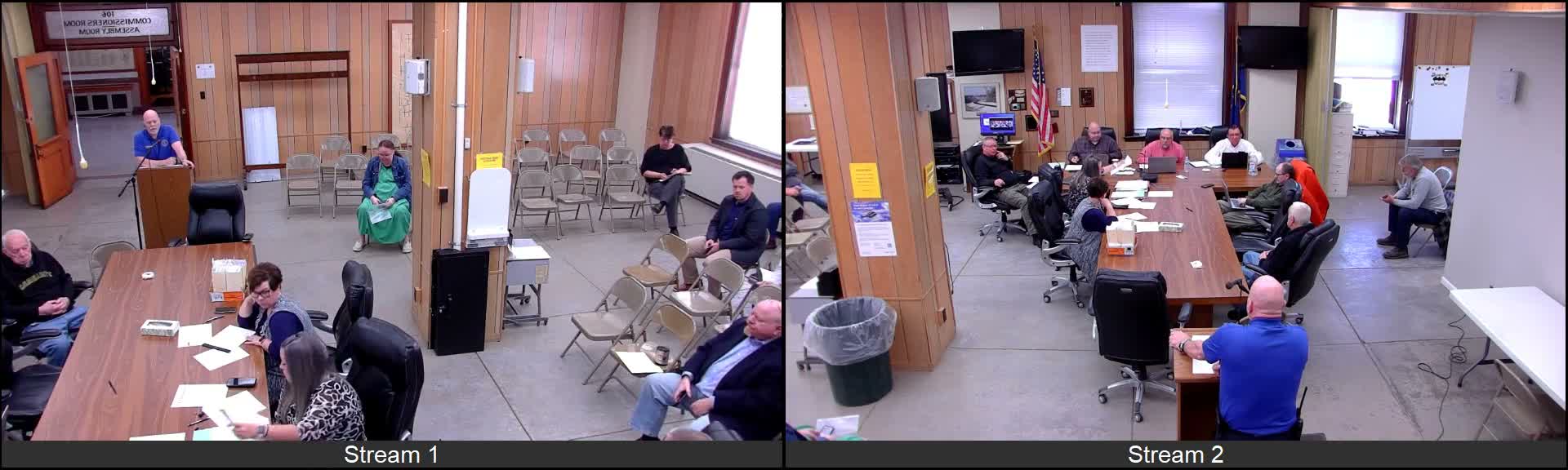
Chair (speaker 1) and county staff heard a detailed presentation on the Hodge Branch flood‑mitigation project and the county’s options for pursuing grant funding.
Aaron (speaker 6), introduced by county staff, summarized the prior proposal that included a 9x6 box culvert intended to reduce flooding through the city of Rush. He told commissioners a phased approach—breaking the full $16.2 million project into smaller segments—could make the county eligible for state funds rather than having to compete for federal funds, and could spread local matching costs over a longer period. He cautioned, however, that FEMA typically requires each phase to provide measurable benefits on its own and that detailed hydraulic and benefit modeling would be needed to demonstrate that to funders.
Staff member (speaker 3) said the county could update last year’s cost estimates to current dollars and that an engineering rule‑of‑thumb for study/design is roughly 10% of construction costs for the work needed to produce deliverables, surveys, permits and a grant application. Commissioners discussed tradeoffs: pursuing the entire project at once (which could place it in federal competition) versus phasing so parts fall under the state allocation with smaller caps per project. Staff noted a state cap and an example cap for projects around $20 million, and that splitting the project could allow a portion to be funded through the state program, where maximum shares are smaller but competition is different.
During discussion commissioners asked whether phasing could leave the county “stuck” if later phases were not funded; staff agreed that risk exists and that each phase would need to show benefit. After considering engineering costs for phasing analysis and updated estimates, the board voted to delay applying this cycle and to refine the phasing analysis and updated cost figures for a later application cycle (commissioners directed staff and the consultant to continue work on phasing scenarios and to return with clearer cost and modeling outputs).
The decision: the board will not submit the current grant application as drafted and will revisit the schedule after updated engineering estimates and modeling clarify how to structure phases and local match obligations.
Next steps noted in the meeting: consultants will update cost estimates to current dollars, perform modeling to define viable phasing boundaries and benefits, and return with a recommendation on whether to pursue a phased state application or the full federal application in a later cycle.
Aaron (speaker 6), introduced by county staff, summarized the prior proposal that included a 9x6 box culvert intended to reduce flooding through the city of Rush. He told commissioners a phased approach—breaking the full $16.2 million project into smaller segments—could make the county eligible for state funds rather than having to compete for federal funds, and could spread local matching costs over a longer period. He cautioned, however, that FEMA typically requires each phase to provide measurable benefits on its own and that detailed hydraulic and benefit modeling would be needed to demonstrate that to funders.
Staff member (speaker 3) said the county could update last year’s cost estimates to current dollars and that an engineering rule‑of‑thumb for study/design is roughly 10% of construction costs for the work needed to produce deliverables, surveys, permits and a grant application. Commissioners discussed tradeoffs: pursuing the entire project at once (which could place it in federal competition) versus phasing so parts fall under the state allocation with smaller caps per project. Staff noted a state cap and an example cap for projects around $20 million, and that splitting the project could allow a portion to be funded through the state program, where maximum shares are smaller but competition is different.
During discussion commissioners asked whether phasing could leave the county “stuck” if later phases were not funded; staff agreed that risk exists and that each phase would need to show benefit. After considering engineering costs for phasing analysis and updated estimates, the board voted to delay applying this cycle and to refine the phasing analysis and updated cost figures for a later application cycle (commissioners directed staff and the consultant to continue work on phasing scenarios and to return with clearer cost and modeling outputs).
The decision: the board will not submit the current grant application as drafted and will revisit the schedule after updated engineering estimates and modeling clarify how to structure phases and local match obligations.
Next steps noted in the meeting: consultants will update cost estimates to current dollars, perform modeling to define viable phasing boundaries and benefits, and return with a recommendation on whether to pursue a phased state application or the full federal application in a later cycle.
Don't Miss a Word: See the Full Meeting!
Go beyond summaries. Unlock every video, transcript, and key insight with a Founder Membership.
✓
Get instant access to full meeting videos
✓
Search and clip any phrase from complete transcripts
✓
Receive AI-powered summaries & custom alerts
✓
Enjoy lifetime, unrestricted access to government data
30-day money-back guarantee
