Senate approves amended property‑tax state question; special‑election timing provision fails
April 27, 2026 | 2026 Legislature OK, Oklahoma
This article was created by AI summarizing key points discussed. AI makes mistakes, so for full details and context, please refer to the video of the full meeting. Please report any errors so we can fix them. Report an error »
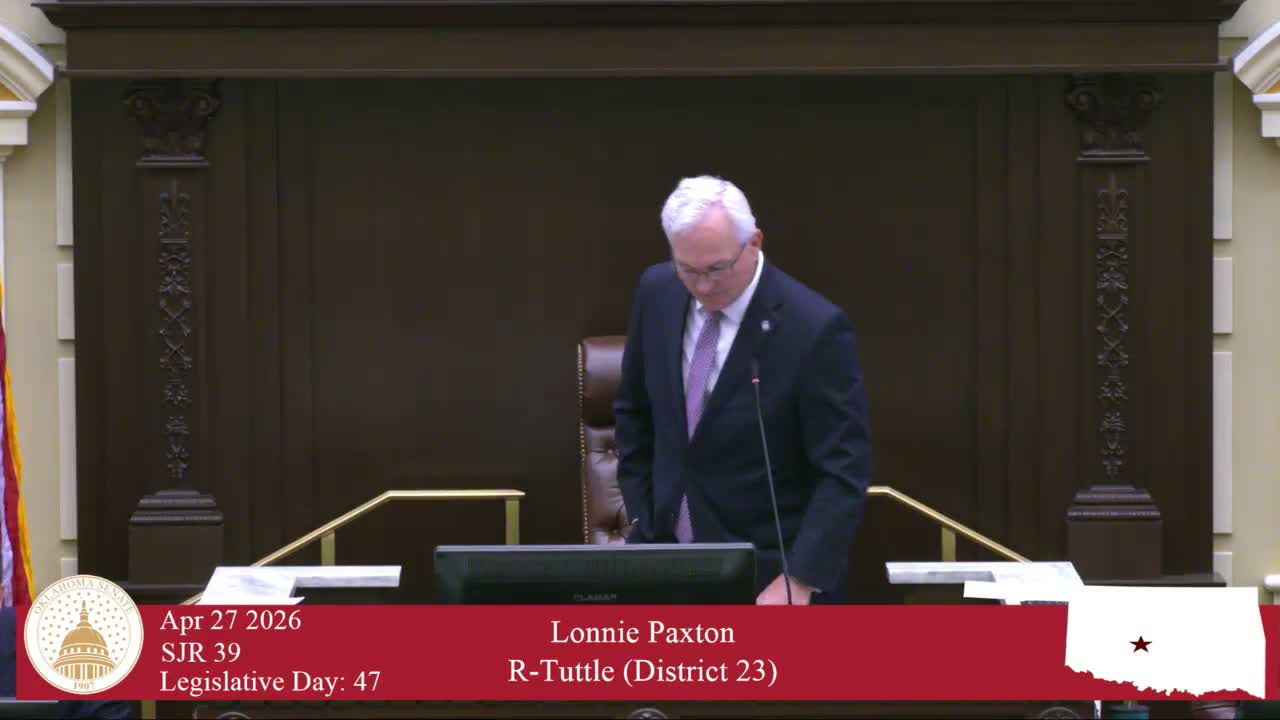
The Oklahoma Senate voted to pass Senate Joint Resolution 39 on final passage, adopting House amendments and approving the measure 40–8 on the floor of the chamber. The resolution would change constitutional caps on annual assessed‑value growth for different property classes and add a tiered senior freeze. A separate procedural vote on the resolution’s special‑election timing provision failed 26–20.
Senator Paxton, the measure’s floor sponsor, told colleagues the amended version was negotiated after conversations with municipalities and school districts concerned about outstanding bond obligations: “It’s several municipalities and specifically school districts that apparently there are bonds that have been issued on behalf of the voters of those districts that go into the future quite a ways,” he said, explaining why the house amendments adjusted the cap changes to soften the impact.
Opponents said the changes will reduce future local revenue and leave schools and other local services with fewer options. Senator Hicks cited an analysis presented on the floor that projected a long‑term employment impact tied to reduced local government funding: “The expected job loss of what we are looking at today with these house amendments, direct and indirect over a 10 year period, is 63,000 to 75,000,” he said in floor debate.
Other senators pressed the author for specifics about which political subdivisions had raised concerns and how the senior freeze tiers would work. Senator Goodwin asked who raised the alarm; Paxton replied that multiple municipalities and school districts had expressed concerns and that the amended numbers were intended to be “something they agreed would not be that impactful to them.” Senators also questioned whether voters’ approved bonds would be protected; Paxton said the revisions were intended to allay bondholder concerns and would not impair existing bond obligations.
Senator Sakieri said the amendment offered only limited relief to homeowners and seniors in his district: “It’s I hate to describe it as better than nothing,” he said, urging more substantial relief for older homeowners and first‑time buyers. Senator Standridge described a constituent at risk of losing a family home to rising taxes and urged additional reforms.
The Senate adopted the House amendments by roll call, 27–19, and later passed the joint resolution on final passage, 40–8. Immediately afterward, senators voted on a separate special‑election timing provision tied to the resolution; that procedural provision failed by a 26–20 vote, meaning that element did not obtain the supermajority threshold required for the proposed special‑election language.
What happens next: the resolution, as passed by the Legislature, would go to the vote of the people under the timetable and procedures set out in the resolution (subject to the outcome of any further procedural matters).
Senator Paxton, the measure’s floor sponsor, told colleagues the amended version was negotiated after conversations with municipalities and school districts concerned about outstanding bond obligations: “It’s several municipalities and specifically school districts that apparently there are bonds that have been issued on behalf of the voters of those districts that go into the future quite a ways,” he said, explaining why the house amendments adjusted the cap changes to soften the impact.
Opponents said the changes will reduce future local revenue and leave schools and other local services with fewer options. Senator Hicks cited an analysis presented on the floor that projected a long‑term employment impact tied to reduced local government funding: “The expected job loss of what we are looking at today with these house amendments, direct and indirect over a 10 year period, is 63,000 to 75,000,” he said in floor debate.
Other senators pressed the author for specifics about which political subdivisions had raised concerns and how the senior freeze tiers would work. Senator Goodwin asked who raised the alarm; Paxton replied that multiple municipalities and school districts had expressed concerns and that the amended numbers were intended to be “something they agreed would not be that impactful to them.” Senators also questioned whether voters’ approved bonds would be protected; Paxton said the revisions were intended to allay bondholder concerns and would not impair existing bond obligations.
Senator Sakieri said the amendment offered only limited relief to homeowners and seniors in his district: “It’s I hate to describe it as better than nothing,” he said, urging more substantial relief for older homeowners and first‑time buyers. Senator Standridge described a constituent at risk of losing a family home to rising taxes and urged additional reforms.
The Senate adopted the House amendments by roll call, 27–19, and later passed the joint resolution on final passage, 40–8. Immediately afterward, senators voted on a separate special‑election timing provision tied to the resolution; that procedural provision failed by a 26–20 vote, meaning that element did not obtain the supermajority threshold required for the proposed special‑election language.
What happens next: the resolution, as passed by the Legislature, would go to the vote of the people under the timetable and procedures set out in the resolution (subject to the outcome of any further procedural matters).
View the Full Meeting & All Its Details
This article offers just a summary. Unlock complete video, transcripts, and insights as a Founder Member.
✓
Watch full, unedited meeting videos
✓
Search every word spoken in unlimited transcripts
✓
AI summaries & real-time alerts (all government levels)
✓
Permanent access to expanding government content
30-day money-back guarantee
