Asheville City Schools outlines tank-and-well plan to enable phased reopening after Hurricane Helene
October 12, 2024 | Asheville City Schools, School Districts, North Carolina
This article was created by AI summarizing key points discussed. AI makes mistakes, so for full details and context, please refer to the video of the full meeting. Please report any errors so we can fix them. Report an error »
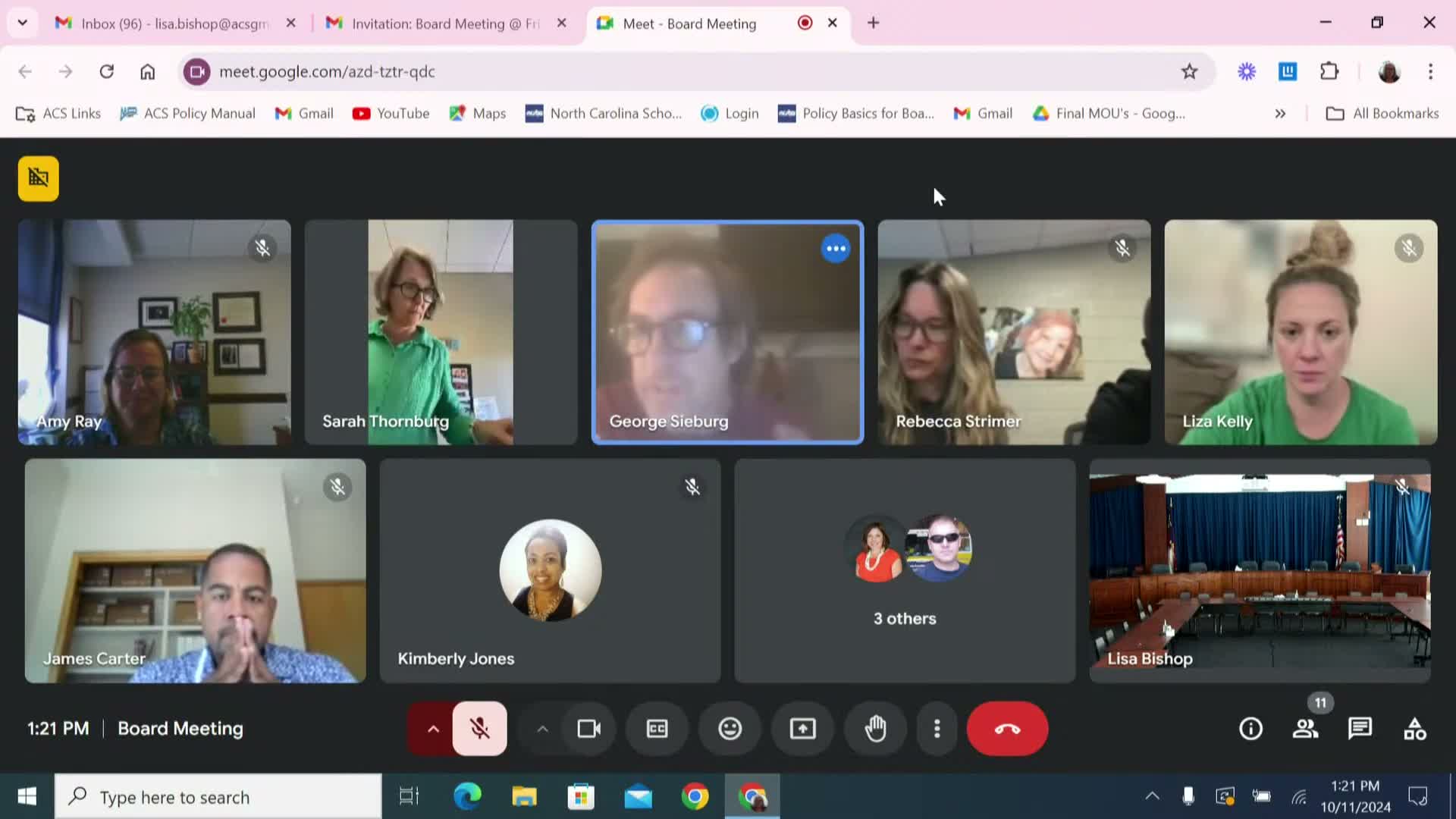
Asheville City Schools officials told the board in a special virtual meeting that a mix of donated potable tanks, temporary well hookups and bottled water will be used to restore water to school buildings and support a phased reopening after Hurricane Helene.
Maggie (district staff) said the district is targeting Oct. 28 as a reopening goal but cautioned that date depends on water availability and logistics. "We set the date or target date of October 28, to reopen our school buildings, but we are still actively working on how we are going to get enough water to our buildings," Maggie said, explaining principals are preparing phased reentry plans to share at the regular board meeting on Monday.
The board heard a detailed operational briefing from Sean Fields, an operations lead on the emergency-management response, who described a current plan that places donated 3,000- to 6,000-gallon potable tanks at school sites and pumps that water into school plumbing. "We found a donor and 3,000 or 6,000 gallon tanks and placed them at school sites," Sean said. He warned, however, that tanks alone probably will not meet demand at larger campuses: "The high school is 9,000 gallons a day, somewhere in that ballpark," he said, and logistics for daily refill and the scarcity of potable fill sites limit how many large campuses can be supported this way.
For middle and high school campuses that exceed tank capacity, staff proposed drilling wells to supplement the tanks. Sean and Maggie told the board the state Department of Environmental Quality and local environmental health officials advised that groundwater pH differences can mobilize metals from pipe systems, meaning untreated well water is likely to be considered nonpotable for drinking. "Any system that we tap a well into ' even though we're delivering potable water ' will essentially become non potable," Sean said, adding that nonpotable water can be used for toilets and handwashing but should not be used for drinking without treatment.
District staff said donors are covering the cost to get tanks and pumps installed at sites; the current plan calls for donor-funded deliveries and installation "at cost" or free to the district. Well costs were described as site-specific; Sean said teams currently estimate about "$12,000 or less" per well in many cases but acknowledged deeper or more complex drilling could raise costs. The board noted one site at which a well had already been drilled; staff gave a rough estimate of $8,000'$10,000 so far for that well.
Drilling and permitting are moving quickly, Sean said, but with constraints: out-of-state drillers lack immediate authorization to work in-state and only a limited number of in-state drillers are available to do discounted emergency work. "Once we get the nod, I would expect drilling to start in a day or two," he told the board, while noting that some permitting steps will occur on-site with environmental health officials to expedite work.
Because wells used in the short term may be exempt from full testing while the district expects not to operate them as permanent sources for 59 days, staff are planning to treat well water as nonpotable and rely on bottled water for drinking and potable needs. Sean described short-term treatment options that could be deployed later if the district needs to keep wells online longer: ultraviolet and charcoal filtration and pH-correction systems such as calcite or sodium-hydroxide dosing.
The board pressed staff on several operational details: whether schools could return earlier if only the district's eight campuses were prioritized, how tanks will be distributed and shared, whether schools would operate an A/B rotation to reduce daily water demand, and how to keep students from accessing nonpotable sources. Sean said DEQ guidance includes steps such as bagging and disabling fountains, clear signage and staff training.
Maggie said principals are drafting plans that prioritize serving the greatest number of students as sites come online, and the district will provide a fuller update at the regular board meeting on Monday. "We're trying to avoid remote learning at all possible," she said, noting options such as shorter school days or phased attendance to stretch water resources.
No formal board action on reopening policy or contracts was taken at the special meeting; the board approved the meeting agenda and later adjourned by roll call vote. Board members asked staff to return with cost and contract details, implementation timelines and clarifications about preschool licensing and how pre-K classrooms will be affected by different water solutions.
Next steps: principals will finalize campus-level plans for phased reopening and staff will bring more detailed cost estimates and implementation proposals to the board at the Monday session.
Maggie (district staff) said the district is targeting Oct. 28 as a reopening goal but cautioned that date depends on water availability and logistics. "We set the date or target date of October 28, to reopen our school buildings, but we are still actively working on how we are going to get enough water to our buildings," Maggie said, explaining principals are preparing phased reentry plans to share at the regular board meeting on Monday.
The board heard a detailed operational briefing from Sean Fields, an operations lead on the emergency-management response, who described a current plan that places donated 3,000- to 6,000-gallon potable tanks at school sites and pumps that water into school plumbing. "We found a donor and 3,000 or 6,000 gallon tanks and placed them at school sites," Sean said. He warned, however, that tanks alone probably will not meet demand at larger campuses: "The high school is 9,000 gallons a day, somewhere in that ballpark," he said, and logistics for daily refill and the scarcity of potable fill sites limit how many large campuses can be supported this way.
For middle and high school campuses that exceed tank capacity, staff proposed drilling wells to supplement the tanks. Sean and Maggie told the board the state Department of Environmental Quality and local environmental health officials advised that groundwater pH differences can mobilize metals from pipe systems, meaning untreated well water is likely to be considered nonpotable for drinking. "Any system that we tap a well into ' even though we're delivering potable water ' will essentially become non potable," Sean said, adding that nonpotable water can be used for toilets and handwashing but should not be used for drinking without treatment.
District staff said donors are covering the cost to get tanks and pumps installed at sites; the current plan calls for donor-funded deliveries and installation "at cost" or free to the district. Well costs were described as site-specific; Sean said teams currently estimate about "$12,000 or less" per well in many cases but acknowledged deeper or more complex drilling could raise costs. The board noted one site at which a well had already been drilled; staff gave a rough estimate of $8,000'$10,000 so far for that well.
Drilling and permitting are moving quickly, Sean said, but with constraints: out-of-state drillers lack immediate authorization to work in-state and only a limited number of in-state drillers are available to do discounted emergency work. "Once we get the nod, I would expect drilling to start in a day or two," he told the board, while noting that some permitting steps will occur on-site with environmental health officials to expedite work.
Because wells used in the short term may be exempt from full testing while the district expects not to operate them as permanent sources for 59 days, staff are planning to treat well water as nonpotable and rely on bottled water for drinking and potable needs. Sean described short-term treatment options that could be deployed later if the district needs to keep wells online longer: ultraviolet and charcoal filtration and pH-correction systems such as calcite or sodium-hydroxide dosing.
The board pressed staff on several operational details: whether schools could return earlier if only the district's eight campuses were prioritized, how tanks will be distributed and shared, whether schools would operate an A/B rotation to reduce daily water demand, and how to keep students from accessing nonpotable sources. Sean said DEQ guidance includes steps such as bagging and disabling fountains, clear signage and staff training.
Maggie said principals are drafting plans that prioritize serving the greatest number of students as sites come online, and the district will provide a fuller update at the regular board meeting on Monday. "We're trying to avoid remote learning at all possible," she said, noting options such as shorter school days or phased attendance to stretch water resources.
No formal board action on reopening policy or contracts was taken at the special meeting; the board approved the meeting agenda and later adjourned by roll call vote. Board members asked staff to return with cost and contract details, implementation timelines and clarifications about preschool licensing and how pre-K classrooms will be affected by different water solutions.
Next steps: principals will finalize campus-level plans for phased reopening and staff will bring more detailed cost estimates and implementation proposals to the board at the Monday session.
Don't Miss a Word: See the Full Meeting!
Go beyond summaries. Unlock every video, transcript, and key insight with a Founder Membership.
✓
Get instant access to full meeting videos
✓
Search and clip any phrase from complete transcripts
✓
Receive AI-powered summaries & custom alerts
✓
Enjoy lifetime, unrestricted access to government data
30-day money-back guarantee
