Committee backs change to due-process rules in Communications with Students Act
April 21, 2026 | 2026 Legislature OK, Oklahoma
This article was created by AI summarizing key points discussed. AI makes mistakes, so for full details and context, please refer to the video of the full meeting. Please report any errors so we can fix them. Report an error »
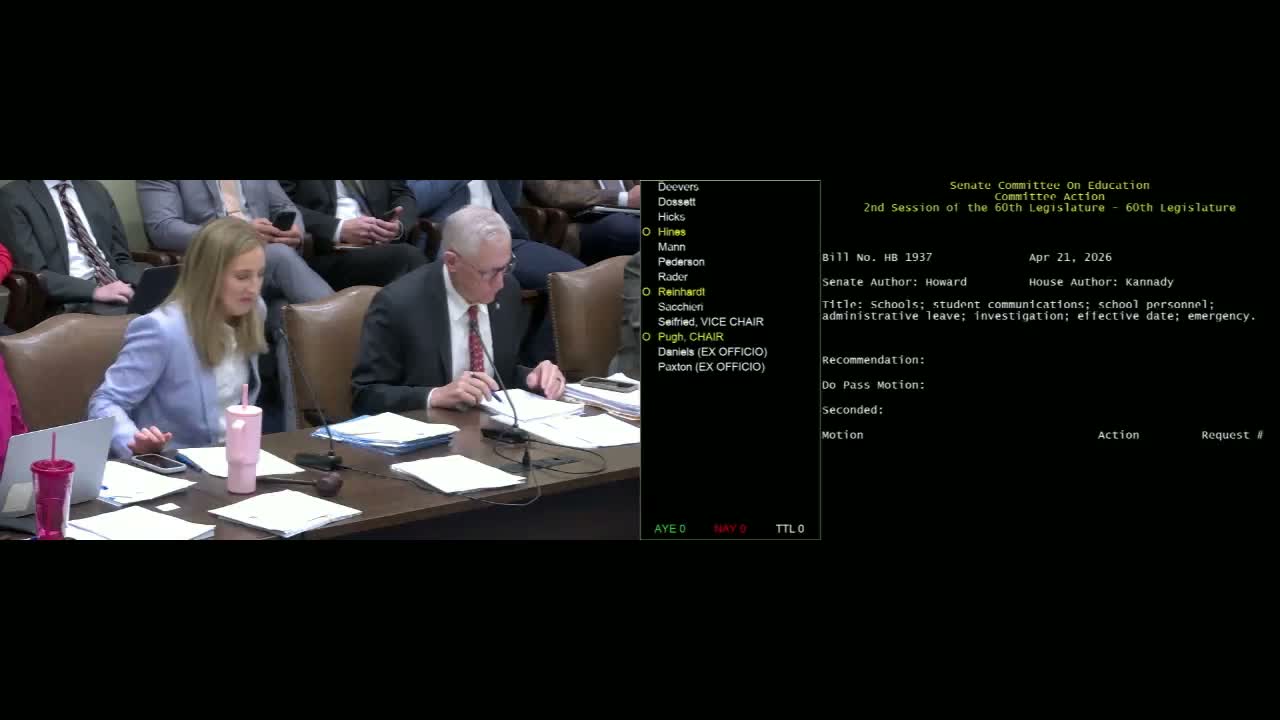
The Senate Education Committee voted 9-0 on April 26 to pass House Bill 1937, a measure that adjusts the Communications with Students Act to add procedural safeguards for school employees accused of illegal communications with students.
Sponsor Senator Howard told the committee the bill makes two changes: "a change to the definition of student" that aims to protect high-school students and younger from certain direct communications, and a requirement that there be a "corroborated report" before immediate suspension occurs. Howard said the prior practice sometimes led to automatic suspension on the basis of an allegation alone and that the sponsor wanted to ensure investigators have evidence before removing employees from duty.
Under the sponsor's description, a "corroborated report" could be evidence such as a screenshot of the alleged communications or other third-party verification; absent such corroboration, administrators would notify and investigate rather than automatically suspend. Senator Sakieri asked for a practical example and the sponsor explained that an anonymous tip without supporting evidence would trigger investigation but not immediate suspension.
Supporters framed the bill as balancing student safety with due process. "We all count on the Fourteenth Amendment and having due process carried out the right way," Senator Rader said during debate, commending the bill's approach. The committee recorded 9 ayes and 0 nays.
The bill as presented focuses on process: it does not change the underlying prohibition on illegal communications but changes the threshold for administrative leave pending an investigation. If passed by the full Senate, the measure would require school administrators to pursue an investigation when allegations arise and to apply suspension when corroborating evidence is present or when an investigation substantiates the allegation.
The committee did not attach a fiscal note to the bill in the hearing record; sponsors said changes are procedural and handled within existing district processes. The bill now advances to the Senate floor for further consideration.
Sponsor Senator Howard told the committee the bill makes two changes: "a change to the definition of student" that aims to protect high-school students and younger from certain direct communications, and a requirement that there be a "corroborated report" before immediate suspension occurs. Howard said the prior practice sometimes led to automatic suspension on the basis of an allegation alone and that the sponsor wanted to ensure investigators have evidence before removing employees from duty.
Under the sponsor's description, a "corroborated report" could be evidence such as a screenshot of the alleged communications or other third-party verification; absent such corroboration, administrators would notify and investigate rather than automatically suspend. Senator Sakieri asked for a practical example and the sponsor explained that an anonymous tip without supporting evidence would trigger investigation but not immediate suspension.
Supporters framed the bill as balancing student safety with due process. "We all count on the Fourteenth Amendment and having due process carried out the right way," Senator Rader said during debate, commending the bill's approach. The committee recorded 9 ayes and 0 nays.
The bill as presented focuses on process: it does not change the underlying prohibition on illegal communications but changes the threshold for administrative leave pending an investigation. If passed by the full Senate, the measure would require school administrators to pursue an investigation when allegations arise and to apply suspension when corroborating evidence is present or when an investigation substantiates the allegation.
The committee did not attach a fiscal note to the bill in the hearing record; sponsors said changes are procedural and handled within existing district processes. The bill now advances to the Senate floor for further consideration.
Don't Miss a Word: See the Full Meeting!
Go beyond summaries. Unlock every video, transcript, and key insight with a Founder Membership.
✓
Get instant access to full meeting videos
✓
Search and clip any phrase from complete transcripts
✓
Receive AI-powered summaries & custom alerts
✓
Enjoy lifetime, unrestricted access to government data
30-day money-back guarantee
