Votes at a glance: House advances budget and policy bills, approves child 'Trump account' deposit but emergency fails
April 14, 2026 | 2026 Legislature OK, Oklahoma
This article was created by AI summarizing key points discussed. AI makes mistakes, so for full details and context, please refer to the video of the full meeting. Please report any errors so we can fix them. Report an error »
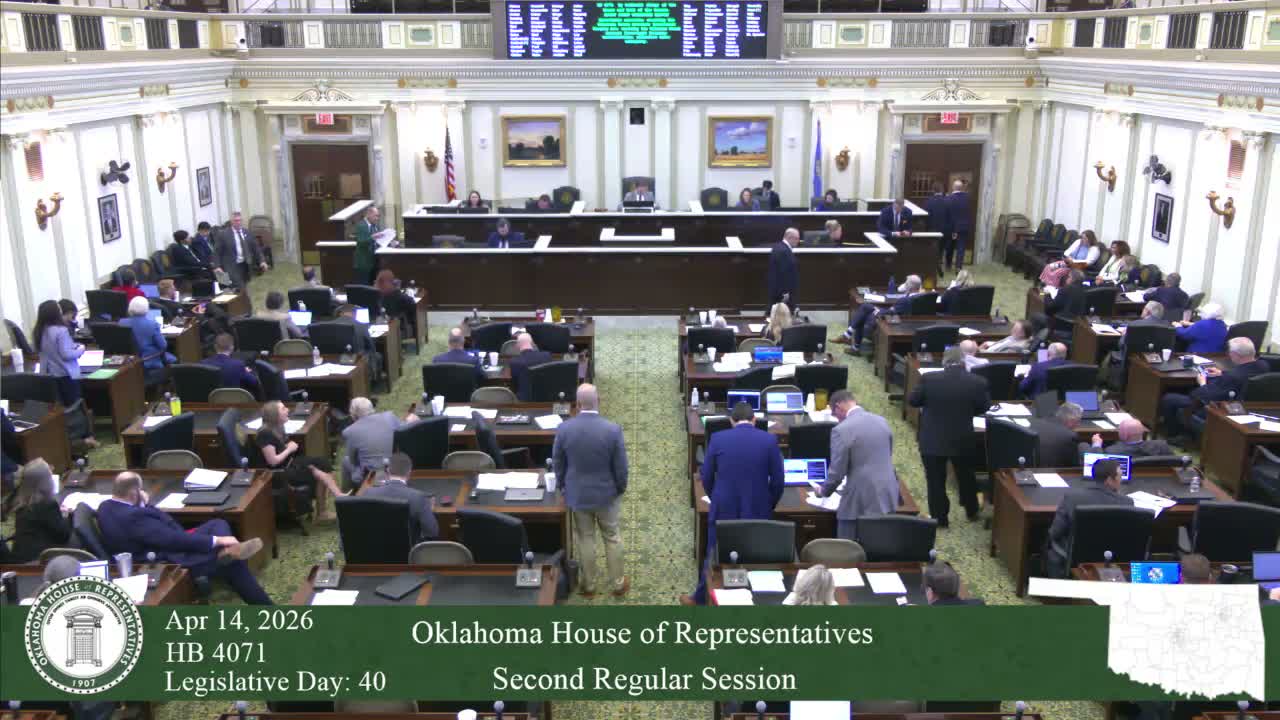
Lawmakers on the House floor took up a sequence of joint committee reports and third‑reading bills covering education, security for specialty schools, capital improvement purchases, transportation projects and an account‑to‑account transfer into a new public finance vehicle. The session recorded roll calls on multiple bills and closed with the House adjourning to April 15, 2026.
A prominent floor debate centered on House Bill 40‑71, which would add $250 per eligible child into federally prescribed accounts sometimes described on the floor as “Trump accounts.” Opponents raised uncertainty about federal implementation and whether state dollars transferred into those accounts would remain under practical state control. Representative Munson asked whether deposited funds would remain accessible and how investments would be managed; he urged the House to consider other uses of the $12.5 million, such as childcare subsidies or veterans homes. One member criticized the federal figure in partisan terms, saying the president had “grifted more money,” and urged a no vote.
Supporters called the accounts safe and pointed to the federal Treasury rules that will govern investment mechanics. The sponsor said the accounts operate as 530A/IRA accounts that convert to traditional IRAs after a child turns 18 and defended the measure as encouraging savings and future retirement preparedness. The House recorded a final passing vote on HB40‑71 by a simple majority; a separate roll call on the bill’s emergency clause did not reach the two‑thirds threshold required to invoke emergency status.
Elsewhere on the calendar the House recorded decisive votes on a string of bills, including (selected results): House Bill 40‑30 (education limits) — 93 aye, 1 nay; House Bill 40‑65 (OSSM security) — 94 aye, 0 nay; House Bill 40‑67 (rehabilitation services / blind & deaf security) — 92 aye, 0 nay; House Bill 40‑38 (transportation projects) — 92 aye, 0 nay; House Bill 40‑31 (aerospace/aeronautics revolving fund) — 89 aye, 5 nay; House Bill 40‑48 (DOT projects) — 93 aye, 0 nay. Several bills were advanced under emergency or with emergency motions recorded when applicable; where a two‑thirds vote was required, the clerk recorded the specific tallies.
The House adjourned until Wednesday, April 15, 2026 at 1:30 p.m.
A prominent floor debate centered on House Bill 40‑71, which would add $250 per eligible child into federally prescribed accounts sometimes described on the floor as “Trump accounts.” Opponents raised uncertainty about federal implementation and whether state dollars transferred into those accounts would remain under practical state control. Representative Munson asked whether deposited funds would remain accessible and how investments would be managed; he urged the House to consider other uses of the $12.5 million, such as childcare subsidies or veterans homes. One member criticized the federal figure in partisan terms, saying the president had “grifted more money,” and urged a no vote.
Supporters called the accounts safe and pointed to the federal Treasury rules that will govern investment mechanics. The sponsor said the accounts operate as 530A/IRA accounts that convert to traditional IRAs after a child turns 18 and defended the measure as encouraging savings and future retirement preparedness. The House recorded a final passing vote on HB40‑71 by a simple majority; a separate roll call on the bill’s emergency clause did not reach the two‑thirds threshold required to invoke emergency status.
Elsewhere on the calendar the House recorded decisive votes on a string of bills, including (selected results): House Bill 40‑30 (education limits) — 93 aye, 1 nay; House Bill 40‑65 (OSSM security) — 94 aye, 0 nay; House Bill 40‑67 (rehabilitation services / blind & deaf security) — 92 aye, 0 nay; House Bill 40‑38 (transportation projects) — 92 aye, 0 nay; House Bill 40‑31 (aerospace/aeronautics revolving fund) — 89 aye, 5 nay; House Bill 40‑48 (DOT projects) — 93 aye, 0 nay. Several bills were advanced under emergency or with emergency motions recorded when applicable; where a two‑thirds vote was required, the clerk recorded the specific tallies.
The House adjourned until Wednesday, April 15, 2026 at 1:30 p.m.
View the Full Meeting & All Its Details
This article offers just a summary. Unlock complete video, transcripts, and insights as a Founder Member.
✓
Watch full, unedited meeting videos
✓
Search every word spoken in unlimited transcripts
✓
AI summaries & real-time alerts (all government levels)
✓
Permanent access to expanding government content
30-day money-back guarantee
