Budget committee warned of steep PERS rate increases and payroll pressure
April 24, 2026 | Corvallis SD 509J, School Districts, Oregon
This article was created by AI summarizing key points discussed. AI makes mistakes, so for full details and context, please refer to the video of the full meeting. Please report any errors so we can fix them. Report an error »
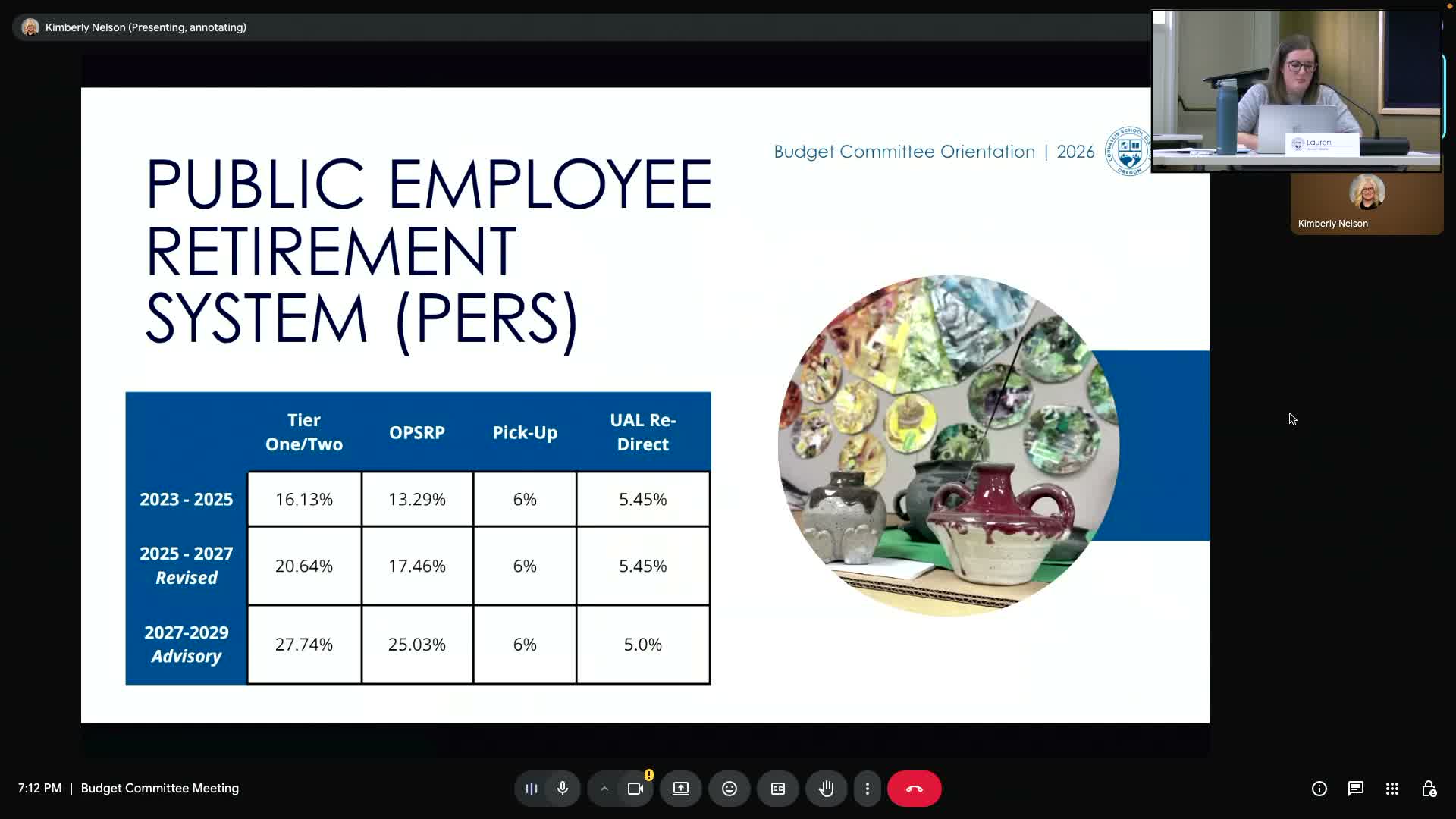
Lauren Wolf, a district staff member leading the orientation, warned budget committee members that rising Oregon PERS advisory rates are a major long‑term cost driver for the district. She said advisory rates for the 2027–29 biennium showed a sharp increase from roughly 16.13% in an earlier biennium to 27.74% in the advisory rates, and that the district's previous use of side accounts (created with prior bond proceeds) to buy down its employer rates is ending.
"The 27.74% advisory rates came out, and those are at 27.74%," Wolf said when discussing the advisory rates published for future biennia. She explained that employer contribution is calculated on each payroll dollar and gave an illustrative example: for "every dollar I pay out of a tier 1 employee, I will have to budget about 21¢ just for their PERS contribution rate," plus other employer costs. Wolf noted the district also pays an additional pickup (about 6% in negotiated practice) and debt service related percentages for the pension bonds, so total payroll‑related costs approach roughly 40¢ on each payroll dollar when including FICA, Medicare and other payroll burdens.
Wolf said the district's historic bond sale created a side account that was used to buy down rates; that reserve is being depleted and cannot be counted on for future biennia. She cautioned that while the immediate budget cycle is manageable, the district must prepare for higher rates in upcoming biennia and that any future pension obligation bond issuance would be risky in the current market.
Committee members asked clarifying questions about how those rates are calculated and how collective bargaining outcomes could interact with these employer costs; Wolf emphasized that PERS advisory rates are distinct from negotiated salary increases and that the district models conservatively for high advisory rates when planning.
"The 27.74% advisory rates came out, and those are at 27.74%," Wolf said when discussing the advisory rates published for future biennia. She explained that employer contribution is calculated on each payroll dollar and gave an illustrative example: for "every dollar I pay out of a tier 1 employee, I will have to budget about 21¢ just for their PERS contribution rate," plus other employer costs. Wolf noted the district also pays an additional pickup (about 6% in negotiated practice) and debt service related percentages for the pension bonds, so total payroll‑related costs approach roughly 40¢ on each payroll dollar when including FICA, Medicare and other payroll burdens.
Wolf said the district's historic bond sale created a side account that was used to buy down rates; that reserve is being depleted and cannot be counted on for future biennia. She cautioned that while the immediate budget cycle is manageable, the district must prepare for higher rates in upcoming biennia and that any future pension obligation bond issuance would be risky in the current market.
Committee members asked clarifying questions about how those rates are calculated and how collective bargaining outcomes could interact with these employer costs; Wolf emphasized that PERS advisory rates are distinct from negotiated salary increases and that the district models conservatively for high advisory rates when planning.
View the Full Meeting & All Its Details
This article offers just a summary. Unlock complete video, transcripts, and insights as a Founder Member.
✓
Watch full, unedited meeting videos
✓
Search every word spoken in unlimited transcripts
✓
AI summaries & real-time alerts (all government levels)
✓
Permanent access to expanding government content
30-day money-back guarantee
